



Estimated reading time: 9 minutes

The fastest way to find your trash bag size: check the gallon label on your can. No label? Measure the height and width, then add 4-6 inches for overhang. That’s it.
If you’ve ever brought home a box of bags only to find them comically short (hello, dragging on the floor) or awkwardly large (wasted plastic, messy overhang), you’re in the right place. Below is the exact 2-step method we recommend, plus a 2026 quick-reference size chart that covers everything from 4-gallon bathroom cans to 33-gallon outdoor bins.
We’ll also cover bag thickness (mils), HDPE vs. LDPE, and which type fits your kitchen, bath, or garage.
The Quick Answer
How do I know what size trash bag I need?
- First, check for a label on your trash can (usually on the bottom or inside rim) that states the gallon capacity.
- If there’s no label, measure your can’s height and width. Choose a bag that is slightly larger than these measurements.
- Use the standard size chart below for the most common bin and bag pairings.
The most common trash bag size for standard kitchen bins is 13 gallons.
The 2-Step Method to Find Your Perfect Trash Bag Size
Forget complex calculations. Follow these two easy steps to never buy the wrong size again.
Step 1: Check for the Gallon Label
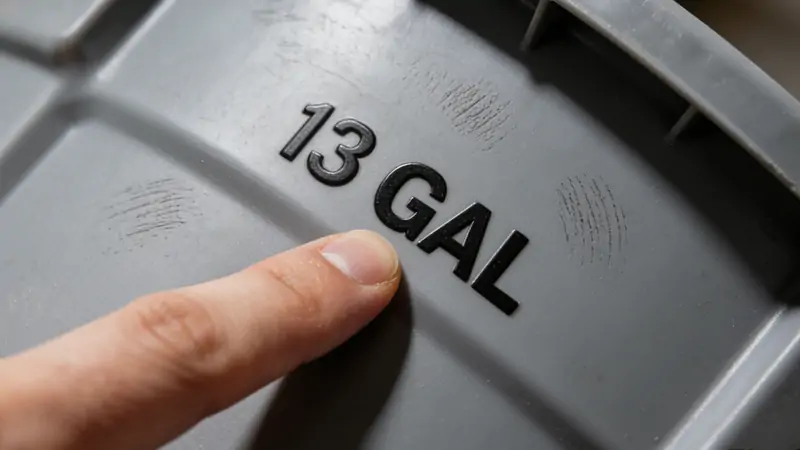
This is the easiest and fastest way to get your answer. Most modern trash cans have their gallon capacity printed directly on them.
- What to do: Simply lift the liner out of your trash can and turn the can upside down. Look for a number followed by “gal” or “gallon” (e.g.,
13 gal,30 Gal). This number is your golden ticket. - Why it works: Trash bags are sold primarily by gallon capacity. If you can say “13 gal,” you need 13-gallon trash bags. It’s that simple.
Step 2: Measure for a Snug Fit
No label? No problem. If you have an older can or one without a label, a quick measurement is all you need. This method is slightly more involved than Step 1 but guarantees a perfect fit. You’ll need a tape measure and maybe a calculator (or your phone.
The key to a bag that fits well is matching its gallon capacity to your can’s volume. Since you can’t easily measure your can’s volume in gallons, we use its dimensions (height and width) to find a bag with a similar gallon rating.
1. Measure Your Trash Can’s Dimensions:
- Height (H): Measure from the inside bottom of the can to the very top rim.
- Width (W): For square or rectangular cans, measure the length of one side of the opening. For round cans, measure the diameter (straight across the center of the opening).
2. Use Our Simple “Fit Formula”:
Once you have your measurements, plug them into this simple formula to find the minimum garbage bag size you should look for.
- For Rectangular Cans:
- Formula: Bag Width = (Length + Width) of the can opening
- Example: If your rectangular can opening is 14 inches long and 10 inches wide, calculate: 14″ + 10″ = 24 inches. Look for a bag with a width close to 24 inches.
- For Round Cans:
- Formula: Bag Width = (Diameter x 3.14) / 2
- Example: If your round can has a diameter of 16 inches, calculate: (16″ x 3.14) / 2 = 25.12 inches. Look for a bag with a width close to 25 inches.
3. Don’t Forget the Height!
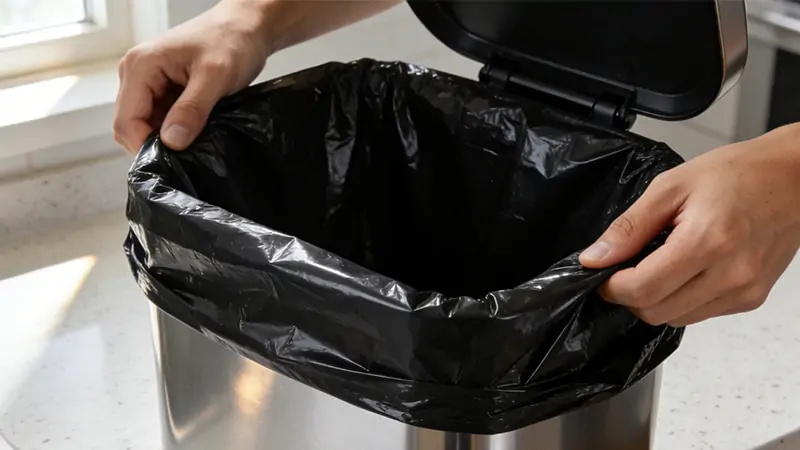
The bag’s height should be taller than your can’s height to allow for an overhang. A good rule of thumb is to add the can’s height + half its width/diameter + 4-6 inches for the overhang.
- Example: If your can is 30 inches high and 16 inches in diameter, a well-fitting bag height would be: 30″ + (16″/2) + 5″ = 30″ + 8″ + 5″ = 43 inches.
Quick Reference Table for Common Scenarios:
| Your Can’s Approx. Dimensions | Recommended Bag Size (Look for on the box) | Why It Works |
|---|---|---|
| H: 20″, W: 12″ (Rectangular) | 8-10 Gallon Bags | Formula: 12″ + 12″ = 24″ width. 10-gallon bags are typically ~26″ wide. |
| H: 24″, Diameter: 14″ (Round) | 13 Gallon Bags | Formula: (14″x3.14)/2 ≈ 22″ width. 13-gallon bags are typically ~24″ wide. |
| H: 30″, Diameter: 18″ (Round) | 30-33 Gallon Bags | Formula: (18″x3.14)/2 ≈ 28″ width. 33-gallon bags are typically ~30″ wide. |
When comparing bags in the store, the package always lists the bag’s dimensions (e.g., “24” x 30″). Use your calculated width and height to find the closest match. When in doubt between two closely sized options, always choose the larger one. A slightly bigger bag is far better than one that’s too small.
How to Choose the Right Thickness & Material
Getting the right fit is only half the battle. Prevent leaks and tears by choosing the right bag strength.
Understanding Thickness (Mils or Microns):
- Light-Duty (0.7 – 0.9 mils): For dry office/bathroom waste. Not for kitchen wet trash.
- Standard/Medium-Duty (0.9 – 1.1 mils): All-purpose for general kitchen use. A good balance of strength and cost.
- Heavy-Duty (1.2 – 1.5+ mils): Essential for wet kitchen waste, heavy materials, or sharp objects. Prevents leaks and tears.
Material Matters:
- Low-Density Polyethylene (LDPE): Softer, more stretchy, and more tear-resistant. Best for the kitchen and heavy waste.
- High-Density Polyethylene (HDPE): Stiffer and rustles. Often more economical for light, dry trash.
- Recycled/Compostable Materials: Eco-friendly options. Note: Compostable bags often have different strength properties.
Room-by-Room Trash Bag Recommendations
- Kitchen: Use 13-gallon, heavy-duty (1.1+ mil), LDPE bags with drawstrings. Opt for leak-proof technology if available.
- Bathroom: 4-7 gallon, standard-duty bags are perfect. Scented or small flip-top bags can help with odor and aesthetics.
- Office/Home Office: 4-10 gallon standard bags. Clear bags or recycled content bags are popular choices.
- Garage/Outdoor: 30-45 gallon, heavy-duty bags to handle recycling, yard waste, and heavier debris.

Standard Trash Bag Size Chart & Quick Reference Guide
Now that you know how to find the right size, use the chart below as your go-to guide for the most common scenarios. This is especially helpful if you’re shopping without your measurements handy.
Once you know your trash can’s capacity or dimensions, use this quick-reference chart to find the right bag. This covers the most common household and commercial scenarios.
| Trash Can Capacity | Common Scenarios | Recommended Bag Size | Pro Tip |
|---|---|---|---|
| 3-5 Gallons | Small bathrooms, home office, bedroom | 4-Gallon Bags | Perfect for lightweight, dry waste. |
| 7-10 Gallons | Small kitchens, break rooms, and larger offices | 10-Gallon Bags | A versatile size for medium-traffic areas. |
| 12-14 Gallons | Standard Kitchen Bin | 13-Gallon Bags | The most common size. Look for “Tall Kitchen” bags for deeper cans. |
| 30-35 Gallons | Large outdoor bins, garage, yard waste | 33-Gallon Bags | Opt for thick, heavy-duty bags to handle heavier loads. |
| 44-48 Gallons | Large wheeled bins (common for curbside) | 55-Gallon Bags | These are extra-large and often used with a trolley. |
Find Your Perfect-Fit Trash Bags
At ShinHigh Bio, we manufacture BPI-certified compostable trash bags in every size above:
- 13-Gallon Kitchen Bags → Leak-proof, food-safe, drawstring or coreless roll.
- 10-Gallon Medium Bags → Medium-duty, odor control, tear-resistant.
- 33-Gallon Commercial Bags → Heavy-duty, puncture-resistant for yard & outdoor waste.
- Custom Sizes → OEM & private label, low MOQ.
All bags are made from plant-based PLA + PBAT + cornstarch. Factory-direct pricing for bulk orders.
FAQs
A: The 13-gallon trash bag is the standard size for most kitchen trash cans in the United States. If you’re stocking up for a typical home, this is the size you’ll likely need the most.
A: Not exactly. While they are designed to fit standard 13-gallon bins, the exact dimensions (such as height and width) can vary slightly among brands like Glad, Hefty, ShinHigh, and store brands. If you have a can that is a very tight fit, it’s a good idea to check the specific dimensions on the box.
A: This is a common point of confusion! A 42-gallon can often requires a 55-gallon trash bag. Why? The bag needs to be large enough to line the entire interior and still have enough material to drape over the rim of the tall can. Always refer to the bag’s specifications on the package, which usually indicate which can sizes it fits.
A: This refers to how the bottom of the bag is sealed.
Star Seal (or Diamond Seal): The bag is sealed in a star or diamond pattern. This creates a flat bottom that allows the bag to expand more fully to fit the shape of your can, providing better strength and leak resistance.
Flat Seal: The bag is sealed with a single straight seam across the bottom. While still effective, it may not conform to the can’s shape as well and can be more prone to leaking with liquid waste.
Simple Choice: For general kitchen use, Star-Seal bags are typically the better, more reliable option.
A: 1 US gallon ≈ 3.785 liters. A common 13-gallon kitchen bag holds about 50 liters. European brands often list capacity in liters.
A: Ensure the bag is tall enough! A good rule is that the bag’s height should be the can height + half the can’s width + 6-8 inches. The extra length allows you to cuff the bag over the rim securely.
Conclusion: No More Guesswork
Choosing the right trash bag size isn’t about luck—it’s about knowing two simple things: your can’s gallon capacity or its basic measurements. With the straightforward 2-step method and the quick-reference chart in this guide, you’re now equipped to make the perfect choice every time, saving you from wasted money, frustrating messes, and unnecessary plastic waste.
Bookmark this page for easy future reference, or take a screenshot of the size chart to keep on your phone for your next shopping trip. Say goodbye to bagging mishaps and hello to a cleaner, more efficient home.
We are committed to providing clear, practical advice to simplify your everyday tasks. If you found this guide helpful, please share it with friends and family who might also benefit from it!
You May Also Be Interested In:
How Long Can Bedbugs Live in a Trash Bag? Proven Tips for 2026
How to Tie a Garbage Bag (Drawstring & Flap-Tie): Leak-Proof & Odor-Free
How to Keep Flies Away From Your Trash Can: 10 Proven Methods