




How Much Does a Ziplock Bag Weigh? (Grams-by-Size Chart + Tare Guide)
By ShinHigh Bio · Updated August 27, 2026 · 8 min read
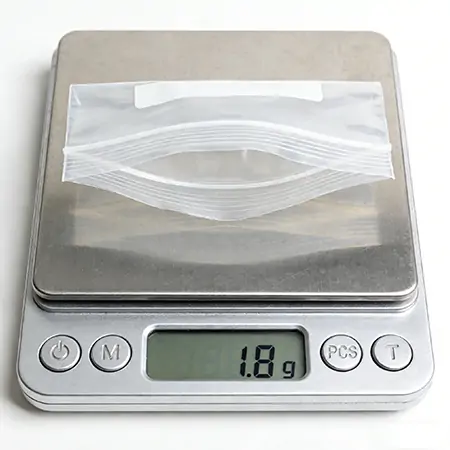
An average ziplock sandwich bag weighs 1.5–2.5 grams; a gallon bag weighs 5.0–8.0 grams. Exact tare depends on size, thickness, and zipper type.
Use the chart below to find snack, sandwich, quart, and freezer bag weights in grams and ounces, plus three tare methods for shipping, food scales, and bulk counts.
Table of Contents
Ever packed a small order and worried one extra gram would push the parcel into the next USPS, FedEx or UPS weight bracket? Or prepped a meal and wondered whether the bag itself was skewing your macros? If so, you’re asking the right question: how much does a ziplock bag weigh?
The short answer: an average sandwich bag weighs 1.5–2.5 g. But one number is rarely enough. The real tare weight depends on the brand, the size (snack to gallon), the material thickness (storage vs freezer-grade), and the zipper type. This guide gives you a verified comparison chart plus three ready-to-use methods to apply it—saving money on postage, tightening nutrition data, and producing reliable project results.

Quick reference: Ziploc bag weight chart (empty, dry bags)
| Bag size & type | Approx. weight (g) | Approx. weight (oz) | Best use cases |
|---|---|---|---|
| Small snack bag (2×3″–4×6″) | 1.0–1.5 g | 0.035–0.053 oz | Mailing jewelry, small parts, pills, samples |
| Standard sandwich bag (6.5×5.8″) | 1.5–2.5 g | 0.053–0.088 oz | Lunch snacks, single food portions |
| Quart storage bag (7×7.5″) | 3.0–5.0 g | 0.11–0.18 oz | Marinating meat, sauces, leftovers |
| Gallon storage bag (10.5×11″) | 5.0–8.0 g | 0.18–0.28 oz | Documents, clothes, freezing large items |
| Quart freezer bag (thicker film) | 4.0–7.0 g | 0.14–0.25 oz | Moist or frozen contents, longer storage |
| Gallon freezer bag with zipper | 6.0–10.0 g | 0.21–0.35 oz | Long-term freezing, liquids, heavy items |
Approximate empty tare weight of common resealable bag sizes. Ranges reflect thickness and zipper differences between brands and batches.
Tip for absolute accuracy: these ranges are reliable estimates. When every gram counts, weigh your bag on a 0.1 g-precision digital scale—this accounts for minor variation between manufacturing batches. (See the precision method below.)
For buyers choosing packaging by the kilogram or planning shipments, the key takeaway is simple: size drives weight linearly, and thickness multiplies it. A gallon freezer bag can be six to ten times heavier than a snack bag because it contains six to ten times more material—and thicker film on top.
Why ziplock bag weight isn’t one fixed number
Resealable bags look alike, but their tare weights differ for four measurable reasons. Understanding them helps you predict—not guess—the number.
1. Size (surface area)
A larger bag uses more film. A gallon bag is roughly 4–5× the area of a sandwich bag, so it weighs correspondingly more even at the same thickness.
2. Thickness (mils)
Film thickness is measured in mils (1 mil = 0.001 inch). Storage bags typically run ~1.5–2.0 mils; freezer bags ~2.5–4.0 mils. Thicker film means more material and more grams.
3. Material & brand
Most bags use polyethylene (LDPE/HDPE). Brands differ in film density, zipper mass and reinforcement. A commercial bulk sandwich bag can reach ~3 g—nearly double a standard sandwich bag.
4. Zipper & features
Single-track, double-track and slider zippers each add a little plastic. Sliders add the most; a press-seal/grip track adds the least. Reinforced edges and gussets also raise weight.
How to add zipper weight
The formula above gives the flat film only. Add the zipper track to match the finished bag:
Zipper type | Approx. added weight |
Press-seal / grip seal | 0.5–1.0 g |
Double-track seal | 1.0–1.8 g |
Slider zipper | 1.5–3.0 g |
For real orders, the only way to be sure is to weigh 5–10 bags from the batch and average them. If you need a consistent tare across every batch, specify the material, thickness, and zipper type up front—our custom compostable zipper bags can be built to a fixed gram target.

Application A: precise shipping & mailing — “every gram costs money”
For jewelry, electronics components, trading cards, coffee samples or any small lightweight SKU, the packaging tare weight is a real part of the billable mass. Carriers charge by total package weight, and a few grams per parcel across thousands of orders is no longer “rounding error”—it’s a line item.
The estimator (quick check)
Use the chart above as a first-pass estimate. Example: item = 0.8 oz; quart bag ≈ 0.15 oz → estimated total just under 1 oz. This tells you which carrier bracket you’re likely in, fast.
The precision method (recommended for every live order)
- Place the empty shipping envelope or box on a digital scale. Press Tare / Zero to zero the scale.
- Put the empty Ziploc bag inside and press Tare again. The scale is now zeroed with the bag in place.
- Add the item to the bag. The displayed weight is the exact net weight of the item—ready for accurate postage calculation.
Shipping math that matters: if you ship 10,000 units/month and save 3 g per bag, that’s 30 kg/month less packaging mass—often enough to drop a weight tier on international lanes. Lighter, right-sized bags protect margin without sacrificing durability.
Need packaging built around your product and parcel weight targets? See our custom compostable zipper bags or read how to select the right ziplock bag for size, thickness and zipper guidance.

Application B: food scale accuracy & calorie tracking — “track the food, not the bag”
Meal prepping or tracking macros? Logging “100 g almonds” only works if those 100 g don’t include the bag. A consistent 1.5–2.5 g error is small per meal, but it compounds across weeks of tracking.
Your precision strategy: master the Tare function
- Place the empty ziplock bag or container on your food scale.
- Press Tare / Zero. The display resets to 0, effectively ignoring the bag.
- Add the food (chicken, nuts, pasta). The number shown is the exact weight of the food alone.
No “Tare” button? Many kitchen scales label the tare key PCS (pieces / counting). In normal weighing mode, a short press of PCS usually zeroes the scale just like Tare; press-and-hold enters counting mode. Short press = zero the bag. That’s the goal.
For food-safe resealable storage, our compostable ziplock bags are made from food-contact-approved materials and are a practical choice when you want accurate weighing and a lower-impact package. Need a fun, hands-on way to test bag sealing and temperature? Try making ice cream in a Ziploc bag.
Application C: science projects & bulk use — calculating total weight
In a classroom, lab, or inventory count, “about 2 g” isn’t scientific. Use the sampling method to derive a defensible average for the whole batch without weighing every bag.
Sampling method (average → total)
- Weigh a sample: randomly pick 5–10 bags, weigh them together.
- Average: total weight ÷ number of bags.
- Total: average weight × total bag count.
Worked example: 5 bags weigh 12 g total → 12 ÷ 5 = 2.4 g per bag. For 100 bags: 2.4 g × 100 = 240 g total. Measuring a sample of 5–10 bags also smooths out the ±0.2–0.5 g variation common between individual bags from the same box.
For large-quantity buyers, we can supply a consistent specification (material, thickness, dimensions, zipper type) so your calculated tare stays stable batch to batch—see custom ziplock / zipper bag specifications.
Brand comparison: Ziploc vs Glad vs ShinHigh Bio (approximate)
Different brands use different materials and thicknesses, so same-size bags are not identical. The table below is a planning aid; for critical applications, weigh your actual stock.
| Brand / type | Sandwich bag (g) | Quart storage (g) | Notes |
|---|---|---|---|
| Ziploc (standard storage) | 1.5–2.5 g | 3.0–5.0 g | Market-reference baseline |
| Glad (standard storage) | 1.5–2.5 g | 3.0–5.0 g | Similar range; verify per SKU |
| ShinHigh Bio compostable ziplock | Comparable in size class | Comparable in size class | PLA/PBAT/cornstarch; tare depends on chosen thickness & zipper |
Approximate empty weights for sandwich and quart storage sizes across common brands. Individual batches vary.
Because ShinHigh Bio manufactures to order, we can tailor film thickness and bag size so the tare weight fits your shipping math while maintaining the seal strength and food-contact performance you need.
Frequently asked questions
Q1: How much does a ziplock bag weigh in grams?
As the chart shows, a small snack bag is about 1.0–1.5 g, a sandwich bag 1.5–2.5 g, a quart storage bag 3.0–5.0 g, a gallon storage bag 5.0–8.0 g, and a gallon freezer bag 6.0–10.0 g (empty, dry).
Q2: How much does a small ziplock bag weigh?
A 2×3″ snack bag usually weighs 1.0–1.5 g. A small sandwich bag (around 4×6″) is closer to 1.5–2.0 g, depending on thickness.
Q3: How much does a gallon ziplock bag weigh?
A standard gallon storage bag weighs about 5.0–8.0 g. A gallon freezer bag, with thicker film, weighs about 6.0–10.0 g.
Q4: Does a ziplock bag add weight to shipping?
Yes. One bag is negligible, but at scale the tare weight raises total shipment mass and can push parcels into a higher carrier weight bracket.
Q5: How do you calculate the weight of a ziplock bag?
Most accurate: weigh 5–10 empty bags on a 0.1 g scale and average. For a quick estimate, use Width × Length × Thickness (mils) × 0.03015, then add 0.5–3 g for the zipper track.
Q6: Are heavier freezer bags worth the weight?
For long-term freezing, yes. The extra grams come from thicker film and a stronger seal that protect against punctures and freezer burn.
Q7: Are compostable ziplock bags heavier than plastic ones?
Not necessarily. Compostable resealable bags can be made to the same thickness as standard plastic bags; thickness and zipper type matter more than the material family alone.
Q8: Why do freezer bags weigh more?
Freezer bags use thicker film and reinforced seals to block moisture and air, so they contain more material.

Need ziplock bags weighed to your specification?
ShinHigh Bio is a direct manufacturer with 20+ years’ experience, 30,000-ton annual capacity, and bags made from our patented compostable raw materials XH-918 and SH-133—BPI / TÜV / DIN CERTCO / FDA / AS4736 certified. Tell us your size, thickness, zipper type and artwork; we’ll recommend the right solution and quote factory-direct.
Conclusion: Master the Details, Optimize Your Results
As we’ve seen, the question “how much does a Ziplock bag weigh?” is far from trivial. Those few grams of plastic can have a real impact on your budget, your health goals, and your project’s success. The key takeaway is simple: for everyday use, an estimate is fine, but for precision-critical tasks, actual measurement is essential.
By understanding the approximate weights of different bag sizes and, more importantly, mastering techniques like the “Tare” function on your scale, you empower yourself to:
- Ship with confidence, ensuring you never overpay on postage.
- Track your nutrition with precision, making your fitness journey more accurate.
- Execute projects flawlessly, whether in the classroom or at home.
Don’t let a small detail derail your big plans. Grab your digital scale and a Ziplock bag, and put this knowledge into practice. The path to greater accuracy and efficiency is literally at your fingertips.
Do you have a unique tip for weighing small items? Is there another scenario where bag weight matters to you? Share your thoughts and questions in the comments below—let’s learn from each other!
Related reading
Size· material· zipper· thickness buyer’s guide
PLA/PBAT/cornstarch resealable bags
Use cases across food, travel, retail & more
10-minute science-meets-snack project