



 Trash bags are essential for daily life and industrial operations, and customization is becoming increasingly refined due to complex usage scenarios and growing environmental awareness. From heavy-duty construction waste disposal to convenient kitchen cleanup, from outdoor event sustainability to high hygiene standards in laboratories, custom trash bags must balance material properties, structural design, load capacity, application scenarios, and eco-certifications. This guide will provide an in-depth breakdown of how to customize trash bags for specific needs across three key dimensions: material, style, and load-bearing capacity of a garbage bag.
1. Trash Bag Material: Balancing Puncture Resistance, Tear Strength, and Sustainability
The core performance of a trash bag hinges on its material composition, with each type offering distinct advantages in puncture resistance, tear strength, flexibility, and environmental impact.
- Low-Density Polyethylene (LDPE) – Superior Flexibility & Impact Resistance
LDPE is soft, highly transparent, and offers good impact/puncture resistance (due to its elasticity) but has relatively low tear strength.
- Linear Low-Density Polyethylene (LLDPE) – The All-Rounder
LLDPE features high puncture resistance, excellent tear strength, high load-bearing capacity, and greater stiffness than LDPE. Due to this balanced performance, LLDPE is gradually replacing LDPE in many applications.
For household waste collection and outdoor event management, LLDPE trash bag is the preferred choice. For example, a 2-mil LLDPE trash bag effectively handles food scraps thanks to its high puncture and tear resistance.
- Biodegradable Materials (PLA & PBAT) – The Eco-Friendly Choice
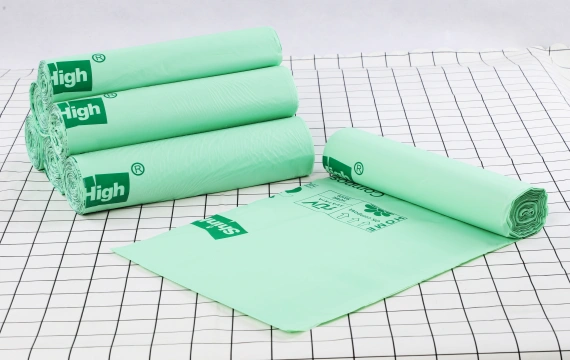
Biodegradable trash bags can break down into CO₂ and water in industrial composting within 45 days (meets ASTM D6400 (U.S.) and EN 13432 (Europe) standards).
Biodegradable trash bags are recommended for parks, festivals, and eco-sensitive venues.
Through sustained technological advancements, the production costs of PBAT & PLA have declined substantially, reaching parity with conventional petroleum-based plastic raw materials under large-scale customized procurement. For enterprises adhering to Environmental Policies, cost concerns no longer constitute a prohibitive barrier. In addition, through design adjustments, the practicality of biodegradable garbage bags has been significantly enhanced. Learn about custom biodegradable garbage bags immediately.
2. Trash Bag Design: Optimizing Load Capacity, Sealing, and Usability
The structure of a trash bag impacts ease of use, leak prevention, and durability.
- Flat-Bottom Trash Bags – Maximum Load Support
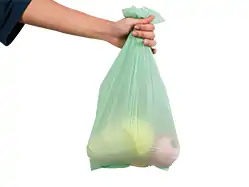
The seamless bottom of flat-bottom bags distributes weight evenly, preventing leakage due to stress concentration.
Industrial bins and construction sites are suitable for using flat-bottom trash bags. A 56-gallon flat-bottom bag (90×110 cm) holds 40 lbs of debris—20% stronger than Star-Seal bags. (Flat-bottom trash bags require double-layer co-extrusion blow molding for uniform thickness.)
- Star-Seal Trash Bags – Leakproof Performance
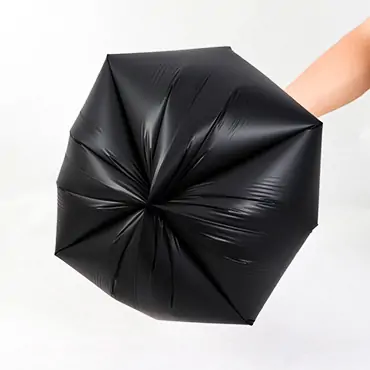
The multi-layer heat-sealed bottom (120° fold angle) can prevent liquid leaks. This is why Star-Seal bags are suitable for use in kitchens and bathrooms. A 13-gallon star-seal bag (55×65 cm) resists oily waste 40% better than flat-bottom bags.
- Drawstring Trash Bags – Convenience-Focused
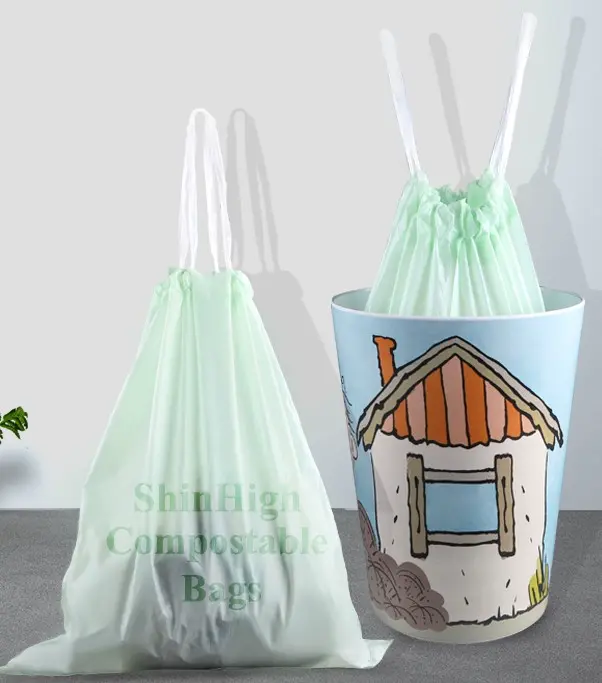
compostable-drawstring-bags
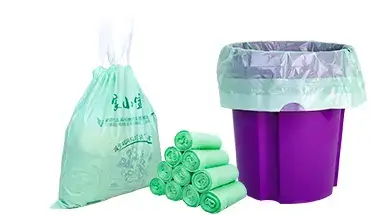
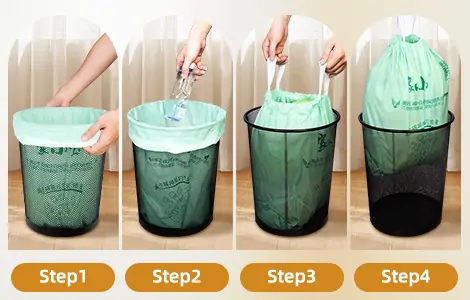
Drawstring trash bags feature one-handed operation with polyester drawstrings (15+ lb tensile strength). Homes and offices constitute primary application scenarios for drawstring trash bags. A 30-gallon drawstring bag (70×90 cm) speeds up disposal by 50%. (The drawstring of a trash bag must undergo a durability test, which requires the string to withstand 1,000 open/close cycles without breaking.)
3. Dustbin Bag Sizes & Load Capacity: Matching Scenarios
Custom trash bags must align thickness, volume, and strength with their intended use.
- Thickness (Gauge) Guidelines
Light-Duty (1.0–1.5 mil) trash bags are ideal for lightweight waste (paper, bottles). Low cost but weak puncture resistance.
Medium-Duty (1.6–2.0 mil) trash bags balance cost and performance for kitchen/industrial waste.
Heavy-Duty (2.0+ mil) trash bags handle construction debris, withstanding 50+ psi puncture force. - Capacity & Dimensions
Small (8–10 gal, 45×50 cm)trash bags are suitable for bedrooms/cars (10-lb capacity).
Medium (13 gal, 55×65 cm)trash bags are a standard kitchen size (20-lb capacity).
Large (56 gal, 90×110 cm)trash bags designed for industrial bins (40-lb capacity).
If you want the garbage bag to have the greatest possible load-bearing capacity, you can consider aspects such as material, structure, and thickness. For example, the load-bearing capacity of HDPE plastic bags is 25% higher than that of LLDPE. The drawstring bag with an integrated handle can increase the load limit from 15 pounds to 25 pounds.
Eco-Certifications & Compliance: From Standards to Sustainability
Here are some global certifications for environmental and safety compliance to help you purchase high-quality trash bags.
- Compostability Certifications
ASTM D6400 (U.S.): Requires a 45-day breakdown in industrial composting.
EN 13432 (Europe): Stricter—must fully decompose within 6 months without toxins. - Eco-Labeling Systems
Recycling Symbols: Must follow ASTM D7611.
Degradability Claims: Must specify conditions (e.g., industrial vs. marine degradation).
Carbon Footprint: Clients may demand <1.5 kg CO₂eq/kg lifecycle emissions.
Customization Process: From Concept to Delivery
- Needs Assessment: Define usage, waste type, load needs, and eco-standards.
- Material & Design: Select HDPE/LDPE/LLDPE/biodegradable + structure (flat/star-seal/drawstring).
- Prototyping & Testing: Lab simulations (puncture/load tests) determine optimal specs.
- Certification: Third-party verification (e.g., TÜV, SGS) for ASTM/FDA compliance.
- Mass Production & QC: Automated film-blowing/printing/bag-making with 100% thickness checks + random load/seal tests.
As waste sorting policies and carbon-neutral goals advance, high-performance, bio-based materials will replace conventional plastics. For businesses, customization isn’t just functional—it’s a strategic advantage in sustainability and market leadership. By aligning materials, design, sizing, and certifications, custom trash bags can truly become a pillar of “green productivity.”
At ShinHigh Bio, you can also print brand patterns for your garbage bags. We are an ODM & OEM service provider specializing in the plastic bag field, possessing full-stack capabilities from material research and development to mass production and delivery. We rank within the TOP 100 in the sales of biodegradable bags on Amazon in the United States, with our company’s customer base accounting for over 30%. Looking forward to cooperating with you.