



If you’re sourcing eco-friendly waste solutions, the first thing to clear up is terminology—because “biodegradable” and “compostable” are not interchangeable, and mixing them up can cost you both compliance headaches and customer trust.
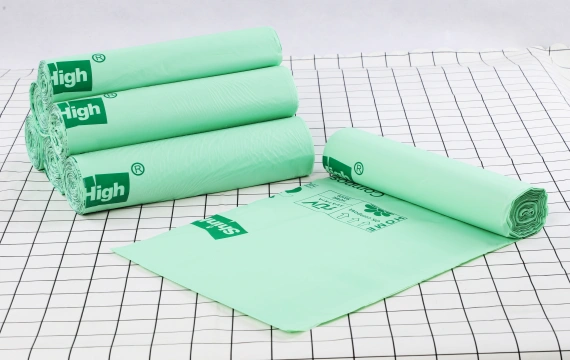
Compostable trash bags are made from plant-based resins (usually PLA + PBAT blends) that, under specific composting conditions (controlled temperature, humidity, microbial activity), break down completely into water, CO₂, and biomass—leaving no microplastics or toxic residue. In the U.S., they must meet ASTM D6400; in the EU, EN 13432.
Biodegradable trash bags, on the other hand, are a broader, loosely regulated term. Many “biodegradable” bags are still petroleum-based plastic blended with additives (often oxo-degradable formulas) that accelerate fragmentation. The catch: they may still leave microplastic particles behind, and in landfills, they behave almost like conventional PE bags.

Are Compostable Bags Better Than Biodegradable?
|
Dimension
|
Biodegradable Trash Bags
|
|
|---|---|---|
|
Raw material
|
Plant-based (corn starch, potato starch, PLA/PBAT)
|
Conventional plastic + additives, or partially bio-based
|
|
Certification
|
BPI / TÜV Austria / ASTM D6400 / EN 13432
|
No mandatory standard; prone to greenwashing
|
|
Degradation condition
|
Industrial composting (some home-compostable)
|
Highly environment-dependent; near-normal plastic in landfills
|
|
Residue
|
Water, CO₂, biomass—no microplastics
|
May leave microplastics & chemical additives
|
|
Disposal route
|
Organics bin/compost facility
|
General waste (most regions reject it from composting)
|
What Are Compostable Trash Bags Made Of?
-
PLA (Polylactic Acid) – derived from fermented corn or cassava starch; provides rigidity, often the base resin.
-
PBAT (Polybutylene Adipate Terephthalate) – a biodegradable polyester that adds flexibility and tear resistance; the “stretchy” part of the blend.
-
PHA (Polyhydroxyalkanoates) – marine-degradable bio-polyester, increasingly used in premium grades.
-
PBS (Polybutylene Succinate) – heat-resistant alternative, sometimes blended for higher-temp industrial compost.
A typical 13-gallon kitchen compostable bag might be composed of ~60% PLA, 35% PBAT, and 5% starch filler, with a total thickness of 0.85–1.1 mil (thicker than standard PE because biopolymers have lower puncture resistance).
⚠️ One thing suppliers don’t always tell you: compostable ≠ infinite shelf life. Even when unopened, PLA/PBAT blends begin to lose their mechanical properties after 12 months in hot/humid warehouses. More on that in the bulk-buying section below.
Home Composting vs Industrial Composting: Which Bags Work Where?
-
Temperature: 50–60°C (122–140°F)
-
Timeline: 90–180 days for full disintegration
-
Microbial environment: Controlled, high-density
-
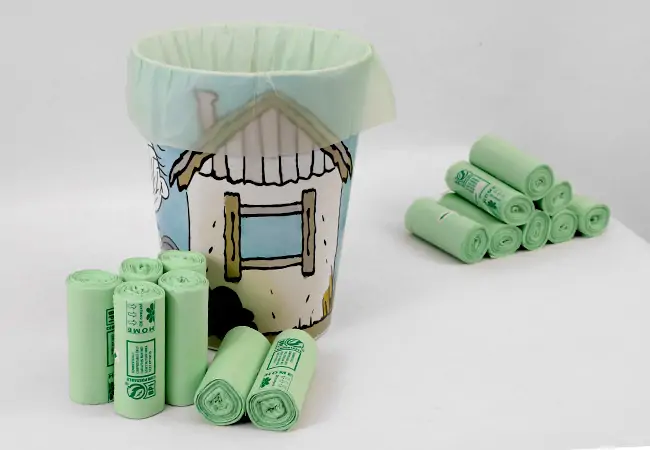
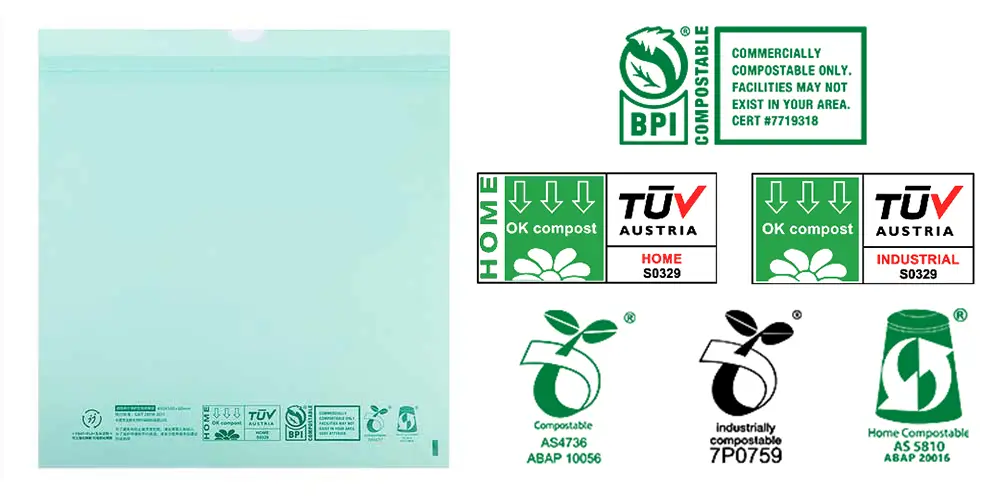
✅ Most compostable trash bags on the U.S. market are certified for industrial use only (look for the BPI logo)
-
Temperature: Ambient, 20–30°C typically
-
Timeline: 12–24 months
-
✅ Only bags carrying “OK Compost HOME” (TÜV Austria) or explicitly labeled home-compostable will break down here
Do Biodegradable Bags Really Break Down in Landfills?
-
PLA and other bioplastics stall—degradation may take years, behaving like conventional PE.
-
Slow anaerobic breakdown releases methane, a greenhouse gas ~28–36× more potent than CO₂ over 100 years.
-
One study cited ~3.1 t CO₂e per tonne of PLA in landfill scenarios—higher than incinerating conventional plastic.
-
Most landfills don’t install gas collection until 2 years after closure, so early methane vents straight to the atmosphere.
Certifications to Look For: BPI, TÜV Austria, ASTM D6400, EN 13432
-
BPI (Biodegradable Products Institute) – U.S. gold standard; requires ASTM D6400 testing + third-party verification. Look for the circular BPI logo on the roll.
-
ASTM D6400 – The actual test method: 90% disintegration within 84 days in industrial compost, and ecotoxicity testing on the finished compost.
-
EN 13432 – EU equivalent; 90% disintegration within 12 weeks, 90% biodegradation within 6 months.
-
TÜV Austria OK Compost / OK Compost HOME – European certification body; “HOME” variant is the only meaningful “backyard compostable” credential.
-
Seedling Logo – The EU-wide mark that signals EN 13432 compliance.
- AS 4736 / AS 5810 – Australia (industrial / home respectively; AS 5810 includes earthworm test).
Gotcha: Certification applies to the finished product (ink, adhesive, drawstring, thickness), not just the resin pellet. Always ask your supplier for the cert that matches the exact SKU you’re buying—not a generic “PLA is compostable” line.
Buying Compostable Trash Bags in Bulk: What B2B Buyers Should Know
This is where the article pivots from “vs” education to your actual pipeline. If you’re a distributor, grocery chain, jan-san supplier, or eco-brand looking to private-label compostable liners, a few specs matter more than the “compostable” label itself.
-
3 gal – office desk-side / bathroom bins
-
8 gal – small kitchen/café prep station
-
13 gal – “tall kitchen,” the highest-volume SKU in U.S. retail
-
33 gal – outdoor / yard waste / back-of-house restaurant
-
Custom printing (up to 4–6 colors, water-based inks only—solvent inks can fail compost certification)
-
Private label / white label packaging (box, roll header, dispenser carton)
-
Gusset width & length adjustments per municipal specification
-
Star-sealed or block-bottom options for wet/food-waste loads
Shelf-life note: Compostable resins degrade on the shelf, too. Recommend clients store in a cool (<25°C), dry, shaded warehouse and rotate stock within 12 months of manufacture. After that, PBAT starts embrittling, and you’ll see complaints about “bags tearing.”
ShinHigh Bio supplies BPI- and TÜV-certified compostable trash bags in all four sizes above, with low-MOQ private labeling and custom print. If you’re building a house brand, we’ll match spec to your municipal market (U.S. ASTM D6400 vs. EU EN 13432).
FAQs
A: No. Compostable bags are a subset of biodegradable bags—but with strict certification (ASTM D6400 / EN 13432) and a guaranteed end-point (water, CO₂, biomass, no microplastics). “Biodegradable” alone has no standardized testing in most markets and may still leave microplastic fragments.
A: For B2B and municipal use, yes. Compostable bags are certifiable, accepted by organics-collection programs, and leave no toxic residue. Biodegradable bags without certification are often rejected at compost facilities.
A: Many do. Oxo-degradable and additive-based “biodegradable” bags fragment rather than fully metabolize, leaving microplastic particles. Certified compostable bags (BPI/ASTM D6400) do not.
A: Only if they carry a home-compostable certification (TÜV OK Compost HOME, AS 5810, NF T51-800). Most BPI/ASTM D6400 bags are industrial-only and will not fit in a backyard bin.
A: Industrial composting runs at 50–60°C with controlled microbes (90–180 day breakdown); home composting is ambient temperature and takes 12–24 months. Different certifications, different resin recipes.
A: They degrade very slowly (like biodegradable bags) and may produce methane anaerobically. They won’t leak microplastics, but landfill is still the wrong end-of-life for either bag type.
A: Close, but not identical. A 13-gal compostable bag is typically 0.85–1.1 mil thick (vs. 0.7–0.9 mil for PE) to compensate for lower puncture resistance. Star-sealed bottoms help with wet food waste.
A: In the U.S.: BPI + ASTM D6400. In the EU: TÜV OK Compost / Seedling Logo + EN 13432. Without these, “compostable” is an unverified claim.
A: Most suppliers offer 3 gal (bathroom), 8 gal (small kitchen), 13 gal (tall kitchen), and 33 gal (yard/outdoor). Custom sizes exist for medical or liner-on-liner applications.
A: 12 months in cool, dry storage (<30°C, <65% RH). Heat + humidity accelerate hydrolysis—warehouse planning matters for distributors.
A: Yes—most manufacturers (including ShinHigh) offer 2–4 color water-based ink printing on rolls or boxes, with private-label packaging. MOQ varies by size.
A: Direct from certified manufacturers (lower MOQ, custom print) or through distributors. If you need BPI + TÜV dual certification for U.S./EU crossover, verify the cert number on BPI’s online directory before ordering.
Why Choose ShinHigh Bio as Your Compostable Trash Bag Supplier
-
Certification-first: All compostable trash bag SKUs BPI / ASTM D6400 verified; EN 13432 available for EU programs.
-
Material flexibility: Standard PLA+PBAT (cost-efficient, 3–55 gal), PHA-on-request.
-
Private label & custom print: In-house flexo, compostable ink stack, low MOQ tier for distributor launch.
-
Size coverage: 3 / 8 / 13 / 33 / 55 gal, star-seal or bottom-seal, coreless rolls or flat-pack.
-
Supply stability: In-house blown film + printing + conversion, not trading-only—lead time transparent.
-
Technical support: We’ll tell you if your market needs industrial vs home cert before you order, not after.