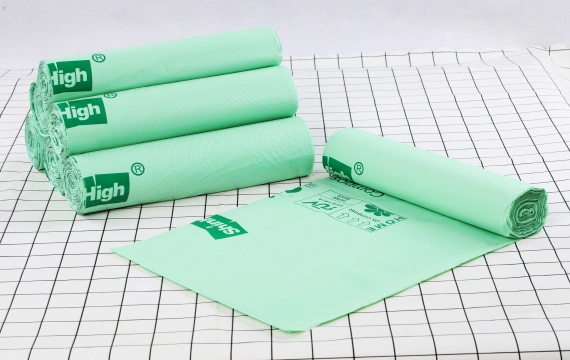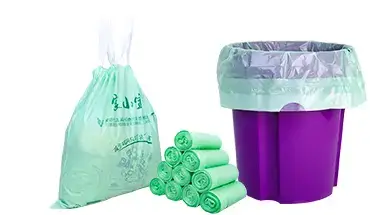




Most “best compostable trash bags” roundups hand you a ranked table and stop. That helps until your kitchen bin leaks on collection day, or your municipal program rejects a bag that looked fine on the shelf. The question that actually matters is not “which bag won a review site’s ranking” but “which bag fits my disposal method, my waste type, and my bin.”
This guide is a framework you can apply to any brand’s specification, the same way a procurement manager would. Read it once, then use it to judge every bag you consider.

Start with disposal method, not the brand
The single biggest variable is where the bag will actually break down. A bag certified only for industrial composting can sit intact in a backyard pile for years. A bag certified for home composting is the only one that belongs in a home bin.
Two families of marks cover most needs:
- OK Compost HOME (TÜV Austria) means the bag is designed for backyard and home composting conditions.
- OK Compost INDUSTRIAL (TÜV Austria), together with BPI (North America) and the ASTM D6400 and EN 13432 standards, means the bag is accepted in municipal or commercial composting where that infrastructure exists.
If a bag shows none of these marks, most composting facilities treat it as conventional plastic contamination regardless of the wording on the box. The compostable bag certification guide covers what each logo requires and how to read it on a roll. The broader “biodegradable vs compostable” distinction is in the compostable vs biodegradable explainer.
How to verify a cert without taking the label’s word
A certification mark is only useful if it points to a real, current certificate. Before trusting a bag:
- Note the certifying body on the roll (BPI, TÜV Austria, DIN CERTCO, and others).
- Look the product up in that body’s public database. BPI and TÜV both publish searchable certificate lists.
- Check the scope: some certificates cover only certain bag sizes or film formulations. A cert on one product in a range does not automatically cover every SKU.
This step takes about two minutes and removes most of the “biodegradable but rejected at the facility” surprises.

The four things every bag is judged on
Once the disposal method is settled, compare bags on four dimensions.
1. Certification. A third-party mark beats a printed adjective. BPI, TÜV OK Compost (HOME or INDUSTRIAL), ASTM D6400, and EN 13432 are the ones composting programs recognize. A claim with no certifying body behind it should be treated as unverified.
2. Material. Certified bags are typically built from a plant-starch film, often a blend of PLA, PBAT, and corn or potato starch. The blend sets whether the bag suits home composting or only industrial, and how it behaves around wet waste. PLA-forward films tend toward industrial-only acceptance. Starch-rich blends are more often formulated for home conditions. Always confirm against the certification, not the material name alone.
3. Thickness. Thickness is the practical line between “held up” and “leaked on the floor.” A common starting point by use:
| Scenario | Typical starting thickness |
| Countertop caddy, light scraps | 0.5 to 0.8 mil (about 12 to 20 microns) |
| Kitchen bin, daily wet food waste | 0.9 to 1.1 mil (about 23 to 28 microns) |
| Yard and garden waste | 1.2 mil and above |
| Commercial, janitorial, heavy loads | 1.5 mil and above |
A mil (密耳, also written “thou”) is a thousandth of an inch. One micron (μm, 微米) is a millionth of a meter. The handy conversion is 1 mil ≈ 25.4 microns (μm). Bags are sold in both units depending on the market: North American and some industrial specs often use mil, while European and technical data sheets lean toward microns. Use the table to compare like for like. These figures are evaluation starting points, not product specifications. The right number depends on what you put in the bag and how long it sits before collection.
4. Closure and seam. Drawstring closures, star-seal bottoms, and side gussets are the features that keep a full bag from splitting on the way to the cart. When a bag fails, it usually fails at the seam or the tie, not the film body. For wet or heavy waste, a star-seal bottom that pulls the load to the center is more reliable than a flat bottom with corner stress points. Beyond the seam, check the spec wording for wet strength and leak-proof. Some certified bags still go limp and hard to lift once saturated with wet food waste, even when they do not actually split. Odor control, when a supplier offers it, usually comes from a film additive rather than the certification, so confirm it directly if bin smell is a concern at your site.
Match the bag to the scenario
The same “compostable” bag is right for one job and wrong for another. Once the disposal method is fixed, the scenario sets the thickness, the format, and the seam.
| Scenario | What drives the choice | Typical format |
| Kitchen and food waste | Wet, heavy scraps punish thin film and weak seams. Start around 0.9 to 1.1 mil, and match the cert to the collection route rather than to the bin. | Compostable garbage bags |
| Yard and garden | Twigs and branches puncture thin film, and the load is bulky but drier. Puncture resistance and a larger format matter more than a low price per roll. | Compostable yard-waste bags |
| Industrial, janitorial, and heavy loads | Higher thickness and documented puncture resistance. A generic “heavy duty” claim is not enough, so ask for film specs per lot. | Industrial garbage bags |
| Business and wholesale | At volume, decisions turn on certification consistency, material spec, and supply reliability, not a single retail review. | Wholesale supply |
Kitchen sizing and film notes are covered in more depth in the 2026 food-waste bag guide.
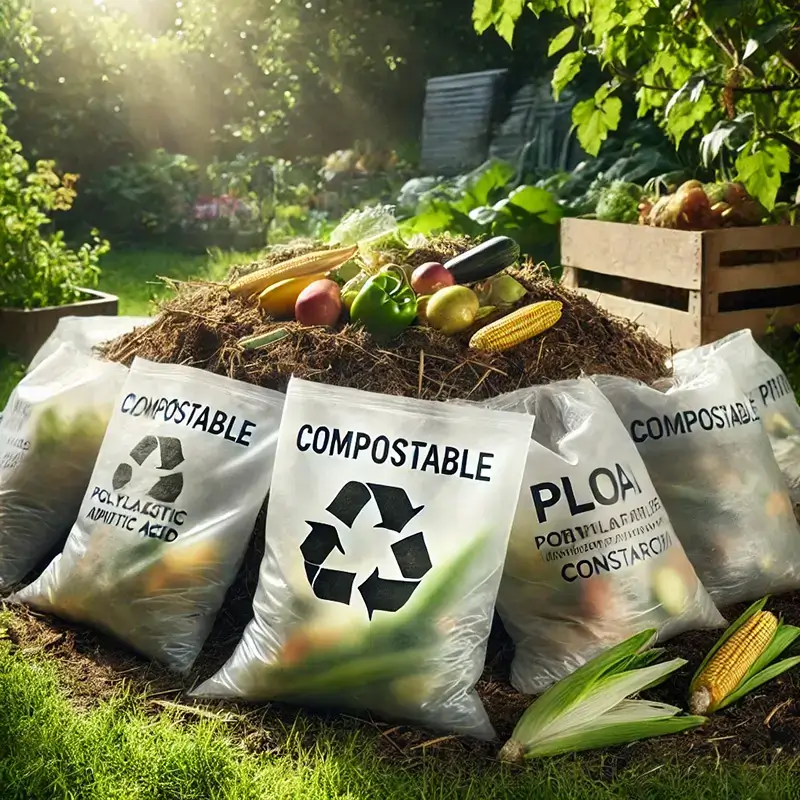
Cost vs value: price per bag, not per roll
For commercial buyers, price is part of the framework, not separate from it. A single compostable bag usually costs more than a conventional plastic bag of the same size, but the per-bag number is only half the story.
Look at cost per bag rather than cost per roll, because roll sizes vary and a cheaper roll can mean more bags you throw away unused. Then add the failure cost: a bag that splits on collection day creates cleaning time, labor, and a poor impression with staff or customers. In some regions, well-sorted organic waste carries a lower disposal fee than mixed waste, which can offset part of the bag premium.
Weigh the bag against compliance exposure, brand and CSR positioning, and avoided cleanup, not against the plastic baseline alone. The supplier questions later in this guide are where you pin down the real per-lot spec behind the price.
What “compostable” does and does not mean
A certified compostable bag is engineered to break down in a defined composting environment under defined conditions. It is not a license to litter, and it will not break down in a landfill the way some labels imply.
Warning: Bags labeled only “biodegradable” or “oxo-degradable” with no recognized composting standard are the ones most facilities reject outright. Oxo-degradable plastics can fragment into microplastics in the environment and have been restricted in the EU for this reason. Unless a bag carries a third-party industrial or home composting certification such as BPI, TÜV OK Compost, ASTM D6400, or EN 13432, treat any “biodegradable” or “breaks down anywhere” wording on the box as marketing, not proof.
The practical rule: match the certification mark to the disposal route you actually have. No mark means assume it behaves like conventional plastic at the facility.
Storage and shelf life
Compostable film can start degrading on the shelf if stored badly, before it ever reaches a bin. Keep rolls in a cool, dry place away from direct sunlight and heat. Long exposure to high temperature or humidity can make bags brittle or weaken the seal so they fail in use rather than in the composting stream. If a bag feels stiff or discolored before you open it, that is a storage signal, not a product defect.
A worked example
Say a small café needs bags for its kitchen food-scrap bin, collected by a municipal industrial-composting program.
- Disposal method: industrial. So the bag needs BPI, ASTM D6400, or EN 13432, not OK Compost HOME alone.
- Waste type: wet food waste daily. Start at 0.9 to 1.1 mil with a star-seal bottom.
- Verification: look the SKU up in the certifying body’s database before ordering a pallet.
- Supplier question: can they document the film spec per lot?
That single pass removes most failure modes before the bag ever reaches the bin.
Representative brands and what they typically certify
To show how the framework applies, here is how several brands position their certifications, including our own. Verify the current marks on each product listing before purchase, because certifications change and regional variants differ.
- UNNI is commonly BPI and OK Compost HOME certified, which is why it appears in many home-composting shortlists.
- BioBag is one of the longest-standing brands and is typically certified to EN 13432 and ASTM D6400, built on a Mater-Bi plant-starch film.
- If You Care is usually certified for both home and industrial composting and uses a potato-starch and vegetable-oil base.
- Green Earth and similar value lines tend to lead with BPI or ASTM D6400 and a thicker plant-starch film.
- ShinHigh is certified to BPI (ASTM D6400), EN 13432, and TÜV OK Compost, with OK Compost Home carried on its XH-918 grade and industrial-only certification on its SH-133 grade. Both are PBAT- and PLA-based, with cornstarch added in the XH-918 grade.
This is an observation of the market, not a ranking, and the list is here to show what the tiers look like rather than who to buy from. We make compostable bags ourselves, so ShinHigh appears here alongside the others. Hold us to the same certificate check you would apply to any brand on this page.
How the bags are made
For buyers evaluating a supplier, the facility behind the bag matters as much as the film. Production at the ShinHigh plant runs under a BRCGS Global Standard for Packaging Materials certification (Issue 7, Grade B, audited by SGS) with scope covering direct and indirect food contact and no exclusions. Current certificate status and full scope are verified in the BRCGS Directory.
The lines run both home- and industrial-grade film, with the grade chosen against the disposal route the buyer actually has. Facility and capability details are on the manufacturers and suppliers page, and the film options sit under trash bags.
Questions to ask a manufacturer before you buy
If you are buying for a business, the framework becomes a supplier questionnaire:
- Which certifications does the film carry (BPI, TÜV OK Compost HOME or INDUSTRIAL, ASTM D6400, EN 13432)?
- What is the base material (PLA, PBAT, starch blend) and which disposal route does it suit?
- What thickness range can you hold, and how is it verified?
- What closure and seam options are available (drawstring, star-seal, gusset)?
- Can the spec be documented for each production lot?
- What customization is possible for size, print, and film color?
Use the same list with any supplier.
Conclusion
A compostable trash bag is only as good as the match between its certification and your disposal route. Judge every bag on certification, material, thickness, and seam, then pick by scenario instead of by a single ranked list. For volume supply, the wholesale page covers how to start an enquiry. The full compostable bag range is grouped by scenario.
Frequently asked questions
A mil (密耳) is a thousandth of an inch. A micron (μm, 微米) is a millionth of a meter, and 1 mil ≈ 25.4 microns. Bags are sold in both units, so use the thickness table above to compare like for like. Thicker is not automatically better: match the number to your waste type and how long the bag sits before collection.
Because most composting facilities reject bags labeled only “biodegradable” or “oxo-degradable” with no recognized standard. Oxo-degradable plastic can fragment into microplastics and is restricted in the EU for this reason. Unless the bag carries a third-party composting certification such as BPI, TÜV OK Compost, ASTM D6400, or EN 13432, treat the wording as marketing, not proof it will break down in a compost stream.
In a cool, dry place away from direct sunlight and heat. Compostable film can start degrading on the shelf under high temperature or humidity, so a bag that feels stiff or discolored before you open it is a storage signal, not a defect. Do not stockpile rolls near radiators, windows, or damp areas.
Not a split, but a usability gap. Check the spec wording for wet strength and leak-proof. Some certified bags still soften once saturated with wet food waste. If bin handling matters at your site, ask the supplier for documented wet-strength performance rather than assuming certification alone covers it.
A single compostable bag usually costs more than a conventional plastic bag of the same size. Judge it on cost per bag, not per roll, and add the failure cost of a bag that splits on collection day (cleaning time, labor, poor impression with staff or customers). In some regions, well-sorted organic waste carries a lower disposal fee than mixed waste, which can offset part of the premium. Weigh it against compliance exposure and brand positioning, not the plastic baseline alone.
Note the certifying body on the roll (BPI, TÜV Austria, DIN CERTCO, and others), then look the product up in that body’s public database. Check the scope, because a certificate on one SKU does not automatically cover every size or film in a range. This two-minute step removes most “biodegradable but rejected at the facility” surprises.