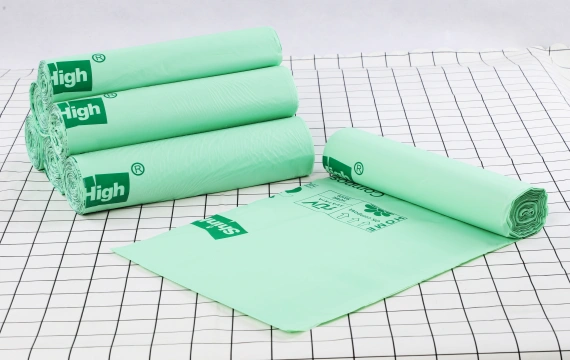




A restaurant kitchen is not a household kitchen with a bigger bin. Volume is higher, the waste is wetter and hotter, and the bag may sit in the bin for a full service before anyone changes it. Compostable bags for restaurant kitchens hold up when four decisions match your operation: bin size, film gauge, seal construction, and a compostability certificate that matches the facility your waste actually goes to. This guide works through each one, and through the two compliance documents buyers most often confuse.

Why a restaurant bin stresses a bag differently
Three variables separate food-service waste from household waste, and each one loads the film in a different way. Daily volume is an order of magnitude higher, the waste is mostly wet prep scraps, oil and sauce rather than mixed dry rubbish, and the bag stays in the bin through a full service instead of a full day.
| Variable | Household kitchen | Restaurant kitchen | How it loads the bag |
| Daily volume | Roughly 2–5 litres | Roughly 30–150 litres per outlet | More weight, more handling, faster turnover |
| Composition | Mixed dry and wet | Mostly wet prep waste, oil, sauce, stock | Film softens; load on the base seal rises |
| Dwell time in the bin | 1–2 days | 4–12 hours, longer in hot weather | Longer contact with moisture and heat |
The failure that comes up most often in food-service discussions is not a burst side wall. It is a base that softens and opens partway through service, or a liner that starts to smell before it is full. Both are moisture-and-grease problems rather than a raw strength problem. That is why the fixes are as much about gauge and seal construction as about the resin itself.
For the wider range of formats, see our food waste bags and the full waste bags range.
Size the bag to the bin, not to the brand
A liner holds its shape when its capacity is slightly larger than the bin it lines, and its opening is wide enough to fold over the rim. Buying a bag that is too small forces staff to stretch it, which thins the film at the rim; buying one that is far too large wastes material and lets the base sit in the bin’s residue.
| Bin or station | Typical capacity | Common format |
| Small prep station, wait station | 10 gallon (38 L) | Flat top, handle tie |
| Kitchen bin, break room | 13 gallon (50 L) | Drawstring, flat top |
| Back-of-house main bin, janitorial | 33 gallon (125 L) | Contractor, industrial garbage bag |
| Trolley or dumpster liner | Custom | Fully custom size |
Measuring the bin takes a minute and saves a wrong first order. If you are still deciding on the bin itself, our guide to what size trash can your kitchen needs covers the decision from the kitchen layout side; the 13-gallon kitchen trash bags for wholesale guide covers the format most food-service outlets settle on for prep and front-of-house bins.
Gauge: match film thickness to the waste stream
Gauge is the measured thickness of the bag film, expressed in microns (µm); 1 mil equals 25.4 µm. ShinHigh’s standard production for trash and food-waste bags is 18–20 µm (0.018–0.020 mm). Commercial and industrial programmes can specify other gauges as a custom order, so the useful question is not “what is the thickest bag”, but “what does this waste stream do to the film”.
| Waste stream | What fails first | Practical direction |
| Dry, light waste (packaging, paper, front-of-house) | Nothing sharp, little moisture | Standard 18–20 µm is usually enough |
| Mixed wet prep waste, sauces, stock | Film softens, base seal carries the load | Standard gauge, changed at least daily |
| Bones, shells, cutlery, glass | Puncture at base and sides | Heavier gauge, specified as a custom order |
| Hot liquid or oil straight off the line | Softening plus base seal stress | Heavier gauge with a star seal; let the waste cool before binning |
Two points that matter in practice. Gauge is not the same as strength: a thicker film of the wrong blend can still fail at the seal. Thickness is also a trade-off against compostability timing and material use, so over-specifying “just in case” is not free.
Seal construction: why the base fails before the sides
The base seal, not the side wall, is where wet-waste liners fail, because the full weight of the contents rests on it and liquid pools there. Two constructions dominate the market. A flat seal welds the film across a straight bottom seam. A star seal folds the base into a star shape and welds it, which spreads the load across more than one bond line.
| Star seal | Flat seal | |
| Load distribution at the base | Spread across folded welds | Concentrated on one straight seam |
| Behaviour with wet, dense waste | Better at holding a heavy, wet load | Can open under prolonged load |
| Bin fit | Suits round and square bins | Suits flat-bottom bins |
| Cost | Higher material and folding step | Lower |
For kitchens that run wet waste, the seal matters more than an extra micron of thickness. Our two practical guides explain how the rest of the chain fits together: leak-proof kitchen trash bags in three steps and choosing leak-proof, rip-proof food waste bags.
Compostability: always state it with the condition
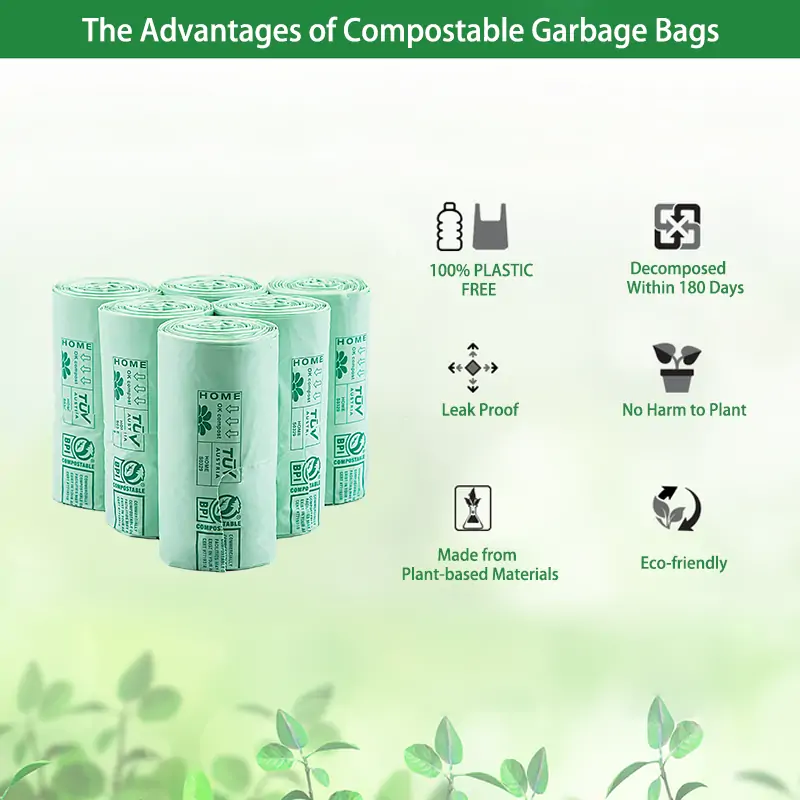
Compostable does not mean “disappears anywhere”. It means the material meets a defined standard and disintegrates under the conditions that standard describes. The distinction matters commercially, because a bag certified for an industrial composting stream will not meet a home composting programme’s requirements, and the reverse is also true.
ShinHigh produces two compostable grades for bag applications:
| Grade | Composition | Compostability |
| XH-918 | PBAT + PLA + cornstarch | Home compostable (also industrially compostable) |
| SH-133 | PBAT + PLA | Industrial composting only (not home compostable) |
Certification families in use:
| Market | Standard | Certification body |
| USA | ASTM D6400 | BPI |
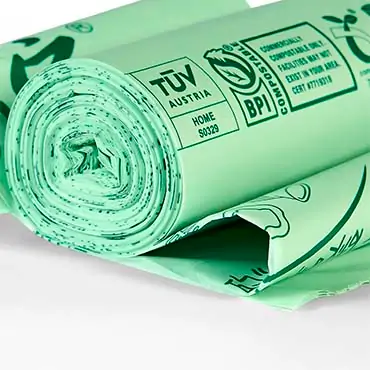
| EU | EN 13432 | DIN CERTCO · TÜV Austria (OK Compost) |
| Australia | AS 4736 (industrial) · AS 5810 (home) | ABA |
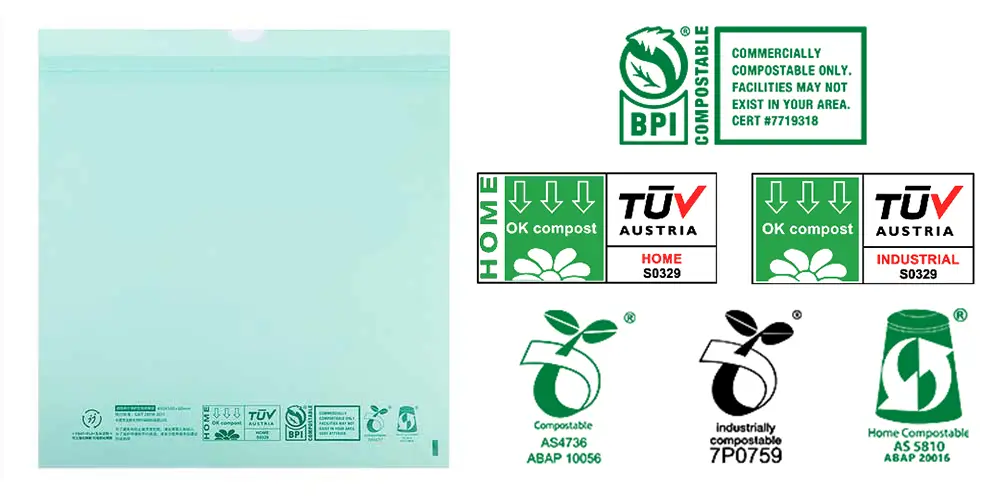
ASTM D6400, EN 13432, and AS 4736 are industrial composting standards. AS 5810 and OK Compost HOME are home composting standards. They are not interchangeable. See European Bioplastics’ explanation of the standards and the ASTM D6400 scope.
On timing, state the condition. Certified compostable bags disintegrate in an industrial composting stream in roughly three months. Home composting takes considerably longer, at least a year under good conditions. Site certificates for each material are listed on our certifications page.
Ask for the certificate number, not the logo. A logo can be printed on any film; a certificate number can be checked against the issuing body’s register.
Food-contact compliance: two questions, two documents
Two different questions get mixed into one. “Can this factory produce packaging safely?” is answered by a factory-level certification. “Is this material cleared for food contact?” is answered by material-level documentation in the destination market. Buyers who ask for only one of the two are left with a gap in their supplier file.
ShinHigh’s plant is certified to the BRCGS Global Standard for Packaging Materials, Issue 7, Grade B, audited by SGS. The certificate scope covers extrusion, blown film, cast film, gravure printing, and bag making of plastic packaging bags and films for direct or indirect contact with food, with no exclusions from scope. Current certificate status and full scope are verified in the BRCGS Directory.
| Question | What answers it | What it does not tell you |
| Can this site produce packaging consistently, hygienically and traceably? | BRCGS Packaging Materials, a factory-level, GFSI-recognised scheme | Whether a specific resin or film is cleared for food contact |
| Is this material cleared for food contact in my market? | USA: FDA route under 21 CFR 177.1520 supported by a compliance statement · EU: framework Regulation (EC) No 1935/2004 with the plastics measure Regulation (EU) No 10/2011 supported by migration testing and a declaration of compliance | Whether the factory runs hygienic, traceable production |
A note on wording. The FDA does not “approve” a bag or a factory. It clears materials, and a supplier demonstrates that clearance through documentation. Treat “FDA approved” as a prompt to ask for the specific document. Ask for both a factory certificate and the material-level statement for the market you are shipping into.

Six handling practices that cut leaks and odour
Most liner complaints in commercial kitchens are traceable to how the bin is run, not only to the bag. The practices below cost nothing and remove the load cases that fail wet-waste bags fastest: heat, standing liquid, and overfilling past the tie line.
- Empty at the end of every service. In warm weather, do not let wet waste sit overnight in a closed bin.
- Drain before binning. Pour off free liquid from prep trays into the drain or a separate container where local rules allow.
- Use a ventilated caddy at prep stations instead of sealing wet scraps into a closed bin for the whole shift.
- Do not compact food waste by hand. Pressing a wet load down drives liquid into the base seal.
- Stop at the tie line. An overfilled liner cannot be closed cleanly and usually tears at the rim.
- Keep the liner roll dry and out of heat. Bags have a 12-month shelf life; storing film next to a hot line or in a damp store shortens usable life.
Why buyers work with ShinHigh
ShinHigh makes its own material and its own bags. ShinHigh traces its bag-making roots to 2000, and the operating entity, Dongguan Xinhai Environment-Friendly Materials Co., Ltd, was established in 2011, giving it over 20 years in the category. Production runs at 30,000 tonnes of modified material and finished bags a year in a 30,000 m² plant with around 200 employees and 10 high-end underwater granulation biodegradable modification lines.
| Capability | Detail |
| Compostability certification | BPI / ASTM D6400, DIN CERTCO / EN 13432, TÜV Austria OK Compost, ABA AS 4736 & AS 5810. Per-material certificate PDFs for XH-918 and SH-133 |
| Food-contact scope | BRCGS Global Standard for Packaging Materials, Issue 7 (Grade B), audited by SGS; scope covers bags and films for direct or indirect food contact, no exclusions |
| Quality systems | ISO 9001; BRC and GRS certificates displayed; OWS testing |
| Factory audits passed | BSCI, Amazon, Woolworths |
| Customisation | Sizes fully custom; printing up to 4 colours (4 on one side, or 2 on each side); OEM and private label supported |
| Process chain | Raw material → film blowing → printing → bag cutting → packaging |
We do not publish customer names or case studies. The certifications above can be verified independently through the issuing bodies and the BRCGS Directory. For programme-scale volumes, see compostable trash bags wholesale.
Conclusion
A commercial kitchen does not need the heaviest compostable bag on the market. It needs the one that matches its bin, its waste and its waste-processing route. Get the size right so the rim does not stretch, choose a gauge for the waste stream, pick a star seal if the load is wet, and hold two documents on file: the factory-level BRCGS certificate and the material-level food-contact statement for the market you ship to. Do that, and the liner stops being the thing that fails during service.
Get free samples and a quote. Send the target market, bag size, waste type, thickness, and print colour count. That is enough for us to come back with the grade, gauge, and seal that fit, free standard samples, and pricing for your specification. Contact our team to start.
FAQ
Q1. Can compostable bags handle greasy restaurant waste?
Yes, with the right gauge and seal. Grease and heat are what soften the film, so a wet prep stream should be changed at least once a day, and heavy or hot loads are better served by a heavier custom gauge with a star seal. Compostability does not make a bag grease-proof. The film construction does that job.
Q2. How often should restaurant kitchen bags be changed?
At least once per service, and always before the bin is full. Two reasons: an overfilled liner tears at the rim, and in warm weather a closed bin of wet food waste will start to smell within hours. Kitchens running hot lines often change twice a day in summer.
Q3. Are compostable bags food-contact safe?
Two documents answer this, and they answer different questions. A factory-level certification such as BRCGS Packaging Materials shows that the site can produce hygienically and traceably; ShinHigh’s certificate covers bags and films for direct or indirect food contact with no exclusions. Material-level documentation shows that the film itself is cleared for food contact in your market: the FDA route under 21 CFR in the USA, or Regulation (EU) No 10/2011 documentation in the EU. Ask for both.
Q4. BPI vs EN 13432: which does my restaurant need?
It depends on where the waste goes, not on your preference. BPI certifies to ASTM D6400 for the US market; EN 13432 is the European standard administered through bodies such as DIN CERTCO and TÜV Austria. Both are industrial composting standards. If your waste goes to a home composting programme instead, the relevant standards are AS 5810 and OK Compost HOME. Note that SH-133 is certified for industrial composting only.
Q5. Do compostable bags leak with wet food scraps?
A well-made bag does not leak simply because it is compostable. Leaks usually come from one of three causes: a flat seal carrying a heavy wet load, a puncture from bones or shells, or free liquid drained into the bin and left standing against the base overnight. A star seal, an appropriate gauge, and end-of-service emptying remove most of it.
Q6. Will compostable bags break down in my kitchen before collection?
Not during a normal service. Compostable bags are designed to break down in a composting environment with the right heat, moisture and microbial activity, not on a shelf or in a bin. The film has a 12-month shelf life, and storage away from heat and moisture keeps it intact until use. Site certificates and full conditions are on our certifications page.