



Most sourcing problems with compostable bags start before the first order. The certificate does not cover the thickness you bought. The quoted price was never the landed cost. The film arrives thinner than the gauge the load needed. None of these show up in a sample photo.
This page is the sequence we run with importers, distributors, and brand buyers before a purchase order. Each section says what to ask, what a workable answer looks like, and what it costs to skip the step.
What a compostable bag supplier must prove before you shortlist
Three things decide whether a supplier belongs on your shortlist:
- a certificate that names the exact product and thickness
- a factory you can audit or verify
- a lead time written down rather than promised on a call.
Website design, sample appearance, and sales speed are secondary. They score well and still fail at the container.
Certification scope: the product, the thickness, the market
Compostability is certified per product and per thickness, not per brand. A certificate issued for a 0.018 mm liner does not automatically cover an industrial bag at a heavier gauge made from the same resin, because the test is run against a specified film thickness and the result carries that limit.
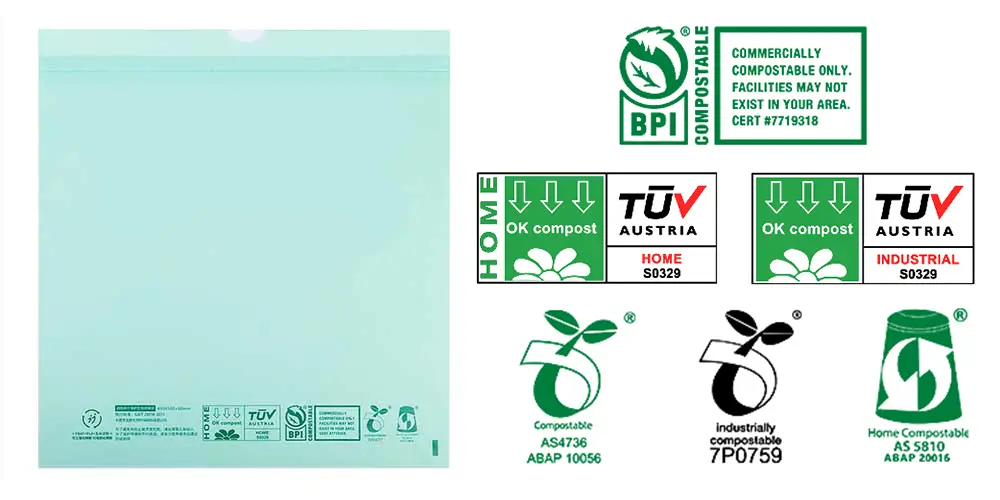
Ask for the certificate number, the product description printed on it, and the maximum thickness it covers. The same resin can carry different limits under different schemes, because a BPI certificate and a TÜV Austria OK Compost Industrial certificate for the same material do not always name the same ceiling. That is why the document answers the thickness question and the brand name does not. Then match the standard to the destination market.
| Market | Standard | Mark buyers recognise | What to ask the supplier |
| United States | ASTM D6400 | BPI | Certificate number and the SKU list it covers |
| European Union | EN 13432 | DIN CERTCO, TÜV Austria OK Compost | Whether the certificate is industrial, home, or both |
| Australia | AS 4736 (industrial), AS 5810 (home) | ABA | Which of the two applies to your liner programme |
| Global tenders | EN 13432 or ASTM D6400 | OWS test report | Full test report, not the summary page |
Home composting is a separate claim. TÜV Austria OK Compost Home, DIN-Geprüft Home Compostable (including NF T 51-800) and AS 5810 cover backyard conditions. Industrial certificates (EN 13432, ASTM D6400) cover facility conditions around 55 to 60 °C. If your buyer sells to households, the industrial certificate alone will not support the wording on the pack.
Full document sets and verification links sit on our certifications page. Standards themselves are covered in more depth in ASTM D6400 testing and EN 13432.
Factory or trading company: five checks that settle it in ten minutes
A trading company can quote faster and still leave you without a production contact when a batch drifts. Five checks separate the two without a factory visit.
- Who owns the film blowing line? Ask for the folding width range. A converter will state it in centimetres.
- Who signs the certificate? The legal entity on the certificate should match the entity on the quotation.
- Who prints. Four-colour work needs a plate line in-house or a named partner with plate records.
- Who handles a claim? Ask what happens to a container with a share of seal failures, in writing.
- Who is on the phone at 2 a.m. your time when the container is held?
ShinHigh runs its own chain: resin modification, film blowing with a 50 to 200 cm folding width, four-colour copper plate printing, and in-house bag making for die-cut handle, T-shirt, trash, pet waste, flat-open, side-sealed bags and gloves. That is what makes a claim answerable rather than forwarded.
The five-step sourcing sequence
Run the steps in order. Each one produces a document you keep. Skipping step 4 costs more than any discount you gain at step 2.
| Step | Output | Indicative duration (planning estimate, not a supplier commitment) |
| 1. Define the application | Written brief: use case, load, size, thickness, print | 1 day |
| 2. Shortlist and quote on identical specs | 3-5 comparable quotes | 3-7 days |
| 3. Verify documents | Certificate pack per SKU, test report | 2-5 days |
| 4. Trial order | Pilot PO with acceptance criteria | 2-4 weeks |
| 5. Scale-up terms | Repeat lead time, price validity, buffer stock | 1 week |
Step 1: define the application before the product
Bag choice follows from four variables: what goes in, how heavy it gets, how wet it gets, and how long it sits before collection. A 13-gallon kitchen liner holding dry office waste and a liner holding food waste for three days in summer are different products at the same nominal size.
Write the brief before you ask for prices. Suppliers who receive a complete brief quote comparable numbers. Suppliers who receive “your best price for compostable bags” quote the cheapest thing that fits the words.
Step 2: shortlist three to five and quote on identical specs
Send the same six fields to every supplier: bag type, size in mm, thickness in mm, material preference, print colour count, target market. Anything less and the quotes cannot be compared, because carton counts and gauge will differ silently.
Three to five is the useful range. Two quotes invite anchoring. Ten quotes consume the week you needed for verification.
Step 3: verify documents, not brochures
Four documents settle most of it: the certificate for the SKU, the third-party test report, the specification sheet with dimensions and thickness tolerance, and the material composition statement. If a supplier sends a certificate covering a product family rather than your SKU, ask for the page that names it.
Step 4: design the trial order
A pilot order answers questions a sample cannot: batch consistency, seal behaviour across a run, print registration at production speed, packing accuracy. Define acceptance before the PO, not after the container arrives.
| Test | How to run it | Pass condition you set |
| Wet load | Fill to rated capacity with wet waste, hang 24 h | No bottom seam separation |
| Thickness spread | Measure 5 points across the roll | Inside the tolerance on the spec sheet |
| Seal peel | Peel a sealed edge by hand at 90° | Film tears before the seal opens |
| Print rub | Rub with a damp thumb, 10 strokes | No transfer to the thumb |
| Dispense | Pull 20 bags from the roll one-handed | No torn next bag |
Step 5: lock the scale-up terms
Before the second order, confirm repeat lead time, how long the price holds, and whether the supplier keeps plates and artwork on file. A repeat order that needs new plates is a first order with extra steps.
Which bag type fits your programme
Eight product families cover most B2B programmes. The thickness below is the standard range for trash and pet waste bags; shopping, mailer and film formats are quoted per specification.
| Application | Bag type | Standard thickness | Specification that decides it | Product page |
| Grocery and retail | T-shirt, die-cut handle, soft loop handle | Per spec | Handle strength and load per bag | /shopping-bags/ |
| Kitchen and commercial waste | 10, 13, 33-gallon liners, drawstring, flat top | 0.018-0.020 mm | Wet load and bin fit | /trash-bags/ |
| Food waste collection | Caddy and food waste liners | 0.018-0.020 mm | Seal integrity when wet | /trash-bags/food-waste-bags/ |
| Produce | Perforated rolls, loose packs | Per spec | Breathability and food contact | /compostable-produce-bags/ |
| Pet waste | Header, drawstring, flat top, tie handle | 0.018-0.020 mm | Odour control and one-hand dispensing | /pet-waste-bags/ |
| E-commerce | Mailers, black and coloured | Per spec | Puncture resistance and adhesive strip | /mailing-bags/ |
| Resealable | Zipper, slider, double ziplock | Per spec | Track strength after repeated open-close cycles | /zipper-bags/ |
| Films and wrap | Cling film, stretch film, layflat tubing | Per spec | Cling, moisture barrier, machine or hand use | /compostable-cling-film/ |
Two adjacent categories come up in the same RFQs: gloves and aprons for food handling. A third, garment bags, appears in apparel programmes.
Market-by-market compliance quick table
Compliance is two questions, not one: does the product meet the standard, and does the print file meet the labelling rule? Suppliers answer the first and stay quiet on the second, which is where shipments get held.
| Market | Product rule | Labelling or claim duty | Document to keep on file |
| US | ASTM D6400 via BPI | State labelling and advertising rules differ; California and Washington are among the stricter ones. Confirm the required marking before the print file is approved | BPI certificate per SKU, print proof |
| EU | EN 13432 | PPWR tightening claim and labelling rules, EPR registration in several member states | EN 13432 certificate, EPR registration number |
| Australia | AS 4736, AS 5810 for home | State organics programmes set their own acceptance | ABA certificate, programme acceptance letter |
| UK | EN 13432 accepted | EPR registration and recyclability assessment | Certificate, EPR reference |
What those documents look like in practice: for the United States we hold nine BPI certificates with thickness caps from 49 μm on finished bags to 195 μm on cling film; for the EU, 35 TÜV Austria and DIN CERTCO documents running from 36 μm home-compost film to 1891 μm certified layers on zipper bags; for Australia and New Zealand, nine ABA certificates split across AS 4736 for industrial conditions (printed film to 143 μm) and AS 5810 for home composting (waste bags to 113 μm).
Send the target market with the brief. A print file approved for the EU is not automatically approved for a US state, and a state marking rule forces a print change rather than a sticker added later. Background on the EU rules sits in what the PPWR changes, and claim wording in compostable bag certification.
MOQ, tooling, samples and lead time: what the numbers actually are
MOQ on compostable bags is set per bag category, not as one policy figure, because two things drive it: the print plate setup and the weight of material per unit. A supplier who quotes the same number for every product is either guessing or selling stock sizes only.
MOQ by bag type
| Bag type | MOQ | With your logo printed |
| Dog poop bags | 1,000–10,000 rolls | 5,000 rolls |
| Trash bags | 1,000 rolls | 5,000 rolls |
| Shopping bags | 1 tonne or 300 cartons | 1 tonne or 300 cartons |
| Flat bags | 1 tonne | 1 tonne |
| Courier and mailing bags | 5,000 pcs | 10,000 pcs |
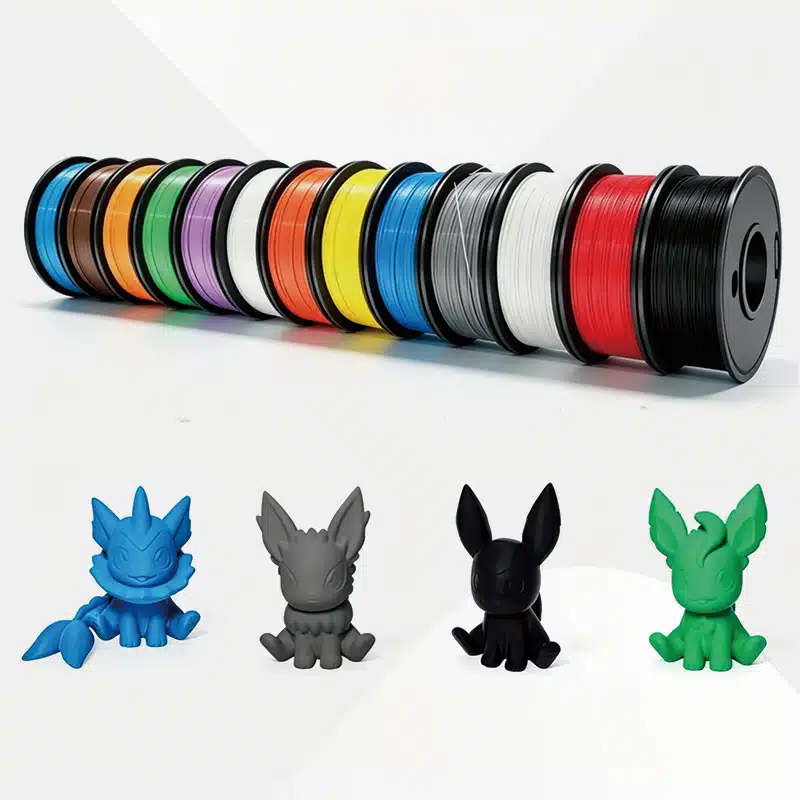
| 3D printer filament | 500 kg per SKU, negotiable | n/a |
Mixed styles can be combined in one order to reach the minimum, which is how a programme carrying four sizes avoids buying four minimums. If your first order sits below these lines, raise it at the brief stage rather than after the quote: the answer depends on whether your format is already running.
Print, plate and tooling fees
Printing runs one to four colours, four on one side or two and two. Size, colour and thickness are all customisable, and the inks are water-based and meet EN 13432, so printing does not compromise the compostability claim.
Plates are made per artwork and per colour: new logo, new plates; repeat of the same artwork, no new plates. The plate fee is one-time, which changes the maths: on the first order it sits inside the unit cost; by the fifth order it is already paid. Ask who stores the plates and who owns the artwork file. A supplier who cannot answer both is holding your reorder hostage.
Samples: what is free and what is charged
Up to five stock samples are free; you prepay the freight only. A custom printed sample is charged at cost, invoiced separately, and not credited against the bulk order. It consumes plates and press time, and a supplier who appears to refund it has usually priced it into the unit cost instead.
Run both rounds for a new programme: the stock sample proves the film, the printed sample proves registration and colour on the actual substrate.
Lead time: counted from deposit and artwork approval
| Stage | Time |
| Sampling | 3–7 working days |
| Bulk production, custom printed | 20–30 days |
| Bulk production, stock item | 10–15 days |
| Sea freight to US West Coast | 18–25 days |
| Sea freight to US East Coast | 30–40 days |
| Sea freight to Australia | 12–18 days |
Door to door that lands at roughly 5 to 11 weeks depending on the destination port, and peak season adds one to two weeks. Final dates belong in the order confirmation, not in an email thread.
Payment, trade terms and packing
Bulk orders ship on FOB, CIF or CFR, with FOB the most common; samples move by DHL, FedEx, or UPS. Payment is by T/T: a deposit starts production, the balance clears before shipment, and the split is written in the quotation rather than agreed later.
Bags ship roll-packed or flat-packed, in a printed carton or poly bag inside an outer carton. Pieces per roll and carton configuration are set per order. Carton efficiency is worth checking here: it moves freight per piece more than most buyers expect.
The order itself runs six steps: you send the spec (size, thickness, material, print, packing, destination market), we quote and confirm MOQ and lead time, you approve the sample, bulk runs with in-line QC, shipping documents and certificates follow, then delivery.
Why factory-gate price is not landed cost
A quote per 1,000 pieces hides four costs that arrive later: freight per cubic metre, duty, defect allowance, and the labour spent handling claims. Two suppliers can differ on unit price and reverse order on landed cost once carton efficiency is counted.
This is the comparison sheet, left blank on purpose: the two columns hold your suppliers’ figures, not ours. Copy it into a spreadsheet and fill both sides from the quotations.
| Cost line | Supplier A | Supplier B | How to fill it |
| Unit price per 1,000 pcs | from quote | from quote | Same size, same thickness, same carton count |
| Plate fee, amortised over the first order | calculate | calculate | Fee divided by the order quantity |
| Cartons per container | from quote | from quote | Changes freight per piece |
| Freight per 1,000 pcs | calculate | calculate | Charge per CBM, not per kg |
| Duty at destination | check | check | Confirm the HS code with your broker |
| Defect and claim allowance | negotiate | negotiate | Based on the replacement policy, not the defect rate claimed on a call |
| Landed cost per 1,000 pcs | sum | sum | This is the number worth comparing |
Normalise before comparing: same size, same gauge, same carton count, same trade term. A quote missing the trade term is not a quote. A row that stays empty is itself a finding: if a supplier will not state the trade term or the carton count, you cannot compare it with anyone.
Specs that decide whether the bag survives
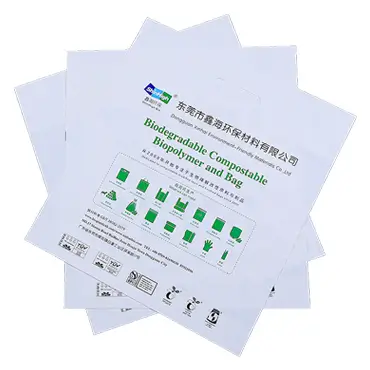
Three specifications cause most complaints: gauge, seal strength, and how long the stock sat in a warehouse. None of them are visible in a product photo.
Thickness and tolerance
Standard production for trash and pet waste bags runs 0.018 to 0.020 mm, with custom gauge for commercial and industrial use. Tolerance matters more than the nominal number: a 0.018 mm bag produced at the low end of tolerance behaves like a thinner bag, and a thin bag fails on a wet load before it fails on a dry.
Measure five points across a roll, not one. Thickness variation across the web is a film-blowing problem, and it shows up as a bag that tears in one place and holds in another.
Seal strength and wet load
The bottom seal carries the load; the side seal holds the shape. Wet content loads both and adds weight over time as the contents settle. QC runs at three stages: thickness and width when the film is blown, colour accuracy at printing, and durability and water resistance at cutting. A sample cannot show any of the three.
Shelf life and storage
Bags carry a 12-month shelf life from the production date when they stay sealed. Material shelf life depends on the grade, running from 6 to 12 months, and the quotation states the figure for the grade you buy. Storage determines whether you get the full figure: cool, dry, out of direct sunlight, away from heat sources, on a FIFO rotation. A bag that has sat two summers in a warm warehouse cracks along the fold line before it reaches a bin.
If your distributor holds stock for retail, put the production date on the carton and rotate. Buyers have written about opening a pack dated years earlier and watching the bag split on the first pull.
Eight red flags that show up after the PO
- Certificate without a product name or thickness limit.
- Quote per kilogram instead of per 1,000 pieces.
- Lead time given verbally, absent from the PI.
- No batch record, so a defect cannot be traced to a run.
- Plate ownership unclear.
- Gauge drift between the sample and the bulk run.
- Claim wording on the print never reviewed against the destination market.
- No written replacement policy for a failed container.
Each one is cheap to check before the PO and expensive after.
China factory vs local distributor
The trade-off is capital against flexibility, not quality against price.
| Factor | Direct from a China factory | Local distributor |
| Unit price at volume | Lower | Higher |
| MOQ | 1 tonne or 300 cartons for shopping and flat bags, 1,000 rolls for trash | Often lower, stock items available |
| Lead time | 15-20 days production plus transit | Days from local stock |
| Documentation | Full certificate pack from source | Depends on what the distributor holds |
| Print and size flexibility | Full custom | Limited to stocked formats |
| Import compliance | Yours to manage | Usually handled |
| Claim handling | Direct with the producer | Mediated |
Importers and distributors usually start direct on their core SKUs and keep a local source for urgent replenishment. Brands testing a market often start local and move to direct once volume justifies a container.

What we can prove
ShinHigh, operated by Dongguan Xinhai Environment-Friendly Materials Co., Ltd, brings more than 25 years in the field and produces 30,000 tonnes of modified material and finished bags a year in a 30,000 m² plant with around 200 employees and 10 modification lines. Certification covers BPI (ASTM D6400), DIN CERTCO (EN 13432), TÜV Austria OK Compost and OK Compost Home, and ABA (AS 4736 and AS 5810), with products tested by OWS: 55 product certificates in total, each naming its covered product and thickness limit on our certifications page.
The plant holds BRCGS Global Standard for Packaging Materials, Issue 7, Grade B, audited by SGS, with a scope covering direct or indirect food contact and no exclusions. Current status is whatever the BRCGS Directory shows today. ISO 9001, 14001 and 45001 sit alongside it. Eleven factory and social audits are on file, including amfori BSCI, Amazon FQA, SQP, Target, Sedex SMETA 4-Pillar, Walmart FCCA and SCS, Woolworths and ICS, and a GRS certificate (Intertek, at least 20% recycled content) covers packaging production.
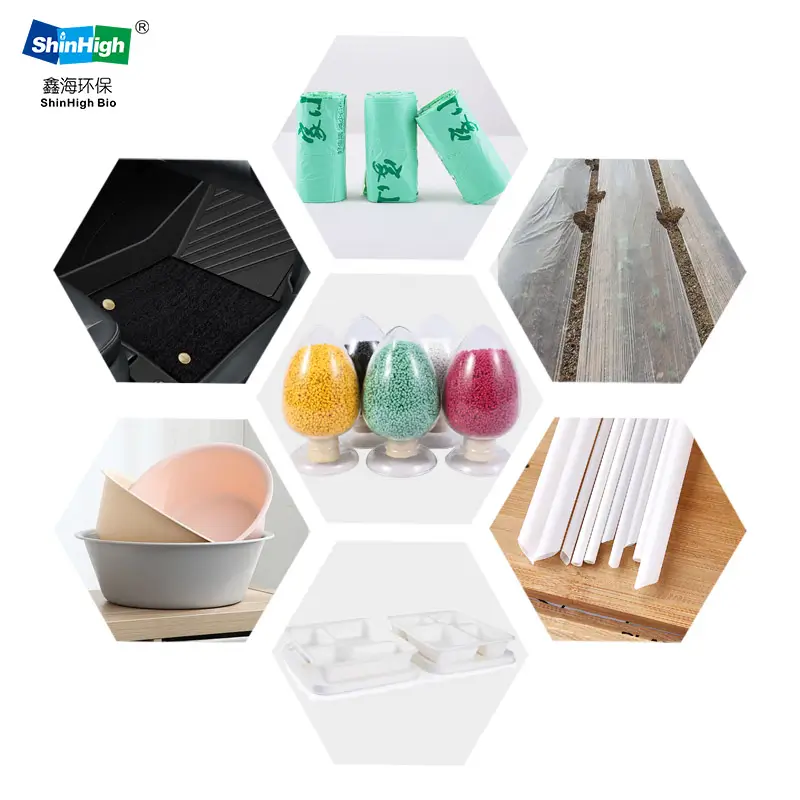
Material is PLA and PBAT, some grades with cornstarch, and the range is industrial and home compostable; the certification for each specification is marked on the quotation, SKU by SKU. Exports go to the United States, Canada, the EU, Australia, and New Zealand.
That is the file a buyer can check. Our testing process explains what is measured at each stage, About Us covers the plant, and recommendations on compostable bags cover selection by scenario.
Conclusion
Choosing a compostable bag supplier comes down to four documents and one trial order: the certificate that names your SKU and thickness, the test report behind it, the specification sheet with tolerance, the landed cost comparison, and a pilot with acceptance criteria written before the PO.
Send your bag type, size, thickness, print colour count, and target market. You get a specification-matched quote, the certificate pack for that SKU, and a sample plan for the trial. Get a quote for your programme.
FAQ
What is the minimum order quantity for compostable bags?
It is set per bag type. Dog poop bags run 1,000 to 10,000 rolls, and trash bags start at 1,000 rolls, both rising to 5,000 rolls with logo printing. Shopping bags and flat bags start at 1 tonne or 300 cartons. Courier bags start at 5,000 pieces unprinted and 10,000 with a logo. Mixed styles can be combined in one order to reach the minimum, and 3D printer filament runs from 500 kg per SKU.
How long does production take?
Sampling takes 3 to 7 working days. Bulk production runs 20 to 30 days for custom printed orders and 10 to 15 days for stock items, counted from deposit and artwork approval. Sea freight then adds 18 to 25 days to the US West Coast, 30 to 40 to the East Coast, and 12 to 18 to Australia, so door-to-door is generally 5 to 11 weeks.
Can you supply BPI or EN 13432 certificates, and how do I verify them?
Yes, per SKU. The certificate names the product and the thickness it covers. Verification goes through the issuing body (BPI for ASTM D6400, DIN CERTCO or TÜV Austria for EN 13432), using the certificate number. Our certifications page lists the documents and links.
Can I test samples before ordering?
Up to five stock samples are free, and you cover the freight. A custom printed sample is charged at cost, invoiced separately, and not credited against the bulk order. Test wet load, seal peel, thickness across the roll, and print rub before committing.
Can the bags be printed with our logo, and in how many colours?
One to four colours, four on one side or two on each side. The inks are water-based and meet EN 13432. Plates are a one-time cost per artwork and are not charged again on reorders.
Do compostable bags have a shelf life?
12 months from production when bags are kept sealed, cool, dry, and out of direct sunlight. Material shelf life depends on the grade and runs from 6 to 12 months, stated per grade on the quotation. Stored past its window, a bag tends to crack along the fold.
How long do compostable bags take to break down?
Under EN 13432 industrial composting conditions, certified bags break down at least 90% within 180 days, typically three to six months depending on the facility. Home composting takes longer and needs a home-compost certificate rather than an industrial one: OK Compost HOME, DIN-Geprüft Home Compostable including NF T 51-800, or AS 5810 in Australia and New Zealand. Timing is set by temperature, moisture, and how the pile is managed.