




Wholesale Compostable Produce Bags
Biodegradable & Compostable Produce Bags Wholesale for Supermarkets, Grocery Chains & Distributors
Which bag format? What thickness? Will the certificate cover your market? These three questions decide most orders for compostable produce bags.
Tell us what you’re packing and where it’s going. We’ll point you to the produce bags that fit — and say so if ours don’t.
Wholesale Produce Bag Specifications
| Material | PBAT + PLA + plant starch (own modified resin) |
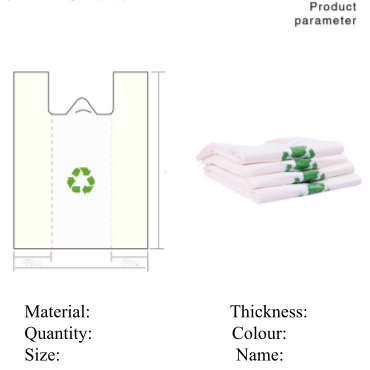
| Formats | Flat open-top / On a roll / T-shirt handle |
| Width × length | Custom |
| Thickness | Custom (µm or mil) |
| Film appearance | Clear, translucent or tinted |
| Bags per roll | Custom (set by roll diameter) |
| Core inner diameter | Custom |
| Perforation | Tear-off perforation available |
| Printing | Custom printing available (logo, text) |
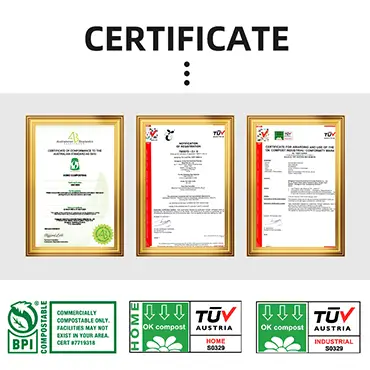
| Certifications | EN 13432, OK Compost, ASTM D6400, AS 4736, AS 5810 |
| MOQ | From 5,000 pcs per specification |
All parameters above are made to order. If you already run a compostable bags programme with a written specification, send it — we produce against your spec rather than asking you to adapt to ours. Certification documents and certificate numbers for your target market are available on request; the standards we hold are listed on our compostable bag certification page.
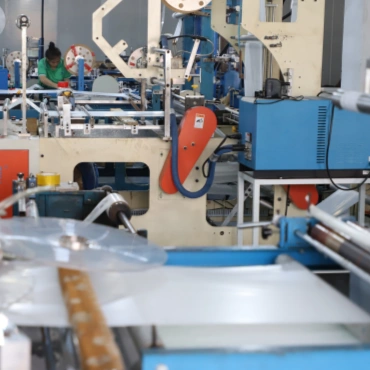
Film is blown from our own modified raw material rather than bought in for each order. In our experience, that helps keep a specification stable from one run to the next.
Bag Formats: Flat Open-Top, On a Roll & T-Shirt Handle
Three formats, each suited to a different packing workflow:
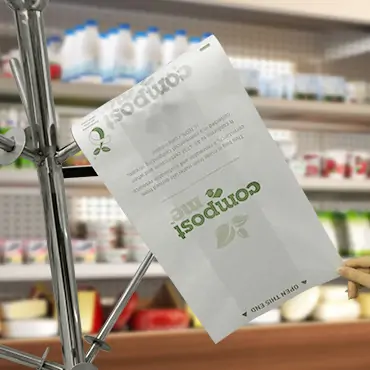
Flat open-top
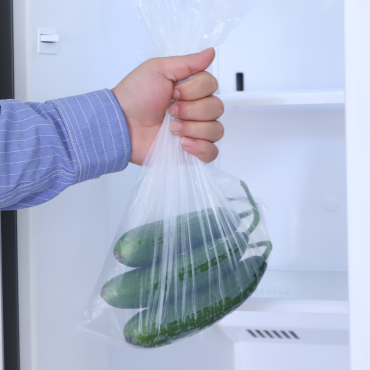
Picked from a bundle or counter dispenser. Standard at packing stations and supermarket backrooms; needs no hardware.

On a roll
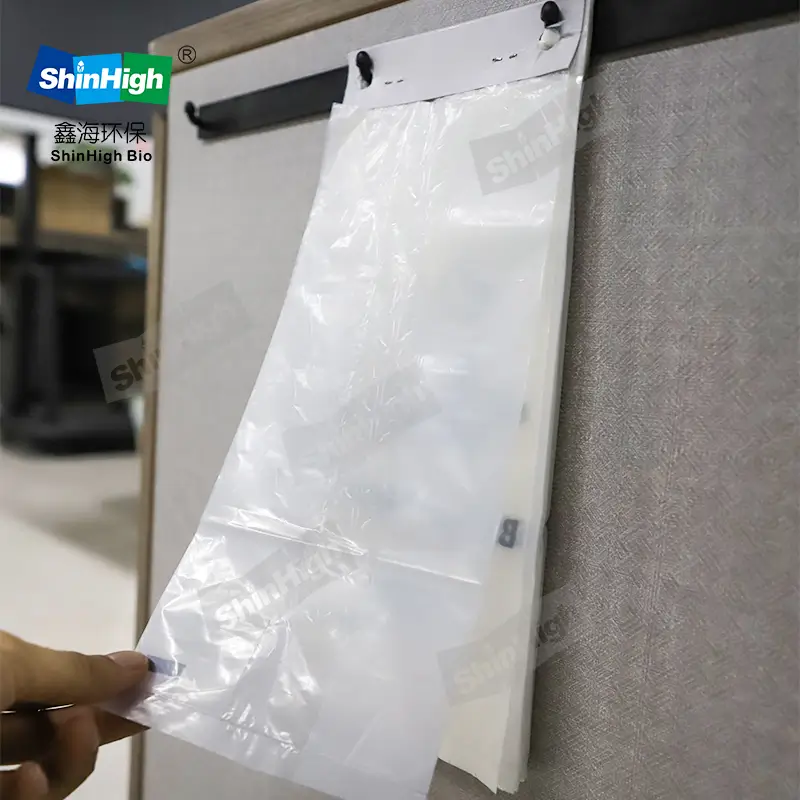
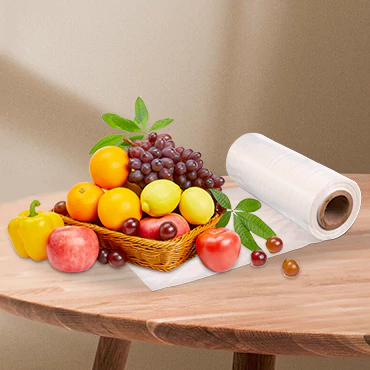
Perforated, torn off at the point of use. The format that supermarket produce dispensers are built around.

T-shirt handle
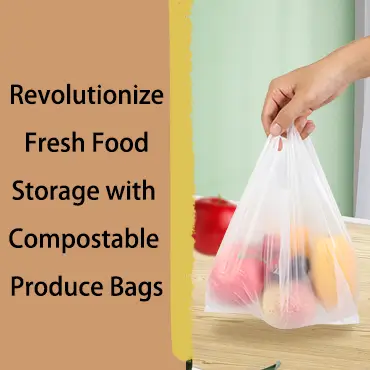
Also called a tie-handle or carry-handle. The bag doubles as the carrier, so shoppers need no second bag. Used for shelf-to-trolley produce and pre-packed bundles.
Custom printing is available on all three. For high-volume packing lines, wicket bags for fresh produce are faster — stacked on a wicket and opened in one motion.
Choosing Produce Bag Thickness
Thickness is the parameter buyers most often guess at, and the one that most often causes problems later. The right choice depends on what goes inside the bag:
- Light, dry, smooth produce — apples, citrus, peppers, brushed roots. A thinner film carries the load and keeps material cost down.
- Heavy or dense produce — potatoes, onions, large citrus packs. More film to resist puncture at the seams and bottom fold.
- Wet or sharp-edged produce — wet greens, stems, produce packed with ice. Water adds weight and stems puncture; go thicker, or specify a reinforced bottom seal.
- Pre-packed for transport — boxed and palletised bags take load from stacking, not only from the produce.
Thicker is not automatically better — it costs more per bag, adds carton weight, and cuts how many bags fit on a roll before the diameter outgrows your dispenser. And compostable film does not behave like LDPE at the same gauge, so do not copy the thickness off a conventional produce bag specification. Approve a physical sample under your real load.
Roll, Core & Dispenser Compatibility
Produce bags on a roll are where orders most often go wrong: the roll has to fit the dispenser you already have, not simply hold as many bags as possible.
- Core inner diameter — must match your existing dispenser spindle.
- Roll outer diameter — must fit inside the dispenser housing.
- Perforation strength — weak enough to tear cleanly one-handed, strong enough not to tear inside the dispenser.
- Bags per roll — set by roll diameter, not chosen independently of it.
- Roll weight — affects carton weight and, at pallet scale, freight cost.
If you already run roll dispensers, send us the make and model, or simply the core inner diameter and the housing clearance. If you are specifying new dispensers, we can build the roll to the dispenser instead of the other way round.
Freshness, Breathability & Honest Limits
Compostable produce bags breathe rather than sealing produce in. That is genuinely useful, and it is also a trade-off — you should hear both sides before you order.
What breathability does well
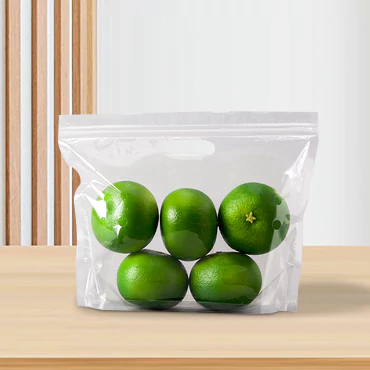
It lets water vapour escape instead of pooling inside the bag. Condensation is what turns stored produce slimy, so a breathable film suits produce with a skin — roots, citrus, apples, peppers, onions.
Where it works against you
The same property means moisture also leaves. Leafy greens, herbs, salad leaves and cut fruit tend to lose water and wilt faster in a breathable film than in a conventional one. If your range is mostly greens, tell us at the enquiry stage — we would rather change the formulation, thickness or format than sell you a bag that underperforms on your own shelf.
Shelf life and storage
Compostable film is perishable, not inert, and ships with a use-by window. Finished bags carry a 12-month shelf life stored cool, dry and out of direct sunlight; the modified raw material carries 6 months. Plan stock rotation around that rather than treating bags as a buy-once item.
FAQ for Wholesale Buyers
What is the MOQ for wholesale compostable produce bags?
Standard custom production typically starts from 5,000 pieces per specification. The applicable minimum depends on bag size and thickness, since a large, thick bag uses more film per piece. Send us the specification, and we will confirm the number that applies to your order.
How long does an order take?
It depends on whether you are repeating an approved specification or opening a new one, on the printing requirements, and on your destination and shipping mode. We give you a production window with the quotation, based on your actual specification and destination, rather than a generic figure.
Can you produce to a specification we already use?
Yes. Send the spec sheet — dimensions, thickness, roll count, core size, printing and packing — and we produce against it rather than substituting our own standard. Worth lining two quotes up side by side: comparing them on price per roll can be misleading if the roll counts or the gauges differ.
Which certifications do the bags carry?
ASTM D6400 (BPI), EN 13432 (DIN CERTCO), OK Compost and OK Compost HOME (TÜV Austria), and AS 4736 and AS 5810 (ABA). Coverage depends on the final specification and target market, and we supply the supporting documents with the quotation.
Are compostable produce bags suitable for leafy greens?
Breathable film lets moisture escape, which suits products with skin. Leafy greens, herbs, and cut fruit tend to lose water and wilt faster in it. Tell us your product mix, and we will advise on formulation, thickness or a different format.
Will the rolls fit our existing dispensers?
They can be built to fit. Send the core inner diameter and the dispenser housing clearance, and we will set the roll diameter and bags per roll around them.
Request a Quote or Samples
ShinHigh Bio has manufactured compostable film and bags since 2000. Send us what you are packing, roughly how many you need, and where they are going, and we will come back with a specification and a quotation.
Samples are available for B2B evaluation. Request a quote or samples.