



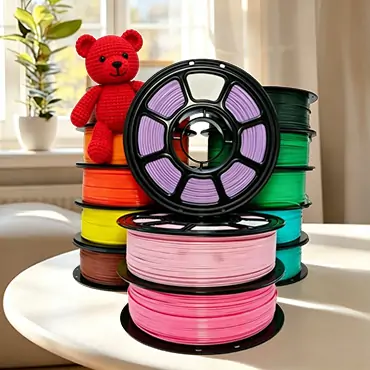
Most filament problems in production come down to four things:
- Color shifts between batches — this month’s matte black doesn’t match last month’s
- Diameter drifting past ±0.05 mm — random under-extrusion or jammed nozzles
- Wet spools on arrival — parts failing before the dryer even finishes
- No usable data sheet — can’t verify specs against your QA requirements
This reference compares the major 3D printing filament types and properties with the data procurement managers and print farm operators actually need: verified temperature and strength ranges, moisture behavior, and how these materials perform in real production environments. Where relevant, we’ve included feedback from professional printing communities to show where the datasheet ends and the shop floor begins.
The Big Four: PLA, PETG, ABS/ASA, TPU
These four materials account for the majority of FDM/FFF filament volume in B2B. Understanding their real-world behavior is the foundation of any sourcing decision.
PLA (Polylactic Acid)
| Property | Typical Value |
|---|---|
| Nozzle temperature | 195–230 °C |
| Bed temperature | 45–65 °C |
| Heat deflection temp | ~60 °C |
| Tensile strength | 50–65 MPa |
| Density | 1.24 g/cm³ |
| Moisture sensitivity | Low |
PLA is a bio-based thermoplastic (typically corn starch or sugarcane). It prints at low temperatures, requires no enclosure, and delivers excellent dimensional accuracy. For B2B, it’s the default for promotional items, display models, packaging prototypes, and non-functional parts.
For a deeper look at PLA variants and how PLA+ differs from standard PLA, see our PLA vs PLA+ breakdown.
PETG (Polyethylene Terephthalate Glycol)
| Property | Typical Value |
|---|---|
| Nozzle temperature | 220–255 °C |
| Bed temperature | 50–80 °C |
| Heat deflection temp | ~75 °C |
| Tensile strength | 50–60 MPa |
| Elongation at break | 30–50% |
| Moisture sensitivity | Low |
PETG bridges the gap between PLA’s ease and ABS’s durability. It offers good chemical resistance (oils, solvents, alcohols), excellent layer adhesion, and sufficient heat resistance for most indoor functional parts. It’s the most common material for brackets, enclosures, jigs, and fluid-handling components.
For a direct comparison between these two, see our PETG vs PLA filament guide.
ABS (Acrylonitrile Butadiene Styrene) & ASA
| Property | ABS | ASA |
|---|---|---|
| Nozzle temp | 230–250 °C | 240–260 °C |
| Bed temp | 90–110 °C | 90–110 °C |
| Heat deflection temp | ~100 °C | ~100 °C |
| Tensile strength | 40–50 MPa | 40–50 MPa |
| UV resistance | Poor | Excellent |
| Enclosure required | Yes | Yes |
ABS is tough, impact-resistant, and vapor-smoothable with acetone. ASA matches ABS mechanically but adds UV stability, making it the correct choice for any outdoor application. Both require an enclosure and proper ventilation (styrene emissions).
TPU (Thermoplastic Polyurethane)
| Property | Typical Value |
|---|---|
| Nozzle temperature | 210–240 °C |
| Bed temperature | 40–60 °C |
| Shore hardness | 85A–95A (most common: 95A) |
| Tensile strength | 30–50 MPa |
| Elongation at break | 400–600% |
| Moisture sensitivity | Low |
TPU delivers rubber-like flexibility. It’s used for gaskets, seals, vibration-damping mounts, phone cases, and wearables. It requires a direct-drive extruder and slow print speeds (20–40 mm/s). Not compatible with Bowden setups without modification.
Engineering & Specialty Filaments
Nylon (PA6 / PA12)
| Property | Typical Value |
|---|---|
| Nozzle temperature | 240–270 °C |
| Bed temperature | 70–100 °C |
| Heat deflection temp | 80–95 °C |
| Tensile strength | 55–70 MPa |
| Moisture sensitivity | Very high |
Nylon is the material for gears, bearing surfaces, cable ties, and living hinges. PA6 is stronger and stiffer; PA12 has better chemical resistance and lower moisture absorption. Both require aggressive drying before printing and sealed storage.
For drying protocols at scale, see our filament drying guide.
Polycarbonate (PC)
| Property | Typical Value |
|---|---|
| Nozzle temperature | 270–310 °C |
| Bed temperature | 90–120 °C |
| Heat deflection temp | ~140 °C |
| Tensile strength | 60–70 MPa |
| Moisture sensitivity | High |
PC survives sustained loads at 110–140 °C. It’s translucent in natural form and extremely tough. Requires a heated enclosure and hotend capable of 300 °C+.
Carbon Fiber Composites
| Property | Typical Value (CF-PA example) |
|---|---|
| Nozzle temperature | 260–290 °C |
| Bed temperature | 80–110 °C |
| Tensile strength | 70–90 MPa |
| Stiffness increase vs base | 2–4× |
| Nozzle wear | High (abrasive) |
Short carbon fibers (10–20% by weight) are added to PLA, PETG, PA, or PC. The result: dramatically increased stiffness, reduced warping, and a professional matte finish. The trade-off: abrasive to nozzles, reduced layer adhesion in some formulations.
PEEK / Ultem (PEI)
| Property | PEEK | Ultem (PEI) |
|---|---|---|
| Nozzle temp | 380–420 °C | 340–380 °C |
| Bed temp | 120–160 °C | 120–140 °C |
| Continuous use temp | ~250 °C | ~170 °C |
| Tensile strength | 90–100 MPa | 85–95 MPa |
These sit at the top of the performance pyramid. Used in aerospace, medical implants, and oil & gas. Require 400 °C+ hotends and heated chambers at 120–160 °C.
Comparison Table
Note: Pricing below reflects indicative FOB benchmarks as of Q2 2026 and varies with volume, formulation, color matching, certification, packaging, Incoterm, and resin market conditions. 2026 has seen filament prices fluctuate significantly due to tariffs and raw material costs. Always request a current quote tied to your specific requirements.
| Material | Tensile Strength | HDT | Moisture Sensitivity | Print Difficulty | Best B2B Use | Indicative Wholesale (Q2 2026) |
|---|---|---|---|---|---|---|
| PLA | 50–65 MPa | ~60 °C | Low | Easy | Prototypes, display, promo | $7–15/kg (varies by channel/volume) |
| PETG | 50–60 MPa | ~75 °C | Low | Moderate | Functional parts, enclosures | $9–18/kg (quote-based) |
| ABS | 40–50 MPa | ~100 °C | Low | Hard | Automotive, jigs, impact | $6–13/kg (quote-based) |
| ASA | 40–50 MPa | ~100 °C | Low | Hard | Outdoor, UV-exposed | $10–14/kg (quote-based) |
| TPU (95A) | 30–50 MPa | ~80 °C | Low | Hard | Gaskets, grips, wearables | $14–35/kg (quote-based) |
| Nylon PA6/12 | 55–70 MPa | 80–95 °C | Very High | Hard | Gears, hinges, bearings | $28–45/kg (quote-based) |
| Polycarbonate | 60–70 MPa | ~140 °C | High | Very Hard | High-heat industrial | $35–55/kg (quote-based) |
| CF Composites | 70–90 MPa | 85–110 °C | Moderate–High | Hard | Fixtures, drone frames | $40–95/kg (quote-based) |
| PEEK | 90–100 MPa | ~250 °C | Low | Extreme | Aerospace, medical | $300–500/kg (unfilled) |
| Ultem (PEI) | 85–95 MPa | ~170 °C | Low | Extreme | Aerospace, FST-rated parts | $290–800/kg |
What the Community Asks Most
We aggregated the most common questions from r/3Dprinting, r/BambuLab, r/AdditiveManufacturing, and professional print farm forums:
“How do I know if my filament is actually ±0.02 mm?”
Micrometer it yourself at 10 random points across the spool. If the range exceeds 0.04 mm total, the claimed tolerance is not being held.
“Is PLA+ just marketing?”
Mostly yes. PLA+ is PLA with impact modifiers (typically elastomers or copolymers). It’s tougher and less brittle than standard PLA, but there’s no industry standard for what “PLA+” means. Ask for the actual tensile and impact test data.
“Can I print ABS without an enclosure if I use a brim?”
No. A brim helps with bed adhesion but does nothing for layer adhesion or warping in the upper layers. An enclosure is non-negotiable.
“Why does my PETG look cloudy?”
Moisture. Even a small amount creates micro-bubbles in the extruded line. Dry at 65 °C for 4–6 hours.
“Do I really need to dry Nylon every time?”
Yes. Even in a dry box, Nylon picks up enough moisture within a print session to affect surface finish. Dry for 8 hours, print, return to vacuum bag with desiccant immediately after.
B2B Sourcing: The Data Points That Matter
When evaluating any filament supplier, these are the objective criteria that separate a production-grade partner from a commodity vendor:
Diameter tolerance. For production use, ±0.02 mm verified by an inline laser micrometer during extrusion — not spot-checked after the fact. This keeps your extrusion multiplier consistent across batches.
Batch documentation. Request a Certificate of Analysis for each batch (diameter range, ovality, tensile test results, moisture content), and retain samples for at least 12 months.
Color consistency. For branded or matched colors, Delta-E < 2.0 between batches is the professional standard.
Compliance. Depending on your market: REACH/RoHS (EU), FDA food-contact (PETG/TPU), UL 94 (ABS/PC in electrical enclosures), ISO 9001/14001 (supplier quality and environmental management).
Moisture control in transit. Vacuum-sealed bags with> 5 g desiccant per kg, moisture barrier bags for long-haul routes, and pallet stretch-wrap with desiccant between layers. Standard cardboard with a silica sachet is not enough for ocean freight through humid climates.
FAQ
PLA. It delivers the lowest cost per part for any application that doesn’t require heat resistance above 60 °C or significant impact strength.
PETG. It costs more than PLA but covers the majority of functional use cases with its chemical resistance and ~75 °C heat tolerance.
±0.02 mm verified by inline laser measurement. Anything looser introduces extrusion variability that compounds across a multi-machine fleet.
Yes — most manufacturers offer OEM/private label with custom RAL or Pantone matching. Minimums and lead times vary by supplier. Sample spools are typically available before committing to a production run.
As of Q2 2026, indicative FOB pricing from Chinese manufacturing bases ran $12–15/kg at commercial volumes, while landed wholesale pricing in North American and Western European markets typically fell in the $7.50–9.00/kg range at mid-tier volumes. These are benchmarks for negotiation, not fixed offers — always request a current quote.
About the Manufacturing Baseline
ShinHigh runs a bioplastics production facility with inline laser QC and batch-level CoA traceability, serving B2B customers worldwide. Evaluation samples are available ahead of any volume order. OEM and private label options include custom RAL/Pantone color matching. Full specs and pricing: 3D printer filament product page.