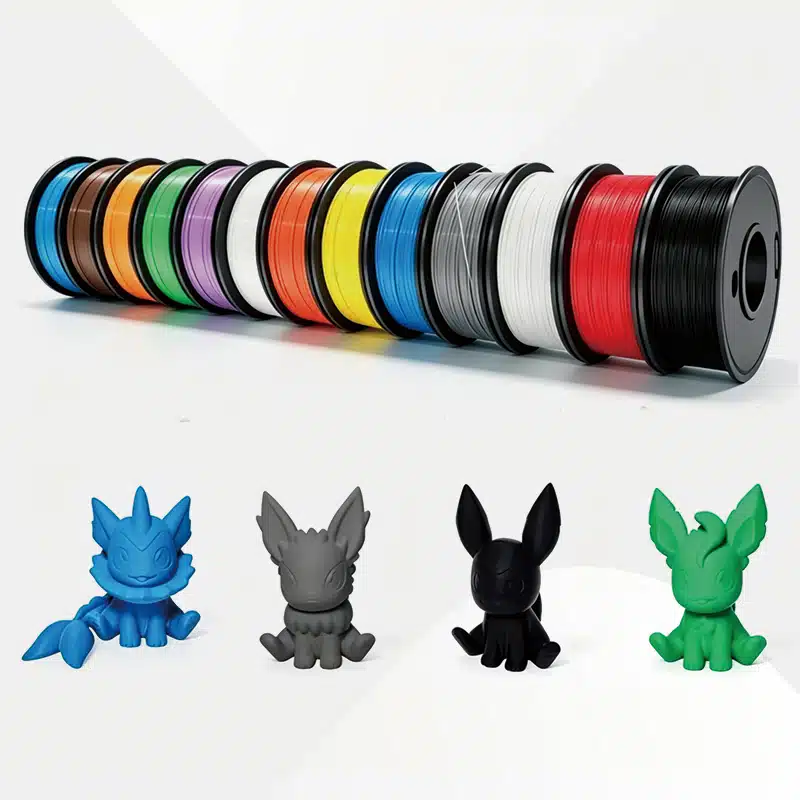




If you’ve just unboxed your first 3D printer, or you’re staring at a spool rack wondering why two almost identical-looking filaments behave completely differently — welcome to the most common dilemma in desktop 3D printing.
Both are workhorse filaments for FDM printers. PLA is the go-to for beginners; PETG is the rugged upgrade.
Which one should you actually buy? The answer isn’t “one is better.” It’s “which one fits what you’re making right now.”
In this guide, we’ll compare them across strength, printability, heat resistance, cost, and real-world scenarios — so you can decide with confidence.
At a Glance: PETG vs PLA Key Differences
|
Parameter
|
PLA
|
PETG
|
|---|---|---|
|
Tensile Strength
|
≥50 MPa
|
≥55 MPa
|
|
Heat Resistance
|
~60°C
|
~75°C
|
|
Impact Resistance
|
Moderate
|
High
|
|
Print Difficulty
|
Low
|
Medium
|
|
Odor During Printing
|
Mild (sweet)
|
Very mild
|
|
Best For
|
Decorative parts, prototypes, and beginners
|
Functional parts, outdoor use, enclosures
|
For the complete technical specification, including diameter tolerance, density, layer height limits, and spool options, please visit our [full PETG vs PLA parameter comparison page]
One-liner verdict:
PLA = pick it if this is your first roll or you’re printing display pieces.
PETG = pick it if the part needs to survive summer in a car, or take an accidental drop.
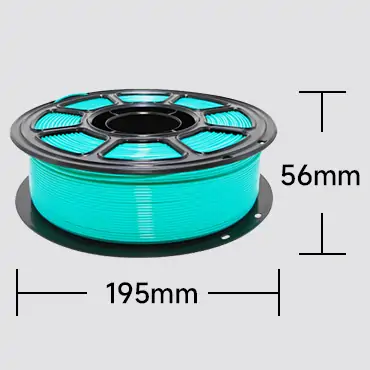
Material Basics: What Are They Actually Made Of
PLA (Polylactic Acid)
PLA is derived from renewable resources like corn starch or sugarcane. It’s biodegradable under industrial composting conditions — not in your backyard bin. This eco-friendly origin makes it popular among hobbyists who care about sustainability, but the “home compostable” claim is often overstated. Standard PLA requires specific temperature and humidity to break down; only specialty blends (like PLA+ with additives) may behave differently.
PETG (Polyethylene Terephthalate Glycol-modified)
PETG is a modified copolyester. Think of it as the 3D-printable cousin of the plastic used in water bottles (PET), with glycol added to reduce brittleness and improve layer adhesion.
The sustainability angle: PETG can be recycled through rPET streams where local facilities accept it. It’s not biodegradable, but it is mechanically recyclable — meaning it can be ground down and re-extruded into new filament or other products.
Key difference in end-of-life:
-
PLA = industrially compostable (documentation available on request)
-
PETG = recyclable (where rPET infrastructure exists)
This is the biggest practical difference between the two materials.
Tensile Strength: Closer Than You Think
At 50 MPa (PLA) vs 55 MPa (PETG), the raw tensile numbers don’t tell a dramatic story. In pure pull-apart testing, they’re in the same ballpark. Don’t switch to PETG expecting double the strength — you won’t get it.
Where PETG Actually Wins
1. Impact resistance. PETG absorbs energy before breaking. PLA snaps cleanly. Drop a PLA part from waist height onto a tile, and it might shatter. Drop a PETG part, and it’ll likely bounce or crack without separating. If your part will ever be handled, bumped, or dropped — PETG.
2. Heat resistance. PLA softens around 60°C. Leave a PLA print in a parked car on a sunny day, and you’ll come back to a droopy mess. PETG holds up to ~75°C, which covers most indoor and outdoor scenarios short of boiling water.
-
Functional brackets and mounts (e.g., wall‑mounted hooks, cable clips)
-
Outdoor planters or garden tools
-
Parts near a hotend enclosure (though not inside the chamber)
-
Cosplay armor that sees wear and tear
Printability: PLA Wins for Beginners, PETG Demands More
PLA is the easiest filament to print. No heated bed required (though 45–60°C helps), low odor, minimal warping, and forgiving of drafty rooms. It sticks well to glass, PEI, or blue tape. Stringing is rare if retraction is set correctly.
PETG is stickier — literally. It adheres aggressively to build surfaces (sometimes too well, risking damage to PEI sheets).
The Three Annoyances of PETG
If you’ve heard people complain about PETG, it’s probably one of these three things:
When to Choose Which: A Quick Decision Tree
-
This is your first spool (or your fifth — PLA is still fine)
-
The part is decorative, a prototype, or low-stress
-
You’re printing toys for kids (non-toxic, no fumes)
-
You want fast iteration with minimal tuning
-
Your printer doesn’t have an enclosure or an all-metal hotend
-
The part needs to survive outdoors, in a car, or near a heat source
-
The part will experience impact or repeated handling
-
You’re printing thin-walled functional components
-
You have time to tune the retraction and drying
-
Layer adhesion failure on PLA has bitten you before
Frequently Asked Questions
Q: Is PETG stronger than PLA?
Yes, marginally in tensile (55 vs 50 MPa), but significantly in impact and heat resistance. For most practical purposes, PETG is tougher.
Q: Does PETG smell like PLA?
No. PLA smells sweet (almost like waffles). PETG has a faint plastic/chemical odor — open a window or use an enclosure with ventilation.
Q: Which filament is easier to post‑process?
PLA sands and paints beautifully. PETG is harder to sand due to its rubbery nature — use primer and filler first.
Q: PETG vs PLA for outdoor use?
PETG wins. UV stability is decent (add UV stabilizer if needed), and it doesn’t degrade as quickly as PLA under sunlight.
Do I need an enclosure for PETG?
Not strictly. An enclosure helps with warping on large parts and keeps the temperature stable, but many users print PETG successfully on open-frame printers. Focus on bed adhesion and draft-free placement first.
Final Takeaway
-
Start with PLA if you’re new, printing decorations, or need fast prototyping.
-
Upgrade to PETG when you need durability, heat resistance, or outdoor longevity.
And remember: you don’t have to choose forever. Keep a spool of each in your dry box. Your slicer profile can swap between them in minutes.
For the full technical datasheet with diameter tolerance, density, layer height recommendations, and spool sizes, visit our [PETG vs PLA Full Spec Sheet].
Still deciding? Grab one of each. You’ll use both eventually.
Happy printing!