



In the fast-paced world of e-commerce, every detail counts—especially your shipping packaging. The humble poly mailer bag has evolved from a simple pouch to a critical tool for modern businesses. It’s not just about getting a product from point A to point B; it’s about doing so efficiently, sustainably, and memorably.
This year’s packaging trends are clear: sustainability is non-negotiable, cost-efficiency is paramount, and the unboxing experience is a powerful marketing tool. A poly mailer, when chosen correctly, addresses all three. It offers a lightweight, durable, and often more eco-conscious alternative to bulky boxes, directly reducing shipping costs—the single largest expense for many online sellers.
This guide is your one-stop solution. We cut through the confusion to help you find the best poly mailer bags for e-commerce in 2026. Whether you’re comparing biodegradable vs recyclable poly mailers or figuring out the perfect poly mailer thickness, we’ve got you covered. Let’s build a smarter, more effective shipping foundation.

Poly Mailer 101: The Basics & Key Advantages

The 7 Golden Rules for Choosing Poly Mailers in 2026
Navigating the world of poly mailers can be complex. Follow these seven essential rules to make an informed, cost-effective decision for your business.
Rule 1: Size is Money – How to Measure Precisely
Choosing the right size is the fastest way to cut waste and cost. A bag that’s too large increases your shipping costs due to dimensional weight; one that’s too small risks damage.
-
How to Measure:
-
Length: Measure your item at its longest point.
-
Width: Measure your item at its widest point.
-
Add Buffer: Add 1-2 inches to both length and width to allow for easy insertion and sealing.
-
-
Pro Tip: For soft items (clothing, fabric), you can often go one size down from the item’s flat measurements, as they can be folded or compressed.
-
Quick Reference Size Chart:Common Size (Inches)Best For (Examples)6 x 10Jewelry, small accessories, patches, cards10 x 13T-shirts, 1-2 books, small soft toys12 x 15.5Hoodies, multiple clothing items, medium kits14 x 20Large apparel (sweatpants), bulkier soft goods16 x 20+Blankets, pillows, and large multi-item orders
Rule 2: Thickness Equals Security – Demystifying the “Mil”
Thickness is measured in mils(1/1000 of an inch). It’s the key to puncture and tear resistance.
-
2-3 mil: Ultra-lightweight. Only for the lightest, flattest items like documents or single pieces of apparel. Risky for most uses.
-
4-5 mil: The standard workhorse for most e-commerce. Ideal for clothing, books, and non-fragile items under 4 lbs. Offers the best balance of cost and durability.
-
6-8 mil: Heavy-duty poly mailer territory. Choose this for heavier items (4+ lbs), products with harder edges, or for added peace of mind. Essential for items that might see rougher handling.
Rule 3: Seal Type Impacts Efficiency & Security
-
Self-Seal (Peel & Stick): The most common. A strip of adhesive is protected by a peel-off liner. Fast, clean, and requires no tape. Ensure the adhesive is high-quality to prevent popping open.
-
Tear-Tape / Pull-Tab Seal: Features a built-in tear strip for super easy, tool-free opening. Enhances customer experience but may be slightly more expensive.
-
Double-Seal (Easy Returns): Has a second adhesive strip on the outside, allowing the customer to reseal and return the item in the original mailer. A fantastic feature for brands with high return rates.
-
Tamper-Evident Seals: Provide visual proof if a package has been opened. Crucial for high-value or sensitive items.
Rule 4: Material & The Sustainability Choice
-
Recyclable (LDPE #4): Standard poly mailers are made from LDPE, which is technically recyclable. The challenge? They must be recycled through store drop-off programs(often at grocery stores), not in curbside bins. Clear communication with customers is key.
-
Biodegradable/Degradable: Often made with additives that cause the plastic to break down into microplastics faster under specific conditions. Lacks standardization and is not suitable for composting. View with caution.
-
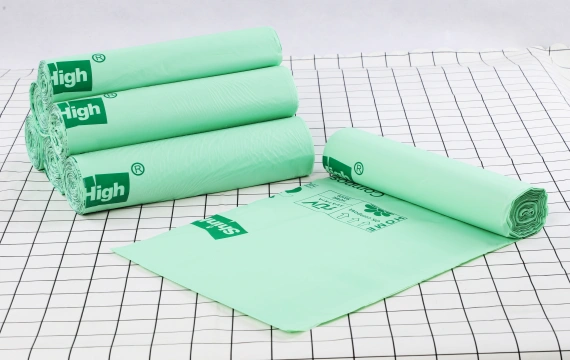
Compostable (The Gold Standard): Made from plant-based materials (like PLA). Will break down into non-toxic organic matter in an industrial composting facility. Look for official certifications like TÜV Austria OK compost INDUSTRIAL or BPI (USA). Remember: “Home Compostable” is a rarer, stricter certification.
- Post-Consumer Recycled (PCR) Content: Made from recycled plastics. This is a strong, practical eco-choice, as it uses existing waste and is fully recyclable again.
Rule 5: Upgrade from a standard mailer if your products demand it.
-
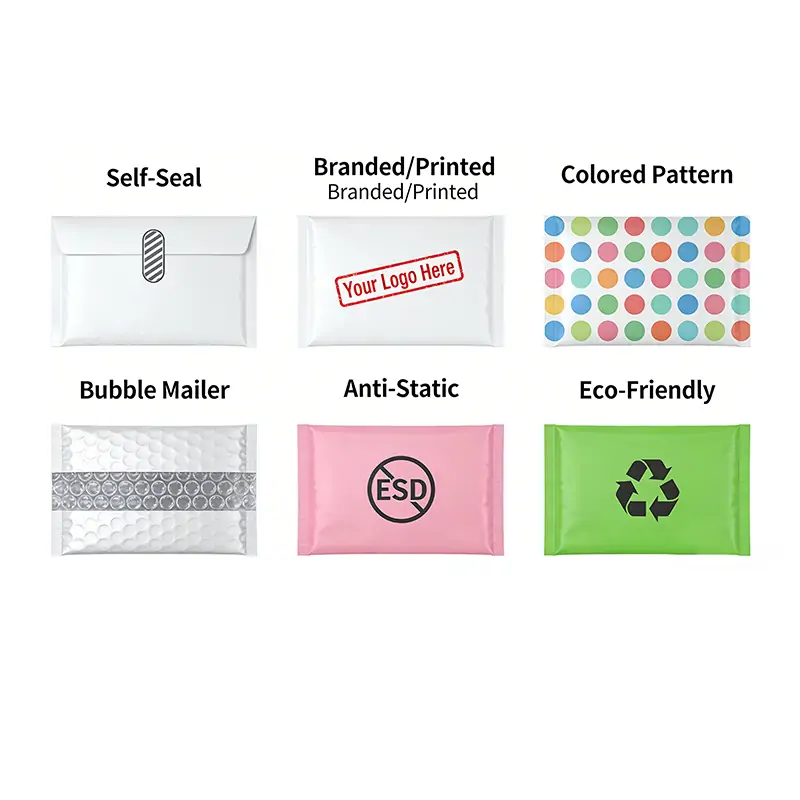
Bubble Cushioning: Integrated bubble lining turns a poly mailer into a lightweight protective mailer for semi-fragile items like cosmetics, small electronics, or framed art.
-
Anti-Static (ESD-Safe): Essential for shipping sensitive electronic components, circuit boards, or media that can be damaged by static discharge.
-
Opaque/Blackout Interior: Provides privacy, hiding the contents of the package. Ideal for subscription boxes, sensitive products, or to maintain a sleek, uniform look.
Rule 6: Branding & Customization
-
Cost Considerations: Custom printing involves setup (plate) fees and higher poly mailer bags wholesale prices due to minimum order quantities (MOQs), typically starting at 500-1000+ units. Ensure your design is simple, high-contrast, and effective in one or two colors to control costs.
Rule 7: Cost Calculation & Supplier Strategy
-
Cost Per Bag Calculation: (Total Cost of Order) / (Number of Bags). Include the quoted price, shipping fees to your warehouse, and any import duties.
-
Supplier Comparison:
-
Specialized E-commerce/Wholesale Suppliers (e.g., Jialan Packaging, EcoEnclose, ShinHigh Bio): Often offer better poly mailer bags wholesale prices for SMBs, lower MOQs for custom work, and more direct expertise in e-commerce needs like branding and sustainability. Focus your search here for the primary supply
 2026 Poly Mailer Types: A Complete Breakdown
With the rules in mind, here’s a guide to the main types of poly mailers and their best uses.
|
Type
|
Key Features
|
Best For
|
Pros
|
Cons
|
|---|---|---|---|---|
|
Standard Poly Mailer
|
Lightweight, water-resistant, cost-effective.
|
Apparel, books, textiles, and non-fragile goods.
|
Lowest cost, lightweight, reliable.
|
No padding, limited branding on plain versions.
|
|
Bubble Mailer
|
Poly mailer with integrated bubble lining.
|
Semi-fragile items: cosmetics, small tech, accessories.
|
Light padding without box weight, all-in-one.
|
More expensive than standard mailers.
|
|
Eco-Friendly Mailer
|
Made from recycled, biodegradable, or compostable materials.
|
Brands with a sustainability focus have eco-conscious customers.
|
Reduces environmental impact and marketing appeal.
|
Higher cost, compostable needs industrial facilities.
|
|
Heavy-Duty / Puncture-Resistant
|
Thicker gauge (6+ mil), reinforced seams.
|
Dense items, items with sharp edges, heavy products.
|
Superior protection reduces damage claims.
|
Higher material cost, less flexible.
|
|
Custom Printed Mailer
|
Full-color or logo printing on one or both sides.
|
Any brand focused on unboxing and brand recognition.
|
Turns shipping into marketing, with a professional look.
|
Set up fees, MOQs, and longer lead time.
|
2026 Product Quick Reference: Comparison Table
|
Type
|
Best For / Use Case
|
Recommended Thickness (mil)
|
Key Features
|
Value Score (1-5★)
|
|---|---|---|---|---|
|
Standard Poly Mailer
|
Every day shipping of clothing, books, soft goods, and accessories. The default choice for most non-fragile items.
|
5-6 mil
|
Lightweight, water-resistant, cost-effective. Available in many sizes and colors.
|
★★★★★
|
|
Bubble Mailer (Padded)
|
Small electronics, cosmetics, jewelry, framed photos – items needing light cushioning.
|
Outer: 3-4 mil
Bubble: 3/16″ |
Integrated bubble lining for protection. Eliminates the need for loose fill. Slightly heavier.
|
★★★★☆
|
|
Eco-Friendly Mailer
|
Brands with a sustainability focus. Must communicate proper disposal to customers.
|
5-6 mil
|
Made from recycled (PCR), biodegradable, or compostable materials. Look for certifications (e.g., TÜV OK compost).
|
★★★☆☆
|
|
Heavy-Duty / Puncture-Resistant
|
Hardware, tools, dense items, multi-packs with sharp edges, or high weight.
|
7-8+ mil
|
Extra-thick, often with a matte/textured finish for superior tear resistance.
|
★★★★☆
|
|
Custom Printed Mailer
|
All businesses where branding and unboxing experience are priorities.
|
5-6 mil
|
Transforms packaging into a marketing tool. Higher upfront cost due to setup and MOQs.
|
★★★★☆
|
Frequently Asked Questions (FAQ)
A: Yes, standard polyethylene (LDPE) poly mailers are highly water-resistant and provide excellent protection against rain, snow, and humidity during transit. They are not 100% submersible waterproof, but they are more than sufficient for standard shipping conditions.
A: The weight limit depends on the thickness (mil) and size. A standard 6 mil mailer can typically safely hold 5-10 lbs (2.3-4.5 kg) of evenly distributed weight. For heavier items, always opt for a heavy-duty poly mailer (7+ mil) and ensure the seal is secure. The seal is often the weakest point, not the bag material itself.
A: This is crucial. Most curbside recycling programs DO NOT accept poly mailers. Their lightweight, flexible nature tangles sorting machinery. However, they are often recyclable with plastic bags and films. Look for the #4 LDPE or “Store Drop-Off” symbol. Many major retailers (like Target, Walmart, and grocery stores) have collection bins at their entrances. Always remove paper labels and ensure the bag is clean and dry before dropping it off.
-
For clothing items (T-shirts, sweatshirts): Fold the item neatly. A 10″ x 13″ or 12″ x 15.5″ mailer is ideal for a single item. For bulkier items like hoodies or jeans, use 14″ x 19″ or larger.
-
For a standard shoebox: You will need a mailer significantly larger than the box. Measure the box’s length, width, and height. A 16″ x 20″ or 18″ x 24″ poly mailer is a common starting point for a single shoebox. Always check the mailer’s flat dimensions against your box’s girth(2x height + 2x width).
Conclusion & Your Action Plan
-
For Startups & New Brands: Start simple. Order a small sample pack of standard 6 mil poly mailers in a few common sizes (e.g., 10×13, 12×15.5). Test them with your actual products. Focus on fit and seal security first. Worry about customization later.
-
For Apparel & Fashion Brands: Size and branding are king. Perfect your folding to minimize mailer size. Invest in custom printed poly mailers early—your unboxing experience is a major brand touchpoint. Consider using recycled content (PCR) mailers to align with modern consumer values.
-
For Bookstores & Media Sellers: Prioritize puncture resistance. Books have sharp corners. Use 6-8 mil heavy-duty mailers to prevent tears. Standard sizes like 6×9 or 9×12 are often perfect for paperbacks and hardcovers.
-
For Eco-Conscious & Green Brands: Your packaging must reflect your values. Choose certified compostable mailers or PCR mailers. Be transparent: clearly label the mailer and educate your customers on how to properly dispose of it (e.g., “Compost in Industrial Facility Only” or “Recycle with Plastic Bags at Store”).
-
Size it right to save on shipping.
-
Choose the thickness that protects without overkill.
-
Select the type (standard, bubble, eco) based on your product and brand.
-
Always test with samples before committing to a bulk order.