



Ever stood in front of the supermarket aisle, staring at rolls of seemingly identical plastic bags, wondering if you really need to buy both? You grab a box of sandwich bags for lunches, but then hesitate—can you use sandwich bags for the freezer in a pinch? Later, you might find a mystery package in the back of your freezer, covered in icy crystals, the bag brittle and torn. Sound familiar?
You’re not alone. While they may look similar, sandwich bags and freezer bags are designed for completely different purposes. Using the wrong bag can lead to freezer burn, messy leaks, wasted food, and wasted money.
This isn’t just another quick tip list. This guide dives deep into the science and design principles behind these everyday essentials. We’ll explain the why behind the what, transforming you from a confused shopper into an informed user. You’ll learn not just the difference between sandwich and freezer bags, but how to leverage their unique strengths for optimal food storage, safety, and value.
By the end, you’ll be able to answer: What’s the real cost of using a sandwich bag for freezing meat? And is it ever okay to use a freezer bag for a simple snack? Let’s settle the debate once and for all.
Part 1: Side-by-Side Comparison – See the Difference at a Glance
Forget the guesswork. In under 60 seconds, this chart illustrates why using the wrong bag is ineffective.
|
|
|
|
|
|---|---|---|---|
|
|
|
|
|
|
|
|
|
|
|
|
|
|
|
|
|
|
|
|
The difference isn’t just marketing—it’s fundamental product engineering. Freezer bags are built with thicker, tougher materials and superior seals to protect your food from the harsh environment of your freezer. Sandwich bags are designed for lightweight, short-term convenience.
Part 2: The Invisible Battlefield: Why Thickness & Material Really Matter
Now that you’ve seen the side-by-side comparison, let’s dig into the science behind the specs. This is where understanding a few key terms will transform you from a casual user into a savvy one.
1. Decoding “Mils”: The Unit of Strength You Never Noticed
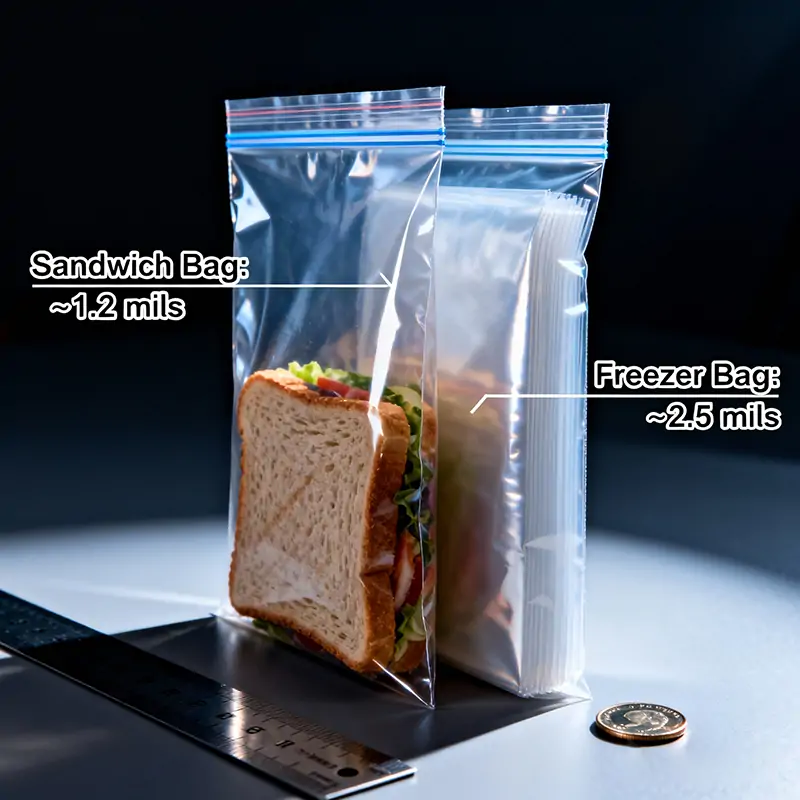
When we talk about bag thickness, we use the term “mil” (not millimeter). One mil is one-thousandth of an inch (0.001″). To visualize it, a standard piece of printer paper is about 3 mils thick.
Why does this tiny unit matter so much for freezer storage?
Imagine your frozen peas or the corner of a frozen steak. They aren’t just cold; they’re covered in hard, microscopic ice crystals that are sharp like tiny knives. A sandwich bag at 1.0 mil is a thin shield. Over weeks in the freezer, those ice crystals, combined with the physical stress of stacking and handling, can fatigue and puncture this thin barrier, leading to freezer burn and dehydration.
A freezer bag at 2.0 mils or more is twice the armor. It provides a critical buffer against puncture and dramatically slows down the transfer of moisture and air—the two enemies of frozen food quality. When you see “extra thick” or “heavy-duty” on a box, this mil measurement is what they’re talking about.
For true long-term freezing, don’t just guess—look for the thickness. This is the single most important physical difference between a bag that can go in the freezer and a bag that’s built for it.
2. The Chemistry of Cold: Not All Plastic is Equal at -18°C
Here’s the insider knowledge: while both bags are primarily made from polyethylene, the type and blend are crucial for performance. Let’s break it down:
-
Sandwich Bags (Standard LDPE): Low-Density Polyethylene is flexible and great for everyday use. However, like many materials, it has a glass transition temperature—the point where it starts to lose flexibility and become brittle. Standard LDPE gets noticeably stiffer and more prone to cracking well before it reaches your freezer’s deep chill.
-
Freezer Bags (The Enhanced Blend): To combat this, quality freezer bags often use a blend of LDPE and LLDPE (Linear Low-Density Polyethylene). Think of LLDPE as the flexible, stress-resistant cousin. Its molecular structure gives it superior toughness, tear resistance, and impact strength at low temperatures.
In practical terms, A bag made with an LLDPE blend can be bent, flexed, or lightly dropped when frozen without developing the micro-cracks that lead to failure. This cold-weather toughness is a deliberate material choice, not an accident.
3. Connecting the Dots: Your Real-World Benefit
So, what does this thickness and material science mean for your kitchen?
-
No More Mystery Leaks: A thicker, tougher bag prevents punctures from bone-in meats, frozen berries, or awkwardly shaped items.
-
Fight Freezer Burn: The combo of thicker walls and a material that better resists micro-cracks creates a more stable barrier. This slows down the escape of moisture from your food, which is what causes that dry, leathery freezer burn.
-
Better Value Through Reuse: Because they are engineered to be more durable, high-quality freezer bags can often be washed and reused several times for non-food items or the same type of food, making them a more economical and eco-friendly choice in the long run.
Choosing a freezer bag isn’t just about surviving the cold; it’s about choosing a product designed to remain flexible, strong, and protective in an extreme environment. The few extra cents you pay translate directly into protected flavor, texture, and value in your food.
Part 3:How Closure Design Makes or Breaks Freshness
If thickness and material are the bag’s “body,” the seal is its “immune system.” A weak seal is the single biggest point of failure, letting in air and letting out moisture. Here’s how the two designs differ fundamentally.
1. The Sandwich Bag Seal: The Basic Barrier
Most sandwich bags use a simple single-track press-and-seal closure. You press the two tracks together, and they interlock. It’s designed for:
-
Keeping dust and dry debris out. -
Containing dry or slightly moist foods for a short period. -
Convenience and easy re-opening.
Its Limitation: This seal is a moisture barrier, not a moisture-proof one. Like those from our brand, under pressure, or with liquid contents, it can wick moisture or fail at the corners. In the freezer, the constant contraction and expansion of air can gradually work this seal open
2. The Freezer Bag Seal: The Engineered Lock
Freezer bags almost universally feature a double-track zipper seal. Running your finger along it, you can feel two distinct “tracks” that click together.
-
-
Preventing liquid leaks (crucial for soups, marinades, or thawing meat). -
Locking moisture IN to avoid dehydration and to prevent freezer burn. -
Locking air OUT to avoid oxidation and to prevent flavor loss. -
The Audible Click: Many premium freezer bags feature a seal that makes a satisfying “click” when properly closed. This isn’t a gimmick—it’s user feedback, a tangible confirmation that the hermetic channel is fully engaged.
-
3. The “Burp” Test and Freezer Burn: A User’s Guide to Perfect Sealing
Knowing the technology is half the battle; using it correctly is the other. The most common user error is trapping too much air inside the bag before sealing.
-
Submerge & Seal (for liquids): For soups or sauces, carefully lower the filled bag into a bowl of water, letting the water pressure push air out until the liquid reaches the seal line. Then zip it shut. -
The Straw Method (for solids): Place your food in the bag, seal almost all the way, insert a straw into the last corner, suck out the air, quickly remove the straw, and complete the seal.
The “Freezer Burn” Connection: Freezer burn is not caused by temperature, but by air contact. When moisture sublimates (turns directly from ice to vapor) out of the food, it leaves behind dry, tough patches. A weak or imperfect seal accelerates this process exponentially. The freezer bag’s double-lock seal is your best defense, dramatically slowing down moisture loss to keep food palatable for months.

Part 4: Beyond the Freezer: Safety, Smarts & Sustainability
Understanding the physical differences is crucial, but using your bags correctly and responsibly is what completes the picture. Let’s talk about the often-overlooked aspects: safety limits, environmental impact, and getting the most value from your purchase.
1. The Safety Line: What These Bags Are NOT Designed For
-
The Microwave Myth: Never microwave food in any standard plastic storage bag unless it is explicitly labeled as “microwave-safe.” Most bags, including freezer bags, can warp, melt, or leach chemicals when exposed to high heat. The “steam vent” created is uncontrolled and dangerous. -
The Boil-Water Bath Danger: Submerging these bags in boiling water for “sous-vide” style cooking is a major risk. They are not manufactured to withstand prolonged temperatures at 100°C (212°F) without potential failure and chemical migration. Always use bags specifically engineered and rated for sous vide cooking. -
The Oven/Open Flame Rule: This should be obvious, but it bears repeating: plastic bags of any kind are flammable and must never be used in or near an oven, toaster oven, or open flame.
Treat plastic storage bags as a temporary, temperature-controlled container. Their safe zone is from the deep freeze (~-40°C/-40°F) up to about refrigerator/room temperatures. Exceeding the high end of this range voids their safety design.
2. The Green Perspective: Reuse, Reduce, Recycle
As a manufacturer, we take the lifecycle of our products seriously. Here’s the responsible way to think about it:
-
Reuse is King (For Freezer Bags): A high-quality freezer bag, due to its durable construction, is an excellent candidate for reuse. After storing raw meat, wash it thoroughly with hot, soapy water, inside and out. Rinse and air-dry completely before reusing it for the same type of food (e.g., meat for meat) or for non-food items (organizing hardware, travel toiletries). This extends its life and reduces waste. -
Recycle Right: Most zipper bags (sandwich and freezer) are made from #4 LDPE or #2 HDPE plastic. Check with your local municipal recycling program. The critical step? They must be clean, dry, and empty. Even a small residue of food or grease can contaminate an entire recycling batch. A quick rinse makes all the difference. -
The Ultimate Goal: The most eco-friendly bag is the one you don’t use. Use reusable containers for home storage whenever possible, and reach for a disposable bag only when its specific properties—like a perfect seal for marinating or a space-saving flat shape for the freezer—are truly needed.
Part 5: Your Decision Matrix: The Final Guide to Choosing Right
Forget memorizing rules. Use this simple, at-a-glance guide to match the bag to the task every single time. Think of it as your kitchen cheat sheet.
✅ The Green Light List: Recommended Uses
|
|
|
|---|---|
|
|
|
|
|
|
|
|
|
|
|
|
|
|
|
|
|
🚫 The Red Light List: What to Avoid
|
|
|
|---|---|
|
|
|
|
|
|
|
|
|
|
|
|
|
|
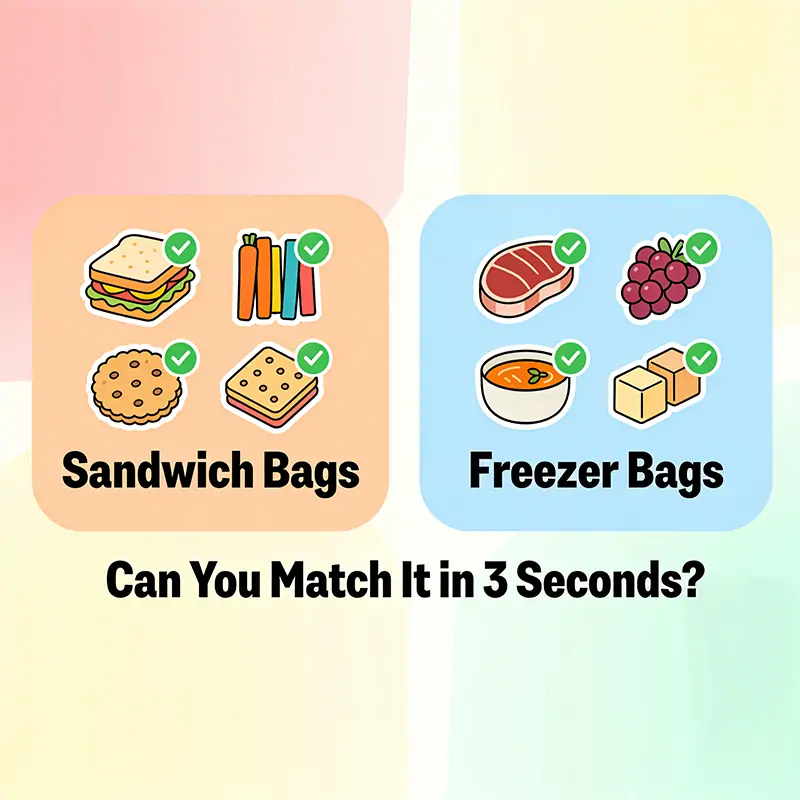
Final, Pro-Tier Advice
-
The 24-Hour “Freezer Test”: In a true pinch, a sandwich bag can handle freezing for less than 24 hours for non-liquid items (like a loaf of bread). Anything longer or for wet items, upgrade to a freezer bag.
-
Label Everything: Always use a permanent marker to label your freezer bags with the contents and date. Your future self will thank you.
-
Your Mantra: Match the bag to the job’s duration, moisture, and physical demands. When in doubt, especially for the freezer, choose the heavier-duty option. The extra penny spent is insurance for your food and your effort.
Conclusion
Choosing between a sandwich bag and a freezer bag isn’t a trivial kitchen detail—it’s a practical application of material science. By understanding the deliberate engineering in thickness, material blends, and seal technology, you’re no longer just buying plastic; you’re selecting a tailored preservation tool.
Invest in quality freezer bags for your long-term storage. Use economical sandwich bags for their intended, short-term purposes. Use both wisely, reuse when possible, and recycle correctly. Now, you’re not just packing food—you’re preserving flavor, saving money, and storing with confidence.