



You’re in the supermarket aisle, facing a wall of trash bag boxes. Your eyes land on two: one boldly promises “Extra Thick, 45 Microns,” the other is a simpler “40 Microns.” Does your hand instinctively reach for the thicker one? If you answered yes, you’re not alone. But this common instinct—what we might call “The Thickness Trap”—could be wasting you up to 30% more each year on a product that might still let you down.
Here’s the counterintuitive truth the packaging won’t tell you: in the world of trash bags, “thicker” does not automatically mean “stronger.” In fact, blindly chasing a higher micron number is a common consumer pitfall and a leading cause of rips, leaks, and messy cleanups.
This article will dismantle this myth and introduce you to a more reliable formula for real-world strength: Durability = Material Formula × Manufacturing Process × Structural Design. Master this formula, and you’ll be able to see past the marketing hype. We’ll equip you to easily identify the truly tough bags, saving you money and the hassle of a broken suitcase for good.
The 3 Unspoken Limitations of “Microns”
Have you ever wondered why a bag with a higher micron rating can still tear so easily? The answer lies in the fact that this single number hides three crucial truths that determine real-world strength.
Limitation 1: It Measures “Peak Thickness,” Not “Average Strength” – Inconsistent Thickness is the Hidden Killer
We assume a “50-micron” rating means the entire bag is uniformly that thick. This is as misleading as using the height of a mountain’s peak to represent the average height of the entire range. During the film-blowing production process, natural variations in thickness occur. An industry-accepted tolerance of ±10% is entirely normal.
This means a bag labeled 50 microns can realistically have thin spots as low as 45 microns and thick spots up to 55 microns. Failure occurs when sharp trash (like bone fragments or can tabs) punctures one of those 45-micron weak spots. A trash bag’s strength is determined not by its thickest points, but by its weakest link.

Limitation 2: It Ignores the Material’s “DNA” – Genetics Dictate Performance
We assume thickness is the primary material factor determining strength. The material’s “genetics” (polymer type and purity) are far more important than its thickness. A 40-micron bag made from high-quality material can easily outperform a 50-micron bag made from inferior material.
The performance of common trash bag materials can be compared as follows:
|
|
|
|
|
|
|---|---|---|---|---|
|
(Linear Low-Density Polyethylene) |
tear and puncture resistant |
|
Great endurance, less prone to injury |
|
|
(High-Density Polyethylene) |
|
brittle, prone to cracking |
Strong but stiff |
|
|
(Low-Density Polyethylene) |
|
easily deforms |
Soft, but cannot handle heavy loads |
|
|
(Unknown origin) |
|
Impurities often have an odor |
May look intact but fragile inside |
|
From a materials science perspective, LLDPE’s molecular chains are linear with short branches, giving it 2 to 3 times the tear and puncture resistance of traditional LDPE.
Using recycled material significantly degrades performance. Each recycling process breaks down and degrades the polymer chains, potentially reducing key toughness indicators by over 50%.
This is why many thick bags still feel brittle and prone to cracking easily.
Limitation 3: It Fails to Capture “Structural Engineering” – Design is a Force Multiplier
We focus solely on the thickness of the material, ignoring how it is used. The structural design of a trash bag, particularly the engineering of the handles and the bottom, determines whether force is effectively distributed.
-
Handle Design: A Study in Physics -
The Problem (Punched-Hole Handles): Force is concentrated on the tiny, sharp edges of the holes, creating extreme pressure points that act like a blade, leading to tears. -
The Solution (Reinforced Loop Handles): Force is distributed across the broad, continuous loop, significantly reducing stress.
-
-
The Physics Principle: -
According to the pressure formula, P = F / A (Pressure = Force / Area). -
When you lift the same weight of trash (F remains constant), the reinforced loop handle drastically increases the load-bearing area (A). -
This simple change significantly reduces the pressure (P) on the handle material by a factor of several times!
-
-
Bottom Seam Engineering is Equally Critical: -
Flat Bottom Seam: All the weight bears down on a single, straight weld line—a classic failure point. -
Star-Sealed (or Diamond) Bottom: Reinforcing ribs distribute the force across a wide surface area, creating a stable, load-bearing structure.
-
Golden Rules for Choosing Bags: Look Beyond Microns
Now that we’ve debunked the “micron myth,” you have more powerful tools at your disposal. Whether your priority is maximum durability or eco-friendly compostability, the following three golden rules will guide you to a smarter choice.
Rule #1: Decode the “Material Formula” – Understand the Material’s Genetics and Purpose
-
Top Formulation: LLDPE or an LLDPE+HDPE Blend -
Why: This is the industry standard for durable bags. LLDPE provides superior toughness and puncture resistance, while HDPE adds stiffness and load-bearing support. Together, they create optimal performance.
-
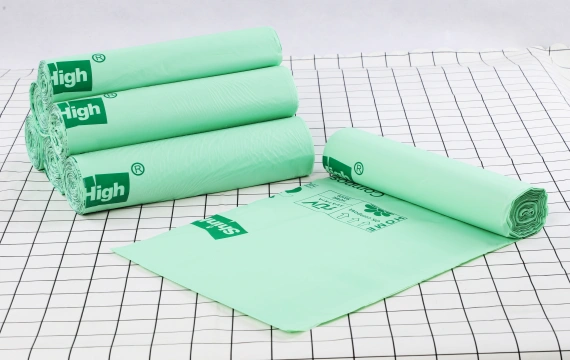
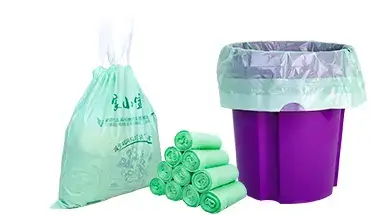
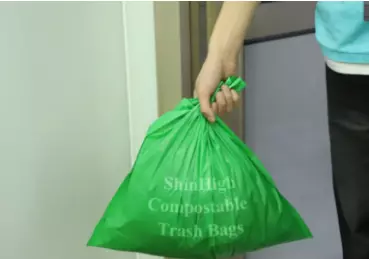
What are they? Typically made from biopolymers like plant starch (e.g., PLA), designed to break down into water, CO₂, and organic matter under specific industrial composting conditions. -
Key Considerations: -
Performance Trade-off: Most compostable bags generally offer lower ultimate strength and toughness compared to premium LLDPE bags. This is a conscious trade-off for the environmental benefit. -
Look for Certification: Always seek out authoritative certification labels like OK compost INDUSTRIAL (EU standard) orASTM D6400 (U.S. standard). Vague claims like “degradable” or “eco-friendly” do not equal “compostable.” -
Ideal Use Case: Perfect for collecting food scraps and other organic waste, allowing you to transfer them directly to a composting system without plastic contamination.
-
Rule #2: Scrutinize the “Structural Design” – Good Design is a Performance Lever
-
Green Flags ✅ – Designs Worth Investing In: -
Reinforced Loop Handles: Distributes the lifting force, preventing tears at the stress points. -
Star-Sealed (or Diamond) Bottom: This design can increase load-bearing capacity by 30% or more, making it the ultimate defense against heavy, sharp trash.
-
-
Special Note for Compostable Bags: -
Because the material itself is inherently less strong, a well-engineered design (like reinforced handles and a star-sealed bottom) is not just a bonus—it’s essential for a positive user experience. Pay even closer attention to these design details when choosing compostable options.
-
Rule #3: Focus on “Performance Promises” – Let the Data Do the Talking
-
For Traditional Plastic Bags, look for: -
Load Capacity Data: e.g., “Static load capacity ≥ 10 kg”. -
Leak/Puncture Resistance Claims: This indicates a deeper level of performance consideration.
-
-
For Compostable Bags, in addition to load capacity, it’s crucial to focus on: -
Certification Labels: Such as the OK compoststandard mentioned earlier. This is the only verifiable proof of its environmental promise. -
Usage Scenarios: Descriptions like “For food waste” or “Industrial composting” ensure you use it correctly. 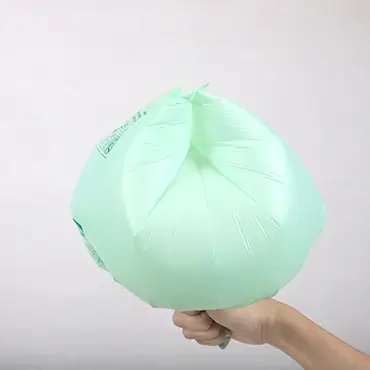
-
|
|
|
|
|---|---|---|
|
|
|
|
|
|
|
|
|
|
|
|
Your Choice, Your Priority. For ultimate durability and cost-effectiveness, high-quality LLDPE bags are a reliable choice. If your primary goal is reducing plastic waste, then choose certified compostable bags and be mindful of their potential performance trade-offs.
FAQ: Your Eco-Conscious Trash Bag Questions Answered
Q: Are compostable or biodegradable trash bags as strong as plastic?
A: Generally, no. Their molecular structure is designed to break down, which can compromise ultimate strength. Use them for appropriate loads (light organic waste).
A: Bags made from virgin LLDPE remain the strongest for puncture and tear resistance. For a more sustainable option, look for high-quality recycled LLDPE.
A: Be skeptical of bags that are just colored green or use vague terms like “eco-friendly” without specifics. Look for transparent material lists and third-party certifications.
A: Not necessarily. Thickness can mask the inferior strength of low-quality recycled content. A thinner bag made from high-quality, high-purity LLDPE will often outperform it.
Your Action Plan — From Insight to Purchase
Next time you’re shopping, just run through this quick checklist:
-
Material Clarity: Does the packaging specify the material (e.g., LLDPE, compostable blend)? Avoid vague terms.✅
-
Strength Indicators: Look for “puncture-resistant,” “leak-proof,” or “extra strong” claims backed by specifications like gallon capacity and pack count (e.g., 13-gallon bags, 50 count). A higher bag count per pack often indicates thinner but well-engineered bags.✅
-
Design Features: Drawstring ties, reinforced “diamond” or “star” seals on the bottom, and thick, flexible handles are all pluses.✅
-
Eco-Credentials (if needed): If you want a biodegradable kitchen trash bag, look for specific, verifiable certifications. Remember the strength trade-off.✅
If it passes these four tests, buy with confidence — even if the micron number isn’t the highest on the shelf!