



Introduction: The Unseen Difference in Every Bag
Look around you—from the grocery sack holding your food to the clear wrapper on a new shirt, plastic bags are everywhere. But have you ever wondered why some bags are soft and whisper-quiet, while others are stiff and rustle loudly? Or why some food bags can go into the microwave, while others melt?
The answer often lies in two common but distinct materials: Polyethylene (PE) and Polypropylene (PP). Although they sound similar, the differences between polyethylene and polypropylene bags are profound, affecting everything from durability and clarity to their environmental footprint.
This guide will move beyond technical jargon to provide a clear, side-by-side comparison of polyethylene and polypropylene bags. You’ll learn how to identify them, understand their strengths and weaknesses, and discover which material is the right fit for applications ranging from heavy-duty shipping sacks to transparent retail packaging.
More Than Just Plastic: The “DNA” of PE and PP
While both polyethylene (PE) and polypropylene (PP) are derived from petroleum or natural gas, a subtle difference in their molecular “blueprint” dictates their vastly different behaviors in the real world.
Polyethylene (PE): The Simple and Flexible Chain
Think of Polyethylene as the straightforward, versatile workhorse of the plastic world. Its molecule is essentially a long, simple chain of carbon atoms densely packed with hydrogen. This simple, linear, and symmetrical structure allows the chains to slide past each other easily.
This simplicity translates into exceptional flexibility, high impact resistance, and excellent chemical stability. It’s what makes PE bags feel soft and pliable.
-
Common Types: PE comes in two primary forms that you encounter daily: -
LDPE (Low-Density Polyethylene): Produced under high pressure, it has a higher branching molecular structure. This makes it softer, more transparent (but hazy), and highly ductile. Think of cling film and soft, squeezable bottles. -
HDPE (High-Density Polyethylene): Produced under low pressure, its chains are more linear and tightly packed. This makes it denser, stronger, more rigid, and more opaque than LDPE. Think of sturdy grocery bags (plastic carry bags), detergent bottles, and milk jugs.
-
Polypropylene (PP): The Strong and Stiff Sibling
Polypropylene is like PE’s more complex and rigid cousin. Its molecular chain has a crucial twist: a methyl group (CH3) attached to every other carbon atom in the backbone. This small “side branch” acts like a knob, preventing the chains from packing as tightly or moving as freely as PE chains.
This structural quirk gives PP a significant advantage in rigidity, tensile strength, and heat resistance. It has a higher melting point and feels noticeably crisper and more rigid than PE. This is the fundamental reason why PP is used for microwave containers and why garment bags are usually made of PP.
-
Common Types: PP is also modified for different uses: -
Homopolymer PP: The standard, most rigid form. -
Copolymer PP: Engineered with other monomers (like ethylene) to improve impact resistance, especially at low temperatures, making it tougher and less brittle
-
The Performance Showdown – 6 Key Comparisons
How do polyethylene and polypropylene stack up in real-world use? This table breaks down the key differences between PE and PP plastic at a glance.
|
|
|
|
|---|---|---|
|
|
|
|
|
|
|
|
|
|
|
|
|
|
|
|
|
|
|
|
|
|
|
|
Touch and Sound: The Everyday Test
-
PE Bags: Feel soft, waxy, and flexible. They can be easily crumpled into a near-silent ball. This makes them ideal for products that require a conforming fit. -
PP Bags: Feel crisp, rigid, and have a higher “crinkle” factor. They resist crumpling and produce a distinctive rustling or crackling sound when handled. This stiffness gives products a more structured, premium presentation.
Clarity and Presentation: See-Through Quality
-
PE naturally has a translucent, milky, or hazy appearance. It diffuses light, which can be desirable for concealing contents or creating a softer look. -
PP can be manufactured to be optically clear, rivaling glass-like transparency. This makes it the undisputed choice for retail packaging bags where product visibility is key, such as for apparel, gifts, or electronics.
Strength Under Pressure: Tensile Strength and Durability
-
PE (especially HDPE) excels in toughness and impact resistance. It can stretch and absorb stress without tearing, making it perfect for holding heavy or irregular items (e.g., carry bags for heavy groceries). -
PP excels in tensile strength and rigidity. It resists stretching and deformation under a constant load, maintaining its shape better. This “dead-fold” property is why it’s used for flat-bottomed shopping bags and durable woven sacks.
Temperature Tolerance: From Freezer to Microwave
-
PE has good cold resistance and remains flexible at very low temperatures, making LDPE perfect for freezer bags. -
PP wins hands-down in heat resistance. With a melting point significantly higher than PE, it is the material of choice for microwave-safe containers, hot-fill applications, and reusable food containers. A simple rule: if you need a bag or container for hot liquids or microwave use, PP is the only safe bet between the two.
From Theory to Practice: Where to Use PE and PP Bags
Now that we understand their properties, the ideal applications for each material become clear. Here’s a guide to matching the right polymer to the job—ensuring performance, cost-efficiency, and customer satisfaction.
Polyethylene (PE): The Champion of Flexibility and Protection
-
T-Shirt/Flat Bags & Grocery Sacks: The quintessential plastic carry bag. HDPE provides the perfect balance of strength, low cost, and decent handle comfort.
-
Zipper Bags & Food Storage: LDPE’s exceptional clarity (for film), sealability, and flexibility make it ideal for freezer bags, sandwich bags, and flexible food packaging.
-
Bubble Mailers & Protective Liners: LDPE is used to create the bubble cushioning and the inner lining of mailers, offering lightweight protection for shipping.
-
Stretch Wrap/Pallet Wrap: Made from linear low-density polyethylene (LLDPE), its exceptional stretch and cling properties secure pallets without adhesives.
-
Heavy-Duty Sacks & Drum Liners: Thick-gauge HDPE provides the puncture resistance and strength needed for industrial materials, fertilizers, and chemical liners.
Polypropylene (PP): The King of Clarity, Rigidity, and Heat
-
Clear Retail Bags & Garment Covers: This is PP’s classic application. Its crystal clarity and stiff, “crisp” hand feel create a premium unboxing experience for clothing, gifts, and luxury items. So, to answer the common question: “What material are garment bags?” – they are predominantly polypropylene.
-
Rewoven/Woven Bags (Big Bags/IBC Liners): PP fibers are woven into incredibly strong, reusable bags for bulk materials like rice, grains, and construction sand.
-
Food Containers & Microwave-Safe Packaging: PP is the standard for microwave-safe plastic containers, yogurt cups, and deli packaging because it won’t warp at high temperatures.
-
Promotional Reusable Totes: Non-woven PP is the most common material for those reusable grocery totes given away at events or sold in stores. It’s durable, printable, and cost-effective for short-term reuse.
-
Snack and Bakery Packaging: PP’s excellent moisture barrier and clarity keep products like chips and cookies fresh and visible.
-
Hi-Friction Bags (Non-Slip Bags): A special application where the surface of PP bags is modified to create a high-friction, non-slip texture, perfect for stacking bags of mulch or soil without them sliding off a pallet.
Practical Decision Flowchart:
To simplify your choice, ask these questions:
-
Is the product heavy or irregularly shaped? → PE (HDPE) for its toughness. -
Does it need to be crystal clear and look premium on a shelf? → PP. -
Will it be used in the freezer? → PE (LDPE). -
Will it be used in the microwave or with hot contents? → PP. -
Is it a standard, low-cost shopping or shipping bag? → PE. -
Is it a rigid flat-bottom bag or a woven sack? → PP.
Beyond Performance: Cost, Sustainability & The Future
Choosing between PE and PP isn’t just about technical specs. For businesses and eco-conscious consumers, the decision hinges on three additional, critical factors: cost, environmental impact, and future viability.
The Cost Equation: Upfront Price vs. Value
The price difference between PE and PP bags is often the first practical consideration.
-
Raw Material & Production: Historically, PP resin has been slightly more expensive per ton than PE. Its processing (especially for high-clarity grades) can also be more energy-intensive. This often makes PP bags marginally more expensive to produce than their PE counterparts. -
The “Value-Added” Factor: However, focusing solely on per-unit cost is shortsighted. The superior clarity, rigidity, and premium feel of PP can enhance a product’s perceived value, potentially justifying a higher price point or boosting sales. A flimsy bag might save a cent but cost a customer’s perception of quality. -
Performance Efficiency: In some cases, PP’s higher strength-to-weight ratio means you can use less material to achieve the same performance as a thicker PE bag, potentially offsetting material cost differences.
The Sustainability Imperative: Recycling and End-of-Life
-
The Recycling Codes & Reality: -
PE is marked with #2 (HDPE) or #4 (LDPE). -
PP is marked with #5. -
While both symbols mean “theoretically recyclable,” the recycling infrastructure is not equal. Collection and processing streams for #1 (PET) and #2 (HDPE, like milk jugs and detergent bottles) are far more established and widespread than for #4 and especially #5.
-
-
The Contamination Challenge: The biggest enemy of plastic recycling is contamination. Thin, filmy bags of any type (like grocery sacks) easily jam recycling machinery. This is why most curbside programs ask you to take plastic bags back to store drop-off bins—if they accept them at all. PP film is less commonly accepted in these take-back programs than PE film. -
Key Takeaway: “Recyclable” does not automatically mean “being recycled.” The likelihood of a bag being successfully recycled depends more on local facilities, consumer action (cleaning, sorting, returning), and a stable end-market for the recycled material than on the material itself. From an infrastructure standpoint, HDPE (#2) currently has the most robust recycling pathway.
The Road Ahead: Innovation and Alternatives
-
Design for Recycling: A major trend is simplifying packaging structures. Moving from multi-layer, multi-material films to mono-material designs (e.g., all-PE or all-PP) makes recycling much more feasible. This is a crucial shift. -
Bio-based & Mass Balance Approaches: Companies are producing bio-based PE and PP from renewable feedstocks like sugarcane waste. This doesn’t make the plastic biodegradable, but it reduces fossil resource dependence. The “mass balance” approach is also gaining traction, attributing renewable content to polymers in complex supply chains. -
Chemical Recycling (Advanced Recycling): This emerging technology breaks plastics down to their molecular building blocks to create virgin-quality plastic. It could be a game-changer for recycling flexible films and mixed plastics that mechanical recycling cannot handle. -
A Critical Note on “Degradables”: Be wary of bags marketed as “oxo-degradable” or “biodegradable” PE/PP. These are conventional plastics with additives designed to fragment into microplastics under certain conditions, not truly biodegrade. For genuine compostability, look for certified standards (like TÜV OK compost HOME) and materials like PBAT or PLA, which are chemically different from PE/PP.
The Practical Guide: Choosing and Identifying PE vs. PP.
Armed with knowledge about properties, uses, and impact, how do you put it all into practice? Whether you’re sourcing 10,000 bags for your business or picking one off the shelf, follow this simple, three-step framework.
Step 1: Define the Need – Let Function Lead
-
Priority: Flexibility & Protection? If you need a bag that can stretch, conform to odd shapes, and absorb impacts (e.g., packing heavy tools, protecting items in transit), lean towards Polyethylene (PE), especially HDPE for strength or LDPE for softness. -
Priority: Clarity & Presentation? If showcasing the product inside is crucial for marketing (e.g., retail apparel, gift baskets, artisanal goods), Polypropylene (PP) is your clear winner. -
Priority: Heat Resistance? Will the bag or its contents be hot, or need microwave heating? Always choose PP. For freezer use, PE is the safer bet. -
Priority: Rigidity & Structure? Does the bag need to stand upright on its own or maintain a specific shape? The stiffness of PP is essential.
Step 2: The Quick Identification Test – “Look, Feel, Listen”
-
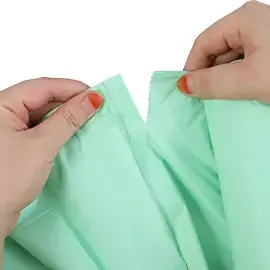
The Feel (Flex) Test: Try to flex or crumple the bag. -
PE: Feels waxy, soft, and pliable. It will fold and crumple easily with little resistance. -
PP: Feels stiff, crisp, and “springy”. It resists folding and wants to return to its original shape.
-
-
The Sound (Crinkle) Test: Crumple a corner of the bag near your ear. -
PE: Makes a soft, muffled, almost silent rustle. -
PP: Produces a loud, sharp, crackling, or crinkling sound.
-
-
The Look (Clarity & Seam) Test: Examine the bag’s appearance and construction. -
PE: Often has a duller, more matte finish and a translucent, milky quality. Seals/edges may be thicker. -
PP: Often has a high-gloss, shiny surface and can be crystal clear. It’s common for clear garment bags with a “living hinge” (a thin, flexible joint) to be PP.
-
Step 3: Check the Official ID – The Resin Code
-
#2 or #4 → Polyethylene (HDPE or LDPE) -
#5 → Polypropylene (PP)
Conclusion: The Final Verdict
-
Think of Polyethylene (PE) as the versatile, tough, and economical all-rounder. It is the champion of flexibility, moisture protection, and cost-effectiveness. When you need a bag to carry, conceal, or cushion reliably, PE is often the answer. -
Think of Polypropylene (PP) as the specialized, high-performance, and premium-feeling contender. It is the champion of clarity, rigidity, and heat resistance. When you need a bag to showcase, structure, or withstand heat, PP is the superior choice.