



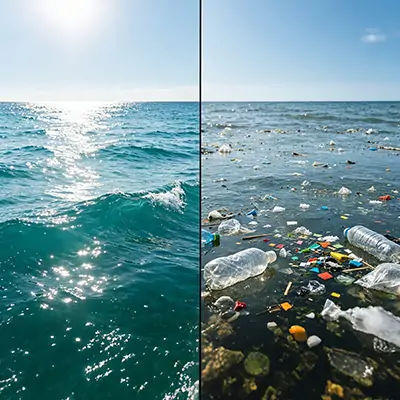
Every minute of every day, the equivalent of a garbage truck’s worth of plastic slides into the world’s oceans. That single image—one truck every sixty seconds—is the easiest way to grasp a problem that has quietly become one of the defining environmental crises of our century. But “a garbage truck a minute” is also a simplification. The true picture is at once more precise and more unsettling: we can count the annual input, model the accumulated stock, and trace the pathways. What we cannot do is claim the ocean will somehow digest what we’ve put there.
Increasingly, scientists are discovering a more disturbing truth: we can’t even claim that plastic pollution stays in the ocean. It is coming back to us. Through the seafood we eat, the water we drink, the salt on our tables, and even the air we breathe, microplastics have entered the human body. They have been found in our lungs, our blood, our feces, our placentas, and even in the breast milk feeding our newborns.
This article goes past the headlines. We’ll look at the most defensible numbers from the United Nations, the Pew Charitable Trusts, and leading medical journals. We’ll break down where the trash comes from (much of it starts in your kitchen), and we’ll explore the growing body of evidence linking ocean plastic to human health risks. And, we’ll show you the unglamorous but genuinely powerful role that proper household waste handling plays in keeping plastic out of the water—and out of our bodies.
The Core Number: How Much Plastic Enters the Ocean Each Year?
The most widely cited figure comes from a 2015 study published in Science by Jenna Jambeck and colleagues, which reported that roughly 8 million metric tons of plastic entered the ocean in 2010. That study became the backbone of a decade of policy and reporting.
But our understanding has sharpened. The latest United Nations data puts the current figure dramatically higher: approximately 52 million metric tons of plastic waste enter the ocean every year. That is a staggering revision, driven by better modeling of mismanaged waste in rapidly urbanizing regions and a fuller accounting of how plastic leaks from river systems, flood events, and illegal dumping.
-
It is the weight of roughly 400,000 blue whales.
-
It means that, on average, more than 1,600 kilograms of plastic enter the ocean every second.
-
At current trajectories, the UN Environment Programme warns that without aggressive intervention, the annual input could triple by 2040.
The Accumulated Stock: How Much Plastic Is Already in the Ocean?
This is where the numbers get truly sobering.
According to a 2020 analysis led by Borrelle et al. and cited by the United Nations Environment Programme, the ocean currently holds an estimated 75 to 199 million metric tons of plastic. The wide range reflects the reality that plastic doesn’t stay in one place—it moves with currents, sinks to the seafloor, and fragments into increasingly tiny pieces.
Here’s the breakdown by location:
|
Location
|
Estimated Plastic Load
|
|---|---|
|
Ocean surface
|
~269,000 metric tons (≈5.25 trillion particles)
|
|
Water column
|
Significant but hard to quantify
|
|
Deep ocean floor
|
9.4 to 15.9 million metric tons of microplastics alone
|
|
Total accumulated stock
|
75–199 million metric tons
|
Notice something important: only a tiny fraction of ocean plastic floats on the surface. The widely shared “5.25 trillion pieces” figure refers to surface plastic only. The overwhelming majority has either sunk to the seafloor or fragmented into microplastics that are distributed throughout the water column. A 2024 study published in Nature Geoscience found that the deep ocean floor holds an estimated 9.4 to 15.9 million tonnes of microplastic debris alone—far exceeding the surface load.
The UN’s latest assessment adds another chilling data point: the upper layers of the ocean contain an estimated 24.4 trillion microplastic particles, and more than 4,000 marine species are known to be affected by plastic pollution.
The Invisible Threat: How Ocean Plastic Becomes Human Exposure
For decades, we treated the ocean as a dumping ground with infinite capacity. Now, the bill is coming due—in the form of microscopic plastic particles that have infiltrated the entire planetary life-support system.
1. The Seafood Connection
One of the most direct pathways is through the marine food web. Zooplankton, the tiny organisms that form the base of the ocean food chain, mistake microplastics for food. Small fish eat the plankton; larger fish eat the smaller fish; humans eat the larger fish.
A 2020 study in Environmental Health Perspectives found that mussels and oysters, common seafood items, can contain up to 0.47 micrograms of microplastics per gram of tissue. Since the average person consumes dozens of grams of seafood weekly, the cumulative intake is significant. The UN Food and Agriculture Organization (FAO) warns that microplastics have been detected in over 100 species of commercially important fish.
2. Table Salt and Drinking Water
It’s not just seafood. A 2018 study published in Environmental Science & Technology analyzed 39 brands of table salt from 21 countries and found microplastics in 90% of them. Sea salt, unsurprisingly, showed the highest concentrations, as it is literally evaporated from plastic-laden seawater.
Even more alarming is the presence of microplastics in drinking water. A 2017 investigation by Orb Media found microplastics in 83% of tap water samples worldwide. In the United States, that number jumped to 94%. Bottled water isn’t necessarily safer; the same study found microplastics in many major bottled water brands.
3. The Air We Breathe
Plastic doesn’t need to be eaten to enter the body. Atmospheric studies show that microplastics are carried by wind, settling in urban centers and remote mountain ranges alike. A 2021 study in PNAS estimated that Americans inhale between 74,000 and 121,000 microplastic fibers annually. Indoor air, laden with synthetic carpet fibers and furniture dust, often contains higher concentrations than outdoor air.
4. The Placenta and Breast Milk
Perhaps the most chilling discoveries involve the most vulnerable among us. In 2021, researchers at the University of Rome published a landmark study in Environment International confirming the presence of microplastics in human placentas. They found an average of 12 microplastic fragments per placenta, primarily on the fetal side.
Later that year, a study in Polymers detected microplastics in human breast milk for the first time. Of 34 healthy mothers sampled, 75% had microplastics in their milk. This means that exposure begins before birth and continues through infancy—the most critical windows for human development.
What Does This Do to Our Bodies? The Emerging Science of Harm
Finding plastic in the human body is one thing; understanding its effects is another. While long-term epidemiological studies are still underway, the mechanistic evidence is deeply concerning.
Endocrine Disruption and Hormonal Havoc
Many plastics contain chemical additives like Bisphenol A (BPA) and phthalates. These are known endocrine-disrupting chemicals (EDCs). According to the Endocrine Society, EDCs interfere with hormone signaling, potentially leading to:
-
Reproductive issues: Reduced fertility, early puberty, and pregnancy complications.
-
Metabolic disorders: Increased risk of obesity and type 2 diabetes.
-
Neurodevelopmental problems: Links to ADHD and lowered IQ in children exposed prenatally.
A 2019 review in The Lancet Diabetes & Endocrinology concluded that the global health cost of EDC exposure exceeds $340 billion annually in the U.S. alone.
Inflammation and Immune Response
Once inside the body, microplastics act as physical irritants. Animal studies (which often precede human clinical trials) show that microplastics can cause:
-
Chronic inflammation in lung tissue (similar to asbestos fibers).
-
Gut microbiome disruption alters digestion and immune function.
-
Oxidative stress, which damages cells and contributes to aging and cancer.
In 2022, researchers at Hull York Medical School found that microplastics can trigger cell death and allergic reactions in human immune cells in laboratory settings.
Carcinogenic Potential
While direct causation in humans is still being studied, the International Agency for Research on Cancer (IARC) classifies certain plastic monomers (like styrene) as possible human carcinogens. Furthermore, microplastics serve as vectors for other toxins. Because plastic is lipophilic (fat-loving), it absorbs persistent organic pollutants (POPs) like PCBs and DDT from seawater. When ingested, these concentrated toxins can leach into human tissues.
Cardiovascular Risks: A Recent Wake-Up Call
Where Does All This Trash Come From? (Hint: Mostly From Land)
NOAA’s Marine Debris Program states plainly: the overwhelming majority of ocean trash originates on land. The UN Environment Programme pegs the figure at 80% from land-based sources, 20% from ocean-based activities.
Let’s break down the land-based 80%:
1. Mismanaged Household Waste
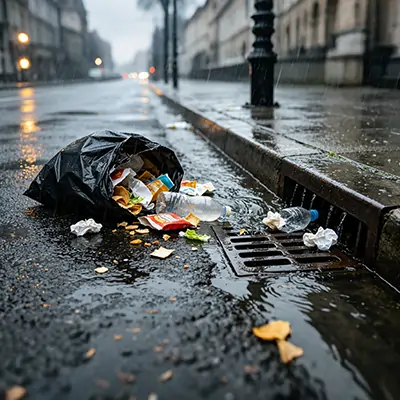
The single biggest category. When waste bins overflow, when bags tear and spill their contents onto streets, when dumps lack liner systems and leach into rivers, plastic escapes. From there, rain and stormwater carry it into drains, into rivers, and ultimately into the sea. A plastic bottle dropped on a sidewalk in Manila can be in the Pacific within weeks.
2. Single-Use Packaging
Plastic bags, food wrappers, bottle caps, and containers make up the bulk of items collected during Ocean Conservancy’s International Coastal Cleanup. These are the items most likely to be littered or blown out of bins.
3. Microplastics from Everyday Life
-
A single load of laundry can release up to 18 million plastic microfibers from synthetic clothing
-
Tire wear sheds particles every time you drive
-
Paint flakes off buildings and ships
These particles are microscopic. They bypass most filtration systems and flow straight into waterways.
4. “Nurdles” – The Raw Material of Plastic
Nurdles are the tiny pre-production plastic pellets that manufacturers melt down to make every plastic product you own. They spill during transport, they wash out of factories during storms, and they’re so small they evade nearly all containment. Reddit communities dedicated to river cleanup regularly report finding thousands of these colorful pellets after rain events.
5. Ghost Gear
Abandoned, lost, or discarded fishing gear—nets, lines, traps—accounts for a significant share of ocean-based plastic. Once lost at sea, a single fishing net can continue “ghost fishing” for decades, killing marine life long after its owner has given up on it.
6. Disaster Debris
The Human Dimension: What Reddit Users Are Saying
If you want to understand how ordinary people feel about this crisis, Reddit is a revealing window. The conversations reveal a mix of despair, anger, and determined action:
-
In r/Anticonsumption, a beachcomber in Oregon posted a photo of the bizarre items they’d collected—a plastic fork, cork, toothbrush handle, shotgun shell, dog collar link, bottle caps, fishing plastics, and a coat hanger hook. “Some are obvious, but some I can’t figure out what they are ‘supposed’ to be,” they wrote. The comments were filled with people applauding the cleanup effort.
-
In r/DeTrashed, an activist known as u/Trashfish documented collecting “nurdles” by the thousands from a riverbank after a storm. “I friggin hate nurdles,” they wrote, explaining to confused commenters that these tiny pellets are the raw feedstock of all plastic manufacturing.
-
After a video surfaced showing plastic waste washing ashore in Guatemala, one Redditor captured the collective frustration perfectly: “There is no such place as ‘Away.’ We don’t throw things ‘away’ when we’re done with them… They don’t disappear into a magical place called ‘Away’ where they never trouble anyone again. It all ends up somewhere.”
That last quote deserves to be printed on every trash bin in the world. It captures the fundamental misunderstanding at the heart of the ocean trash crisis: there is no “away.” There is only “somewhere else”—and increasingly, that somewhere else is the ocean.
Another Reddit thread responding to massive post-event littering at a Florida festival made a crucial point about accountability: event organizers should bear the financial responsibility for waste removal. The commenter wasn’t wrong. But the responsibility doesn’t stop at organizers. It extends to the households that generate the waste in the first place.
Why Ocean Plastic Doesn’t Go Away
Here’s a fact that should reframe how we think about every plastic item we discard: plastic does not biodegrade. It photodegrades—meaning sunlight breaks it into smaller and smaller pieces—but the molecules themselves persist for centuries. A plastic bottle can take 450 years to fully fragment. A plastic bag, depending on conditions, can take 100 to 500 years.
What this means in practice:
-
Every piece of plastic ever made (except what’s been incinerated) still exists in some form
-
Only about 9% of all plastic ever produced has been recycled
-
Global plastic production hit 400 million metric tons in 2022, and the OECD projects it will triple by 2060 without policy intervention
The Role of Waste Management: Where We Come In
As a brand that manufactures waste bags, we believe in radical honesty: a trash bag alone does not solve ocean pollution. But a well-designed waste management system—starting with the bag—is a critical line of defense.
1. Containment Is the First Line of Defense
The journey of ocean plastic almost always begins with escape. A torn bag is leaking wrappers onto a street. A bin without a liner, allowing lightweight items to blow away.
Our role: High-quality, tear-resistant bags with secure closures keep waste contained until it reaches its intended destination. This prevents the “first leak” that sends plastic downstream.
2. Preventing the “Nurdle Effect” at Home
Just as industrial nurdles escape factories, tiny bits of broken plastic from household trash (caps, beads, fragments) escape broken bags. Using puncture-resistant bags ensures these fragments stay inside.
3. Facilitating Proper Sorting
Microplastics from tires are hard to stop, but large items are preventable through sorting. When bags help separate:
-
Recyclables (clean, dry plastics)
-
Organics (food scraps)
-
Landfill waste…the recyclable fraction can actually be recycled instead of leaking into the environment.
4. What Good Household Practice Looks Like
-
Use durable bags that won’t tear when lifted or compressed.
-
Tie bags securely to prevent loose items from blowing away.
-
Keep bins covered to prevent rain saturation (wet waste ruptures bags more easily).
-
Never pour fats, oils, or synthetic-fiber laundry water down storm drains.
-
Separate recyclables at the source to reduce contamination.
-
Support local cleanups and advocate for better waste infrastructure.
The Five Hard Truths About Ocean Trash
Let’s distill everything we’ve covered into five facts that every reader should walk away with:
-
The annual input is enormous and growing: ~52 million metric tons of plastic enter the ocean each year, per the latest UN data. That’s a garbage truck every minute.
-
The accumulated stock is vast: 75 to 199 million metric tons of plastic already sit in the ocean, mostly below the surface.
-
Most of it comes from land: 80% of ocean plastic originates from land-based sources, and the majority of that is mismanaged household waste.
-
There is no “away”: Plastic doesn’t biodegrade. Every piece ever made still exists in some form. A Redditor said it best: “It all ends up somewhere.”
-
Households are both the problem and the solution: The most effective interventions—proper bagging, sorting, containment, and participation in cleanup—happen at the household level, not in the open ocean.
Looking Forward: The Next Decade Is Decisive
-
Countries implementing extended producer responsibility laws
-
Innovations like Microsoft’s ocean plastic resin are proving commercial viability
-
River interception systems (like those from The Ocean Cleanup) capture plastic before it reaches the sea
-
Grassroots movements, from Reddit’s cleanup communities to international coastal volunteer events
A Final Word
The question “how much trash is in the ocean?” leads to an uncomfortable follow-up: “how much of it is already in me?”
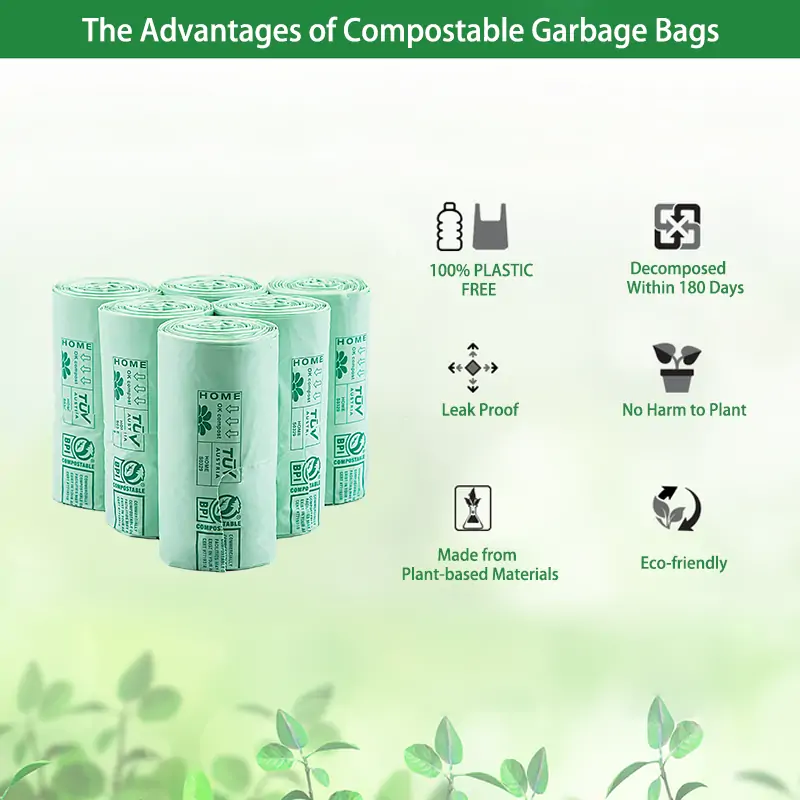
We manufacture certified compostable garbage bags, and that distinction matters more than you might think. Conventional plastics fragment into microplastics—the very particles now found in our blood and placentas. Our bags are engineered differently; they are designed to biodegrade in appropriate composting environments, leaving no microplastic residue behind.
Proper containment prevents litter, but material choice prevents pollution. By switching to compostable options, you ensure that your waste doesn’t contribute to the 52 million tons entering our seas. You are choosing a circular solution over a linear disaster.
The ocean, the whales, the plankton—and our own children—cannot opt out of this plastic experiment. But we can change the variables. It starts with the next bag you buy.
Choose containment. Choose compostability. Ensure your trash becomes part of the earth’s cycle, not a permanent pollutant in our bodies.
Because there is no “away.” There is only “somewhere else”—let’s make sure it’s a place where life can thrive.