



When planning a plastic product, you know that masterbatch is the key to adding color or properties. But did you know that the term “masterbatch” encompasses three distinct types, each with a fundamentally different purpose? Choosing the wrong one can lead to increased costs, production issues, or product failure.
This guide will demystify the three primary categories: Color Masterbatch, Additive Masterbatch, and White Masterbatch. We’ll break down their core functions, unique compositions, and ideal applications, so you can specify the perfect material for your project with confidence. The key to differentiating them lies not in “color” but in their core purpose: visual aesthetics, performance enhancement, or high opacity and whiteness.
Color Masterbatch: The Art of Visual Appeal
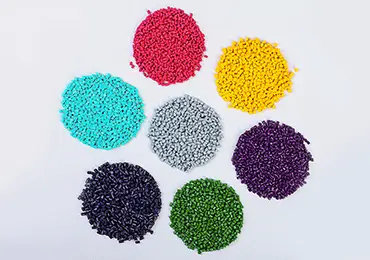
Primary Function: To impart color, shade, or special visual effects to plastic products.
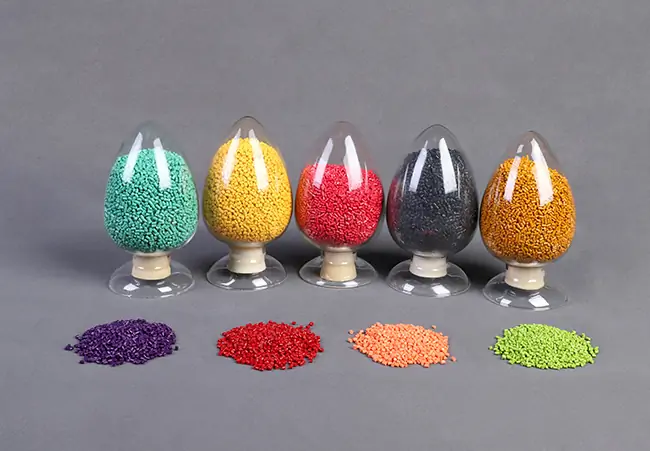
Key Components: This type primarily contains high loadings of pigments or dyes encapsulated within a carrier resin. The pigments can be organic or inorganic, depending on the required color fastness, heat stability, and cost. Special effect pigments for metallic, pearlescent, or fluorescent finishes are also formulated into color masterbatches.
Why It’s Used: Most coloured plastic items we encounter in our daily lives are coloured with masterbatch. It is the preferred choice because the pigments are contained within a pellet, ensuring a much cleaner process than using messy powders or liquid colors. This leads to minimal waste, accurate color dosing, and excellent consistency throughout a production run.
-
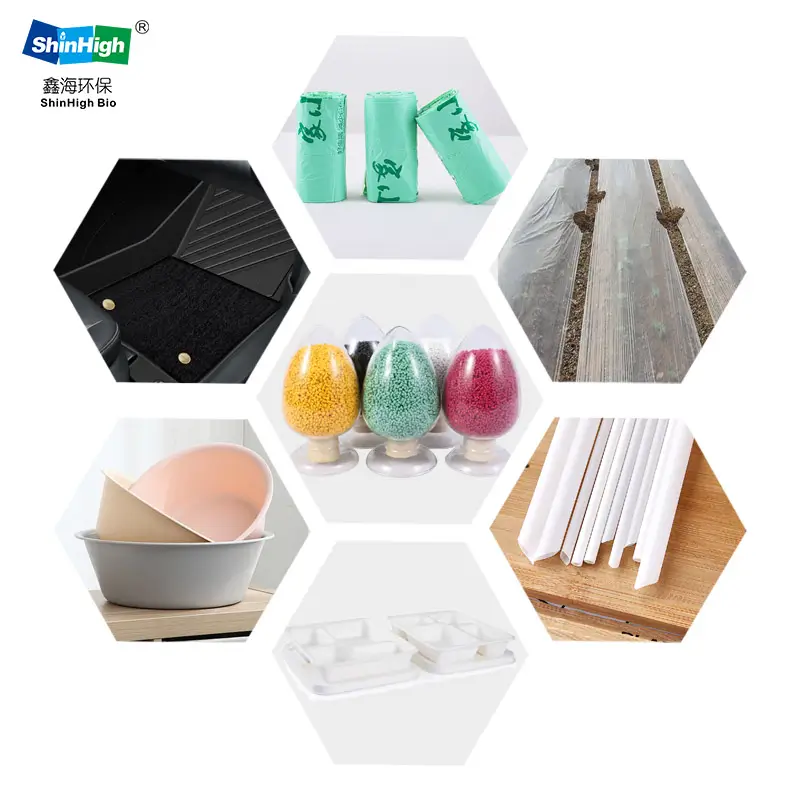
Consumer goods and packaging
-
Automotive interior parts
-
Toys and household items
-
Any application where specific, consistent aesthetics are required.
Additive Masterbatch: The Engine of Performance
Core Function: To enhance the processing behavior or the physical/chemical properties of the final plastic product. While sometimes tinted, its main role is not coloration.
-
UV Stabilizers: To protect against sunlight degradation.
-
Antioxidants: To prevent oxidation and thermal degradation during processing and use.
-
Flame Retardants: To meet fire safety standards.
-
Anti-static Agents: To dissipate static electricity.
-
Processing Aids: Such as slip or anti-block agents for films.
Why It’s Used: additive masterbatches are used to improve processing or enhance the properties of end components. They allow manufacturers to easily incorporate precise amounts of performance-enhancing chemicals into the polymer in a clean, pre-dispersed form.
-
Outdoor Applications: Garden furniture, automotive exterior trim, and fencing often use a UV protection additive masterbatch to prevent fading and brittleness.
-
Construction & Wiring: Pipe and cable insulation utilizing flame-retardant masterbatches.
-
Packaging: Films that require anti-fog or anti-static properties.
White Masterbatch: The Specialty Powerhouse
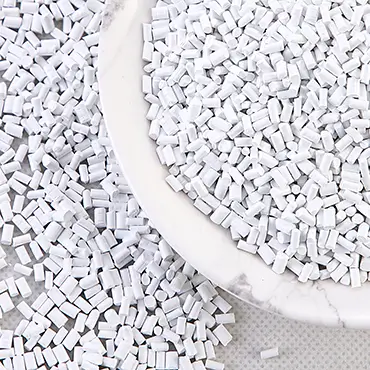
Core Function: To provide high opacity, maximum whiteness, and brightness. White masterbatch is such a large and specialized segment that it is often discussed as its own category, though technically it is a type of color masterbatch.
Key Components: Its defining ingredient is a very high loading of Titanium Dioxide (TiO2), a brilliant white pigment that provides exceptional covering power (opacity) and UV reflectance. It is carried in a polymer resin, just like a standard color masterbatch.
Why It’s Used: White masterbatch is the most efficient way to incorporate TiO2 into plastics. Compared to using raw TiO2 powder, the masterbatch form is dust-free, ensures far better dispersion, allows for precise dosing, and protects processing equipment from abrasive wear.
Unique Properties: It often requires higher let-down ratios (sometimes above 5-10%) than standard color masterbatches to achieve full opacity. Its cost is heavily influenced by the global price of TiO2.
-
Packaging: Milk bottles, opaque food containers, labels, and films.
-
Consumer Durables: Housing for appliances like washing machines and refrigerators.
-
Building & Construction: Pipes, profiles, and siding.
Combined Masterbatch: The All-in-One Solution
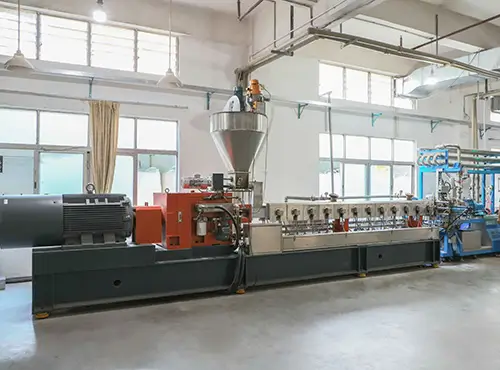
Core Function: To integrate both color and additive functions into a single pellet, simplifying the production process.
Key Components: A blend of pigments/dyes and one or more functional additives within the same carrier resin.
Why It’s Used: This is highlighted as a key advantage in the source material: “It’s often possible to include an additive within a coloured masterbatch to create a combined masterbatch. This means the plastic moulder can dose in one masterbatch, as opposed to adding multiple components to their polymer.”A prime example given is for outdoor products, which use a combined masterbatch containing both color and UV protection additives.
-
Simplified Production: Reduces the number of raw materials to handle and store.
-
Reduced Error: Minimizes the risk of dosing mistakes from multiple feeders.
-
Guaranteed Consistency: Ensures the additive and color are always present in the correct ratio.
Typical Example: A grey masterbatch for garden chairs that already contains the necessary UV stabilizers, creating a durable, weather-resistant product in one step.
How to Choose: A Quick Comparison Table
|
Aspect
|
Color Masterbatch
|
Additive Masterbatch
|
White Masterbatch
|
|---|---|---|---|
|
Primary Function
|
Aesthetics (Color/Effects)
|
Performance Enhancement
|
Opacity & White Base
|
|
Key Ingredient
|
Organic/Inorganic Pigments
|
Functional Additives (UV, FR, etc.)
|
Titanium Dioxide (TiO₂)
|
|
Typical Load %
|
1% – 4%
|
1% – 5% (varies by additive)
|
2% – 10%+ (often higher)
|
|
Cost Driver
|
Pigment type/quality
|
Additive type/performance
|
TiO₂ market price
|
|
Example Use
|
Toys, Electronics, Decorative Parts
|
Outdoor Furniture, Cable, Films
|
Packaging, Appliances, Pipes
|
FAQ: Clearing Common Confusions
Q: Can I use a white masterbatch as a substitute for titanium dioxide powder?
A: Absolutely. In fact, that is its primary purpose. Using a white masterbatch is superior to handling raw TiO2 powder as it eliminates dust, provides much better dispersion in the final product, allows for more precise feeding, and is less abrasive to processing equipment.
Q: Is a black masterbatch a color or an additive masterbatch?
A: It is primarily a color masterbatch, using carbon black as the pigment. However, carbon black also has inherent properties that can be considered additive-like, such as providing some level of UV protection and, in certain forms, electrical conductivity. So, in applications where these secondary properties are crucial, it can be viewed as having a combined function.
Q: Which is more expensive: color, additive, or white masterbatch?
-
Standard Color Masterbatch: Cost is driven by the type and quality of the pigment.
-
Additive Masterbatch: Can be very expensive if it contains high-performance additives like certain flame retardants or long-life UV stabilizers.
-
White Masterbatch: Cost is heavily influenced by the global market price of Titanium Dioxide (TiO₂), which can be volatile.
Conclusion and Next Steps
-
Color Masterbatch determines how it looks.
-
The additive masterbatch determines how it performs.
-
White Masterbatch is the specialist for achieving brilliant, opaque whiteness.
- The innovative Combined Masterbatch merges these functions for efficiency.