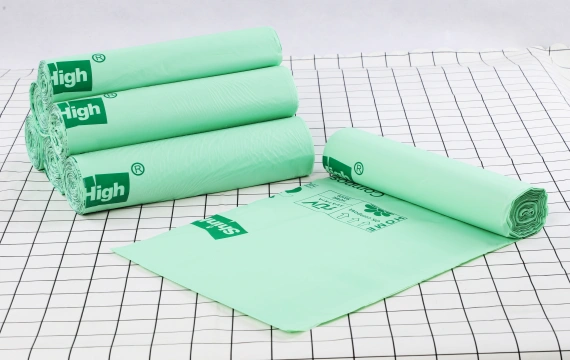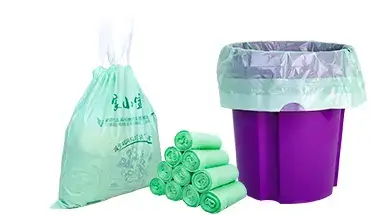




Medical facilities exploring biodegradable ziplock bags are asking sharper questions in 2026: Is “compostable” actually compostable? Can I store medications in them safely? Will my local waste facility even accept them? This guide answers those questions head-on—drawing on certification standards (EN 13432, ASTM D6400, BPI, OK Compost), material science (PLA, PBAT, corn-starch blends), and the disposal realities that platforms like Reddit’s r/ZeroWaste and Quora threads have been debating.
Quick Answer for Procurement Teams: Biodegradable ziplock bags made from certified PLA/PBAT blends are suitable for non-hazardous medical storage—pill packaging, sterile device secondary packaging, lab consumables, and sample transport. They are not a substitute for UN3291/OSHA-compliant biohazard bags. Their environmental benefit depends entirely on whether your region has industrial composting infrastructure. Always verify the certification number, not just the logo.
What “Biodegradable” Actually Means in 2026
The biggest source of confusion—and the most debated topic on social platforms—is that “biodegradable,” “compostable,” and “oxo-degradable” are not interchangeable.
|
Term
|
What it really means
|
Relevant standard
|
|---|---|---|
|
Industrially Compostable
|
Breaks down ≥90% within 180 days at 58°C ± 2°C in controlled facilities
|
EN 13432, ASTM D6400, BPI, OK Compost INDUSTRIAL
|
|
Home Compostable
|
Breaks down at ambient 20–30°C temperatures over 6–12 months
|
OK Compost HOME (TÜV Austria), AS 5810
|
|
Biodegradable (unqualified)
|
Often, a marketing term may be Oxo-degradable PE that fragments into microplastics
|
No unified standard; treat with caution
|
|
Oxo-degradable
|
Traditional PE with additives; banned/restricted in France, Spain, and under EU PPWR scrutiny
|
Not accepted as “compostable”
|

Materials: PLA, PBAT, and Corn-Starch Blends
Modern biodegradable medical ziplock bags are built from three core bio-polymers:
-
PLA (Polylactic Acid): Derived from corn, sugarcane, or cassava starch. Rigid, high tensile strength (25–40 MPa), excellent clarity. Softens at 55–60°C. Ideal for lighter medical items—dressings, pill packaging, dry consumables.
-
PBAT: A flexible biodegradable polymer that compensates for PLA’s brittleness. Adds tear resistance and puncture resistance—critical when bags are opened/closed 200+ times.
-
Corn-starch blends: Cost-effective combinations, often PLA+PBAT+corn starch, balancing performance and price.
Typical formulation for medical ziplock bags: PBAT 61–79%, corn starch 15–30%, PLA 1–7%—engineered to deliver both seal integrity and certified compostability.
⚠️ Temperature limit: PLA softens at 55–60°C. These bags are not suitable for autoclave sterilization or hot contents. For normal room-temperature or refrigerated medical storage, migration of harmful substances is not considered a significant risk under certified food/medical contact grades.
Which certifications actually matter for medical use?
A bag’s marketing language means nothing without third-party certification. For medical packaging procured in North America or Europe, look for:
-
ASTM D6400 — the technical standard: ≥90% conversion to CO₂ within 180 days at 58°C ± 2°C, ≤10% remaining on a 2 mm sieve after 84 days
-
BPI Certified Compostable — the certification mark issued by the Biodegradable Products Institute based on ASTM D6400 compliance. Without this label, a product may violate the FTC Green Guides, exposing your brand to legal risk due to greenwashing.
-
EN 13432 — legally mandated for any product marketed as “compostable” in the EU. Same four-pillar framework: biodegradability, disintegration, ecotoxicity, and heavy metal limits
-
TÜV OK Compost INDUSTRIAL — European industrial compostability mark
-
TÜV OK Compost HOME — higher bar; allows home composting
💡 Procurement tip: EN 13432 and ASTM D6400 are functionally equivalent. A product that passes one will almost certainly pass the other—but each market requires its own regional certification. Don’t let a supplier hand you one certificate and claim it covers both.
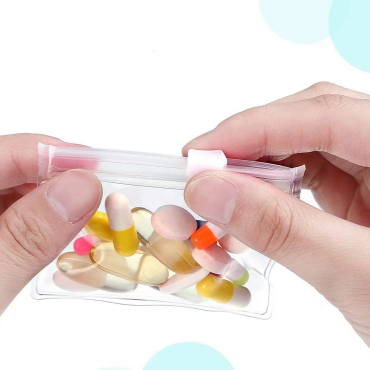
Application Scenarios in Medical & Healthcare
-
Pharmaceutical pill and tablet packaging
-
Secondary packaging for sterile medical devices
-
Storage of dressings, gauze, and non-sharp consumables
-
Sample transport for non-hazardous specimens
-
Dental and orthodontic consumable organization
-
Cosmetic and topical product sampling
-
Biohazardous or infectious waste (requires UN3291 bags)
-
Chemotherapy or cytotoxic drug containment
-
Autoclave sterilization packaging (temperature limit)
-
Long-term freezer storage beyond 4–6 weeks (brittleness risk)
-
Sharps disposal (puncture risk)
Always follow local regulations for disposing of medical waste. When in doubt, consult your facility’s infection control officer.
How to dispose of medical compostable ziplock bags correctly
-
Ideal route: Send to an industrial composting facility equipped to handle compostable plastics
-
If industrial composting is unavailable: Dispose of in general waste—the bags are still preferable to conventional plastic in terms of production carbon footprint, even if end-of-life benefits are limited
-
Never: Place in recycling bins (they contaminate recycling streams), home compost bins (unless OK Compost HOME certified), or municipal food waste bins (unless explicitly accepted by your local authority)
Implementation checklist for healthcare procurement teams
When evaluating a compostable ziplock bag supplier, require:
-
✅ Valid BPI (North America) or TÜV OK Compost INDUSTRIAL (Europe) certification, with certificate number verifiable in the official database
-
✅ EN 13432 or ASTM D6400 test reports showing ≥90% biodegradation within 180 days
-
✅ Food-contact safety documentation (FDA, EFSA, or equivalent)
-
✅ Heavy metal and ecotoxicity test results within threshold limits
-
✅ Clarity on whether the bag is industrial-only or home-compostable
-
✅ Customization options for size, thickness, printing, and zipper type
-
✅ Free samples for your own toughness, weight-bearing, and water permeability testing
Why ShinHigh Bio for your medical compostable ziplock bags
At ShinHigh Bio, we combine 20+ years of manufacturing expertise with a deep commitment to verified sustainability. Our medical-grade compostable ziplock bags are:
-
Made from certified PLA/PBAT blends — plant-based, plasticizer-free, BPA-free
-
Customizable — sizes, thicknesses, and hospital branding printed to your specifications
-
Supported by full certification documentation — we provide EN 13432 / ASTM D6400 / BPI paperwork for your compliance records
-
Available as free samples — test toughness, weight-bearing, and water permeability yourself before committing
The Questions People Actually Ask (Reddit, Quora & Beyond)
These are the five questions generating the most discussion across Reddit’s r/ZeroWaste, r/sustainability, r/medicine, and Quora. We answer them honestly.
Q1: “Can I throw compostable medical ziplock bags in my council food waste bin?”
UK WRAP (Waste & Resources Action Programme) guidelines clarify that acceptance of compostable packaging into municipal food waste collections depends entirely on whether local authorities have access to compatible industrial composting facilities. Brands are required to provide clear alternative disposal guidance for regions lacking such infrastructure. the USDA’s National Organic Standards Board (NOSB) voted in January 2026 against treating compostable plastic as compost feedstock under organic standards.
What to do: Check your local authority’s specific guidance. If industrial composting isn’t available, general waste disposal is the honest fallback—the bag will still break down faster than conventional PE, though not optimally.
Q2: “Are they safe for storing medications and medical supplies?”
-
BPA-free and phthalate-free
-
Non-toxic under normal cold storage conditions
-
Suitable for pill packaging, sterile device secondary packaging, dressing storage, and lab consumables
Avoid for: chemotherapy drugs, corrosive chemicals, high-temperature items (>55°C), and prolonged marination-like exposure to high-fat or high-acid contents (>48 hours).
Q3: “Will they really break down, or is it greenwashing?”
|
Environment
|
Temperature
|
Decomposition time
|
|---|---|---|
|
Industrial composting
|
50–60°C
|
10–45 days
|
|
Home composting
|
~25°C ambient
|
90–180 days (only OK Compost HOME certified)
|
|
Landfill
|
Variable, low oxygen
|
Unknown—many never fully decompose
|
|
Backyard pile (industrial-only certified bags)
|
Ambient
|
Incomplete; risk of microplastic fragments
|
This is why the certification label—and matching it to your disposal infrastructure—is everything.
Q4: “Can I use them for biohazardous waste?”
-
UN3291 and OSHA compliance
-
Leak-proof construction, puncture resistance for sharps
-
Color-coded segregation (yellow/red/black/blue/white per international norms)
-
Visible biohazard symbol printing
Compostable biohazard bags do exist as a separate product category, but they are engineered differently (multi-layer, higher gauge, certified to both EN 13432 AND UN3291).