



PLA (polylactic acid) is still the starting point for almost every desktop 3D printer on the market. Made from renewable resources such as corn starch, PLA has become the first choice for 3D printer filaments because of its ease of printing, eco-friendly profile, safety, and accessible price point. But “PLA” is no longer one product. In 2026, the category spans standard PLA, PLA+, high-speed PLA, matte, silk, and bulk wholesale spools — and picking the wrong one can cost you a weekend of failed prints.
This guide explains what PLA filament actually is, how PLA and PLA+ differ, what print settings work, and which brands — from consumer spools to factory-direct sources like ShinHigh — deserve a place in your 2026 filament shelf.
What Is PLA 3D Printer Filament?
PLA is a bio-based thermoplastic made by polymerizing lactic acid extracted from renewable resources (such as corn starch). It is the default “starter” material for FDM printing because it is stable, predictable, and easy to dial in. Most slicers and printer vendors treat PLA as the baseline profile.
Key properties that define PLA:
-
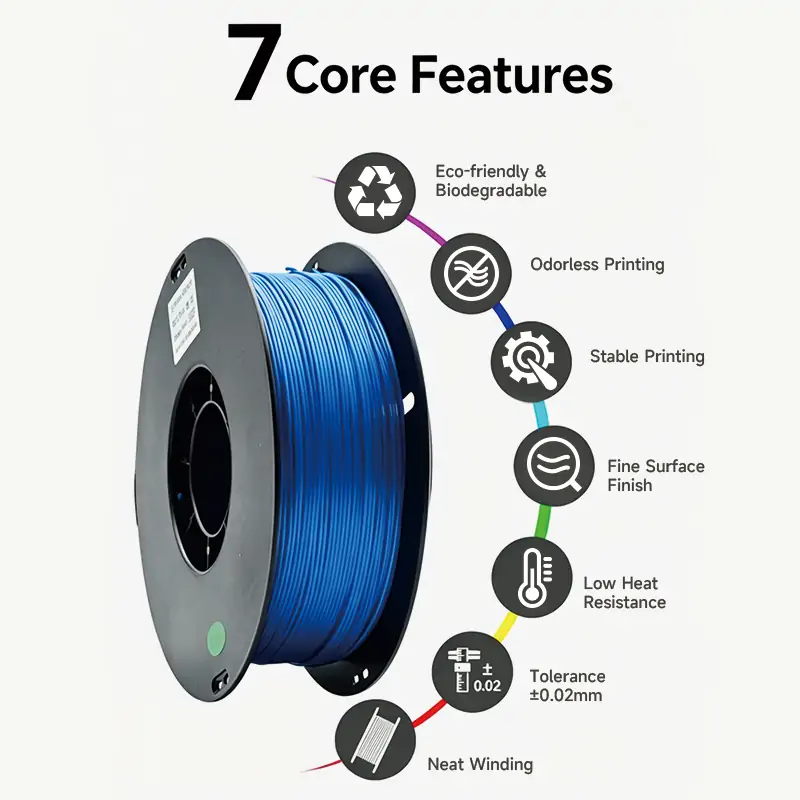
Diameter: 1.75 mm is the consumer standard (2.85 mm also exists for some pro machines), with quality brands holding ±0.02 mm tolerance
-
Nozzle temperature: 190–220 °C, with ~200 °C as the sweet spot
-
Bed temperature: Optional, or 20–65 °C
-
Heat deflection: ~55–60 °C — PLA softens in hot cars or direct sun
-
Print speed: 40–150 mm/s on most machines, up to 200 mm/s on compatible setups
-
Bio-based: Derived from renewable corn starch, making it the eco-friendly choice for 3D printing
PLA vs PLA+: What Actually Changes?
PLA+ is not a single standardized material — it is a PLA-based blend tuned with impact modifiers (often TPU-based tougheners or copolymers). Two PLA+ spools from different brands can be genuinely different materials. Treat “PLA+” as “PLA, but tuned.”
|
Parameter
|
Standard PLA
|
PLA+
|
|---|---|---|
|
Nozzle temp
|
190–220 °C (ideal ~200 °C)
|
200–240 °C
|
|
Bed temp
|
Optional or 20–50 °C
|
50–70 °C
|
|
Print speed
|
40–60 mm/s (up to ~200 mm/s)
|
40–50 mm/s
|
|
Impact resistance
|
Moderate, brittle on drop
|
Higher — less likely to shatter
|
|
Heat resistance
|
55–60 °C
|
55–60 °C (does not improve)
|
|
Best for
|
Decorative models, prototypes, miniatures
|
Functional parts, brackets, mounts, jigs
|
⚠️ Common myth: PLA+ is NOT more heat-resistant. Both PLA and PLA+ soften around 55–60 °C. If your part lives in a hot car or near electronics, you need PETG (~75–80 °C) or ABS (~100 °C) instead.
The $1–3/kg premium for PLA+ is worth it for clips, mounts, and enclosures. For decorative items and prototypes, regular PLA gives you better color selection at a lower cost.
What Makes a Great PLA Filament in 2026?
Every brand claims to be “premium.” Instead of marketing language, evaluate PLA on five measurable criteria:
-
Diameter tolerance — ±0.02 mm is the gold standard (Prusament, Polymaker, ShinHigh). ±0.05 mm is budget-grade and causes inconsistent extrusion
-
Batch-to-batch color consistency — critical for production runs and multi-spool projects
-
Moisture protection — must ship vacuum-sealed with desiccant. Wet PLA causes stringing, popping, and weak layer adhesion
-
Spool winding quality — poor winding = tangles = failed prints at 3 a.m.
-
Traceability & documentation — per-spool QC data, Certificate of Analysis (CoA), and transparent manufacturing
Best PLA Filament 2026: Brands Ranked by Use Case
Below are the brands that consistently deliver in 2026, organized by what they do best. All are available in the US, UK, and EU markets.
Best Overall (Consumer): Hatchbox PLA
The Honda Civic of PLA — not flashy, just works. ±0.03 mm tolerance, 40+ colors, clean winding, prints at 180–220 °C. A safe, predictable choice for beginners and experienced users alike.
Best Premium & Documentation: Prusament PLA
The quality benchmark. ±0.02 mm tolerance, every spool ships with a QR code linking to actual production diameter measurements. Tightest batch-to-batch color consistency in the industry. The standard to measure against for reliability.
Best Value Performance: eSUN PLA+
The gold standard for price-to-performance in PLA+. Tensile strength ≥50 MPa, significantly improved impact resistance over standard PLA, prints at 200–240 °C. Ideal for functional parts that need to survive handling.
Best Matte Finish: Polymaker Panchroma Matte
Beautiful flat finish that hides layer lines better than any standard PLA. 50+ colors, ±0.02 mm tolerance, high-speed compatible. Perfect for display pieces, cosplay, and models that need to look finished without post-processing.
Best for Bambu Lab Ecosystem: Bambu Lab PLA Basic
RFID chip auto-configures temperature, flow, and retraction in Bambu Studio. Zero tuning required. Limited to ~15 colors and locked into Bambu’s ecosystem, but unbeatable for A1/P1S/X1C owners who want plug-and-play.
Best High-Speed PLA: Creality Hyper PLA
Formulated for 300–600 mm/s printing on modern high-speed machines (Bambu A1/P1S, Creality K1, Elegoo Centauri Carbon). Won’t under-extrude at default slicer settings.
Best Budget: Overture PLA / SUNLU PLA
Both deliver reliable print quality at accessible price points. Overture offers ±0.02 mm tolerance at budget pricing; SUNLU provides a full range from standard PLA to PLA+ to silk.
Best Bulk & Wholesale Source: ShinHigh PLA Filament
For print farms, distributors, and private-label brands, ShinHigh stands out as a factory-direct source manufacturer. Backed by 20+ years in bioplastics and a 30,000-ton annual bioplastics manufacturing base, ShinHigh applies the same process control to 3D printing filament:
-
±0.02 mm laser-verified tolerance via continuous in-line laser measurement
-
Full traceability — CoA provided with every lot upon request
-
Factory-direct wholesale pricing with flexible MOQs from 500 kg per SKU
-
Custom color & private label — RAL/Pantone custom color matching, spool weights, and formula adjustments for OEM/ODM partners
-
Global delivery to North America, Europe, Australia & beyond
-
Bio-based PLA derived from renewable corn starch, aligning with sustainable manufacturing values
If you are stocking filament for a print farm, sourcing a brand, or want custom-colored spools with documented QC, ShinHigh’s manufacturer-direct model eliminates the middleman while delivering premium-grade consistency.
Other Notable Mentions
-
Amazon Basics PLA — Prime-backed convenience, entry-level quality
-
Inland PLA+ — Micro Center’s house brand, great for large 5 kg spools
-
Elegoo PLA+ — strong budget PLA+ with good community reviews
PLA Filament Print Settings (Reference Table)
|
Setting
|
Standard PLA
|
PLA+
|
|---|---|---|
|
Nozzle temperature
|
190–220 °C (start at 200 °C)
|
200–240 °C
|
|
Bed temperature
|
20–65 °C (45–65 °C typical)
|
50–70 °C
|
|
Print speed
|
40–150 mm/s (up to 200 mm/s)
|
40–100 mm/s
|
|
Layer height
|
0.1–0.3 mm
|
0.1–0.2 mm
|
|
Cooling fan
|
100% (reduce to 0–30% for first layer)
|
100%
|
|
Retraction (Bowden)
|
2–5 mm
|
2–5 mm
|
Settings are starting points. Always print a temperature tower to dial in your specific spool.
How to Store and Dry PLA Filament
-
Stringing and oozing
-
Bubbling or popping sounds during extrusion
-
Weak layer adhesion
-
Fuzzy surface finish
-
Store spools in vacuum-sealed bags with desiccant when not in use
-
For opened spools, use a sealed container or dry box with fresh desiccant
-
In humid climates, invest in a filament dryer
-
If a spool has been open for weeks, drying is the simplest “upgrade” — it can turn a frustrating roll into a clean one
Choosing the Right PLA for YOUR Project
-
Figurines, cosplay props, decorative pieces → Standard PLA (best color selection, sharpest detail)
-
Jigs, brackets, mounts, functional parts → PLA+ (improved impact resistance)
-
High-speed printing (300+ mm/s) → High-speed PLA (Creality Hyper, or high-speed-rated formulations)
-
Display models, miniatures → Matte PLA (Polymaker Panchroma)
-
Decorative prints with metallic sheen → Silk PLA
-
Print farms, bulk sourcing, private label → ShinHigh (factory-direct, ±0.02 mm, full OEM/ODM support)
FAQs
Q1: What is PLA 3D printer filament made of?
A: PLA (polylactic acid) is a bio-based thermoplastic made by polymerizing lactic acid extracted from renewable resources such as corn starch. It is eco-friendly, safe, and the easiest 3D printing material to work with.
Q2: Is PLA filament biodegradable?
A: Yes, PLA is bio-based and derived from renewable resources, making it an environmentally friendly choice. However, industrial composting conditions are typically required for full degradation.
Q3: Is PLA+ actually stronger than PLA?
A: It depends on the brand. Reputable PLA+ (like eSUN or Polymaker) uses impact modifiers that genuinely improve impact resistance by 30–60%, so parts are less likely to shatter on a drop. Tensile strength is usually similar between PLA and PLA+. Some budget brands simply rebrand regular PLA as PLA+ with no measurable difference.
Q4: Is PLA filament food safe?
A: PLA itself is made from renewable resources and is considered safe. However, printed parts have layer lines that harbor bacteria, and most consumer 3D printers use lead-bearing brass nozzles. Bambu Lab’s PLA Pure has been tested per EU 10/2011 for food contact, but generally, printed PLA parts are not recommended for holding liquid foods.
Q5: What nozzle temperature should I use for PLA?
A: Start at 200 °C for standard PLA (range 190–220 °C) or 215 °C for PLA+ (range 200–240 °C). Always print a temperature tower to find the lowest temperature that still produces strong layer bonds.
Q6: How long does PLA filament last?
A: Unopened, vacuum-sealed PLA can last 2+ years. Once opened, PLA gradually absorbs moisture. After 12 months of partial humidity exposure, standard PLA loses 20–40% of its impact strength. Proper storage in sealed containers with desiccant dramatically extends shelf life.
Q7: Can I mix PLA and PLA+ in the same print?
A: Yes. PLA and PLA+ are compatible in multi-material setups because PLA+ is still PLA-based. They bond well with each other. You can swap between them mid-print (e.g., for color changes) without issues.
Q8: Which PLA brand is best for beginners in 2026?
A: Hatchbox PLA is the most recommended beginner choice — reliable, ±0.03 mm tolerance, wide color range, and extensive community settings available for virtually any printer. Bambu Lab PLA Basic is the best choice for Bambu printer owners, thanks to RFID auto-configuration.