



Last reviewed: 18 September 2026
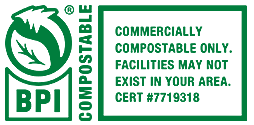
ASTM D6400 sets the labelling requirements for plastics engineered to compost in municipal or industrial facilities. Whether a product may legally carry a “compostable” label also depends on state law (for example, California and Washington) and on the certifying body (such as BPI), alongside the FTC Green Guides. Three measurements, taken together, decide whether a product passes: disintegration, biodegradation, and ecotoxicity. ASTM writes the standard, yet it does not test products or issue certificates. Certification bodies such as BPI verify the test results and issue the mark. The certificate covers only the thickness and formulation that the lab actually tested.
What ASTM D6400 covers — and what it does not
ASTM D6400 sets the labelling requirements for plastics meant to compost aerobically in municipal or industrial facilities that reach thermophilic temperatures. It is a specification, not a certificate: ASTM publishes the criteria, and certification bodies verify results and issue the mark. The standard is aligned with ISO 17088 — ASTM’s own Note 1 states the two are equivalent.
Its full title is Standard Specification for Labeling of Plastics Designed to be Aerobically Composted in Municipal or Industrial Facilities. The scope covers plastics and products made from plastics that compost under aerobic conditions in municipal and industrial aerobic composting facilities. These facilities reach thermophilic conditions.
Three distinctions matter when you are reading a supplier’s claim:
- ASTM International writes the standard. It does not test products or certify anything.
- Certification bodies do the verifying. In North America, BPI commissions or runs the testing; in Europe, TÜV Austria and DIN CERTCO do the same, review the reports, and issue the certificate that allows a product to carry a compostability mark. ShinHigh’s own certifications follow that same split.
- The standard addresses industrial composting only. Home composting is a different test regime, at a lower temperature and over a longer window.
ASTM revises the standard periodically; the current edition is D6400-26 (published 2026). Always confirm the edition cited on the certificate in force, because thresholds and referenced test methods can shift between editions. If a certificate cites a different edition year, read the certificate before relying on any figure here.
The three tests, and what each one measures
ASTM D6400 requires three outcomes at once. The product must physically break apart, its carbon must convert to CO₂, and the resulting compost must support plant growth. Each outcome has its own test method, duration, and pass threshold. The three are not averaged, so a product that fails any one of them does not meet the specification.
A quick comparison
| Requirement | Test method | Condition | Pass threshold | Duration |
| Disintegration | ISO 16929 or ISO 20200 (or another equivalent disintegration method accepted by the certifying body) | Controlled composting, 58 ±2 °C | No more than 10% of original dry weight remaining on a 2 mm sieve | 84 days (12 weeks) |
| Biodegradation | ASTM D5338 (aligned with ISO 14855; both are controlled-composting CO₂ evolution methods at 58 ±2 °C, with minor procedural differences) | Compost inoculum, 58 ±2 °C, aerobic | A high degree of organic-carbon conversion to CO₂ within 180 days (the exact figure and any split by polymer architecture are edition-dependent — see below) | 180 days |
| Ecotoxicity and regulated metals | OECD 208 plant test + chemical analysis | Compost-amended soil | Germination and plant biomass at least 90% of the control; regulated metals no more than 50% of the limit set by the applicable certification scheme | — |
Disintegration
Disintegration measures physical fragmentation, not microbial consumption. A sample composts for 12 weeks at 58 ±2 °C, then technicians sieve it at 2 mm. No more than 10% of the original dry weight may remain on the sieve. A product can pass disintegration and still fail biodegradation. Fragments can be small without the carbon having left as CO₂, which is why both tests exist.
Biodegradation
Biodegradation measures the share of organic carbon that converts to CO₂, following ASTM D5338. Technicians derive the inoculum from compost from municipal solid waste, and they typically run cellulose alongside as a positive control. The exact threshold, and whether it differs by polymer architecture, depends on the edition in force. Many summaries cite 90%, and some editions distinguish 60% for homopolymers versus 90% for copolymers and blends, within 180 days. For radiolabelled (carbon-14) test designs, the method allows an extended window up to 365 days.
Ecotoxicity
The finished compost has to support plant growth. Testing follows OECD 208 and covers both a monocot and a dicot species — wheat or barley, and watercress or tomato are the usual pair. Germination rate and plant biomass must each reach at least 90% of the control compost. Separately, the regulated metals in the product must stay below 50% of the limit set by the applicable certification scheme — for example, US sludge/compost benchmarks for BPI, or European limits for TÜV Austria and DIN CERTCO.
Why a blown film bag is not a moulded cup
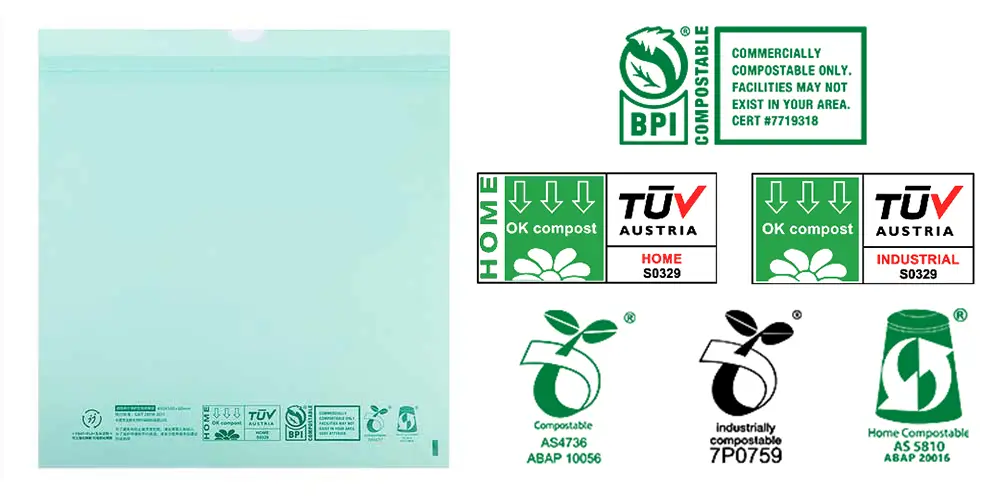
Most published explanations of ASTM D6400 use a moulded article — a PLA cup, a bagasse bowl — as the worked example. However, a blown film bag differs in three ways that bear on the result.
- Gauge. A standard compostable trash or poop bag runs 18–20 µm, far thinner than a moulded food-service item.
- Orientation. The bubble in film blowing stretches the melt and orients the chains.
- Crystallinity. The cooling rate on the line sets how much crystalline structure develops.
The standard names both thickness and crystallinity as variables the result depends on. Because of this, the same resin can behave differently as a bag and as a moulding.
Why the biodegradation bar is often described as two numbers
ASTM D6400 is often described as setting two biodegradation thresholds, not one. Homopolymers are frequently quoted at 60% of organic carbon converted to CO₂ within 180 days; copolymers and blends at 90%. The higher bar for blends reflects the extra work: several different chain structures must break down, not one repeatable unit.
This split is not uniform across every edition or certifier. Some editions and many certification programs apply a single 90% figure regardless of polymer type. Confirm the exact threshold against the edition cited on the certificate you are relying on.
Most published summaries quote only the 90% figure. That number is correct for a blend and may be wrong for a homopolymer where a lower figure applies. This matters in practice because almost all compostable film resins are blends. PBAT is compounded with PLA, and often with starch, to give a bag the toughness, stiffness and sealability it needs.
Both ShinHigh film grades are blends, so they are assessed against the stricter figure required by the certifying scheme. XH-918 (PBAT + PLA + cornstarch) goes into trash bags, shopping bags, pet waste bags, and courier bags. SH-133 (PBAT + PLA) goes into T-shirt bags, produce bags, courier bags, and industrial packaging.
Four limits that can void a compostable certificate
A certificate covers the specific article that the lab tested, not the material in the abstract. Four conditions quietly move a product outside its own certificate: a thickness above the tested maximum, preconditioning before testing, untested additives above the permitted total, and testing a resin rather than the finished product.
Certified only up to the tested thickness
Thickness is a certification variable, not only a performance specification. Most BPI film certificates list a covered thickness range or maximum thickness; one published certificate in that scheme lists 135 µm. Confirm the exact field against the certificate body text. A product that is reformulated or re-gauged thicker than the version submitted no longer falls under that certificate.
Buyers often skip this check when they specify a heavier gauge. A supplier holding a certificate for an 18 µm bag does not hold a certificate for a 30 µm version of the same formulation, even though the resin is identical.
Tested in final commercial form, with no result-improving preconditioning
The standard requires the lab to test the material or product in the form in which it is sold. Two consequences follow. No preconditioning that would improve the degradation result is allowed — no pre-weathering, no accelerated ageing, no pre-composting. Routine sample preparation (cutting to test size, conditioning to moisture) remains permitted. The result also depends on thickness and crystallinity, so a change in gauge or in cooling and orientation during film blowing can move the outcome even when the resin has not changed.
That is why a compostable film cannot be certified from a resin data sheet alone.
Inks, colourants and adhesives: the additive rules
Certification schemes regulate additives by proportion. Under common BPI and similar review rules, an individual functional additive above a set percentage (often around 1%–10%) typically requires separate compostability or toxicology data, and unassessed additives are capped in total. Ink, colourant, adhesive, and filler all count. The exact percentage brackets follow the certifying body’s current rules, so read the scheme documentation rather than treating a single number as universal.
Ink sits inside that definition. For a printed bag, this creates a practical constraint. A four-colour print, a change of ink supplier, or a heavier ink laydown can take a product outside the coverage of a certificate issued for an unprinted or differently printed version. When a printed bag is certified, the print specification is part of what the lab tested.
A resin certificate is not a finished-product certificate
Resin pellets that pass ASTM D6400 are not the same thing as a finished bag that passes it. A resin certificate tells a converter that the material is capable of composting. It does not by itself authorise a compostability mark on the finished article. For that, the finished product typically requires its own evaluation at final form, thickness, and print; certified resins may qualify for a reduced testing path, but that path does not waive all testing.
Suppliers who both compound and convert end up holding documentation at two levels. ShinHigh supplies XH-918 and SH-133 as modified resin and also converts them into finished film and bags, so the two levels are not interchangeable. Ask for the one that matches what you are buying. If the bag will carry a compostability mark on the shelf, you need the product certificate, and its thickness field must be at or above the gauge you are ordering.
What the test does not tell you
Passing ASTM D6400 establishes one thing. The product broke down under industrial composting conditions in a laboratory. It does not say the product will break down in a garden heap, in soil, in freshwater, in seawater, or in landfill. It also does not mean a local organics scheme will accept it.
- Home composting is a separate test. Under BPI’s home program, testing runs at 25 ±2 °C, with disintegration allowed up to 180 days and biodegradation measured over 12 months — a lower temperature and a longer window than the 58 ±2 °C industrial regime. Other home schemes (OK Compost HOME, AS 5810) may set slightly different windows; check the specific program. Of ShinHigh’s two grades, XH-918 carries a home-compostable statement; SH-133 is certified for industrial composting only and is not home compostable.
- Soil, water, and marine are separate standards. OK Biodegradable SOIL, WATER, and MARINE exist precisely because D6400 does not address those environments.
- Landfill is not covered. ASTM D6400 is an aerobic, thermophilic test. Nothing in it predicts behaviour in an anaerobic landfill.
- Collection is a local decision. A certificate is an entry ticket, not a guarantee of acceptance. Municipal organics programmes set their own intake rules, and some exclude film entirely.
- Pet-waste products carry a geographic limit. Per BPI’s current eligibility criteria, pet-waste products are limited to Commercial Only certification for use in Canada, because backyard bins rarely reach the temperatures needed to kill pathogens in pet waste. These criteria can change; always read the certificate scope.
- Coated substrates are a different standard. For paper or other substrates coated with a compostable film (for example, a PLA-lined cup), the relevant specification is ASTM D6868, not D6400.
How to check a certificate in five minutes
Four fields decide whether a certificate covers what you are buying: the certificate number, the issuing body’s public listing, the maximum thickness, and the expiry date. A fifth check — whether the document names a finished product or a resin — decides how you are allowed to use it.
- Find it in the issuing body’s directory. BPI, TÜV Austria and DIN CERTCO publish searchable lists. A certificate number that does not resolve there is a number on a PDF, not a certificate.
- Read the product description, not the company name. The certificate names a specific article. Compare that description with what you have been quoted.
- Check the maximum thickness. If your gauge is above the figure on the certificate, the certificate does not cover your bag.
- Check whether it covers resin or finished product. A resin certificate supports a material claim. A product certificate supports a pack mark.
- Check the expiry date. Certification is periodic, and an expired certificate is not a certificate.
Scope, Editions and Scheme Differences
The thresholds quoted here follow ASTM D6400 and common certification practice, but no single article can capture every scheme’s fine print. BPI, TÜV Austria and DIN CERTCO each set their own product scope and geographic limits on thickness, additives, pet-waste and home-composting acceptance. Editions of the standard are revised over time, and the certification body’s current rules — not this page — are the authority for any specific claim. Before you rely on a figure, confirm three things: the edition cited on the certificate, the issuer’s public directory entry, and the local organics-acceptance policy where the product will be disposed of.
Conclusion
Three things decide whether an ASTM D6400 certificate means anything for the bag you are buying. The three tests have to pass together: disintegration within 84 days, biodegradation within 180 days at the figure required by the cited edition and certifying scheme, and plant growth at 90% of control. The certificate covers one article at one thickness with one print specification. Go thicker, change the ink, or certify resin instead of finished bags, and the coverage does not follow. Industrial certification is not home certification, and neither guarantees local collection.
If you are specifying compostable film or finished bags, ask for the certificate that matches the article. The resin certificate covers material you will convert yourself. The product certificate covers a bag that will carry a compostability mark. Ask for the certificate number, the maximum thickness, and the expiry date, and check them against the issuing body’s directory rather than the PDF you were sent.
The certifications page lists the certificates ShinHigh currently holds and the test reports behind them. Send us the gauge and print specification you need covered, and we will confirm whether an existing certificate covers it.
FAQ
No. ASTM International publishes ASTM D6400 as a specification that sets the test criteria. BPI is a certification body that verifies results against that specification and issues the certificate and mark. ASTM does not certify products.
The disintegration test runs 84 days (12 weeks), and the biodegradation test runs 180 days under the standard. Calendar time from sampling to an issued certificate is longer because it includes laboratory scheduling, report review, and the certification body’s own process.
Yes. The certificate covers the product up to the thickness that the lab tested. Most BPI film certificates list a covered thickness range or maximum thickness. A bag made thicker than the certified version falls outside that coverage and needs its own testing.
It can. Certification schemes treat ink, colourant, adhesive and filler as additives regulated by proportion. Under common review rules, an additive above a set percentage typically needs separate data, and unassessed additives are capped in total. A print change can therefore move a product outside a certificate issued for a different print specification.
No. A resin certificate covers the material. The finished bag typically requires its own evaluation at final form, thickness, and print. Certified resins may qualify for a reduced testing path, but that path does not waive all testing before a compostability mark can appear on the pack.
No. ASTM D6400 tests at 58 ±2 °C under industrial composting conditions. Home composting runs at a lower temperature with a longer window, and the exact parameters vary by home scheme (BPI Home, OK Compost HOME, AS 5810). A bag certified for industrial composting only is not a home-compostable bag.