EN 13432 is the European standard for packaging that can be recovered by organic recycling / industrial composting. It sets the test scheme and pass/fail limits for biodegradation, disintegration, ecotoxicity, and heavy metals. A product that meets it can carry the Seedling mark or a DIN CERTCO / TÜV Austria registration number — but only for the exact formulation, thickness, and structure that was tested.
For EU buyers, EN 13432 is often the first compliance gate. Many retail chains, distributors, and packaging managers ask for it before they will even review a sample. Yet the standard is frequently misquoted: some suppliers treat it as a factory-wide badge, while buyers confuse it with home composting. This article walks through what the standard actually tests, how it compares to North America’s ASTM D6400, and what to check on a certificate.
What EN 13432 Actually Covers
EN 13432 applies to packaging and packaging materials that are meant to enter industrial composting facilities. It does not cover food waste, glass, or products intended for home composters. The standard is catalogued as EN 13432:2000 by CEN and remains the reference for the EU market.
The core claim is simple: after a defined period in controlled industrial composting conditions, the material must break down into CO₂, water and biomass, and leave no harmful residue.
What EN 13432 does not do:
It does not certify home composting. Home composting is covered by AS 5810, NF T 51-800, or OK Compost HOME (or a certifier’s own home-composting scheme in Europe — there is no single EN standard for home composting).
It does not mean the product degrades in landfill, soil, or marine environments.
It is not a single factory licence. It applies to the tested formulation and thickness.
The Four Core Tests (Plus Chemical Compliance)
A certificate that says “EN 13432” means the four core tests below, plus the chemical-compliance checks (material characterisation, volatile solids, organic fraction, fluorine and heavy-metal limits), were passed on the exact sample submitted. Cutting corners on any one of them voids the claim.
Test
What it checks
Typical limit
Biodegradation
Conversion to CO₂ under industrial composting temperature and humidity
≥ 90% in 180 days
Disintegration
Physical breakdown so no large fragments remain
≤ 10% residue on a 2 mm sieve after 12 weeks
Ecotoxicity
Whether composted material harms plant growth
Pass/no-pass on specified plant tests
Heavy metals
Limits for elements such as zinc, copper, lead, cadmium, mercury and others
Below EN 13432 thresholds
Industrial composting conditions are normally run at 58 ± 2 °C under controlled composting methods such as ISO 14855 (biodegradation), ISO 16929 (disintegration) and OECD 208 (ecotoxicity) — not room temperature. That is why a material that passes EN 13432 may behave very differently in a backyard composter — and why home composting requires its own standard.
Who Certifies EN 13432: TÜV Austria, DIN CERTCO and the Seedling Mark
In Europe, two bodies dominate EN 13432 certification for compostable packaging:
TÜV Austria assesses products under its OK Compost INDUSTRIAL scheme and issues the notification; products that qualify may then use the Seedling mark under licence from European Bioplastics.
DIN CERTCO issues DIN-Geprüft certificates and authorises the Seedling mark under the same European Bioplastics licence.
Both are recognized by compostable packaging buyers across the EU. A valid certificate should show:
the holder’s legal name and address;
the product description and model name;
the exact standard edition (EN 13432);
the registration number;
the validity dates;
the scope limits, such as thickness, colour and material form.
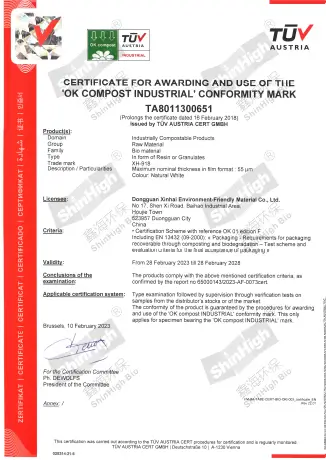
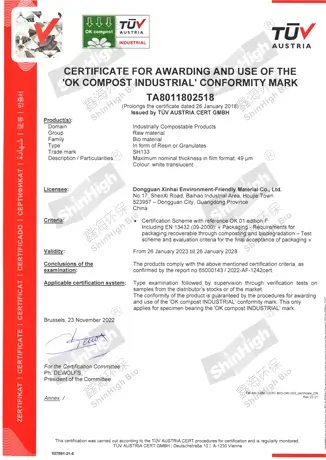
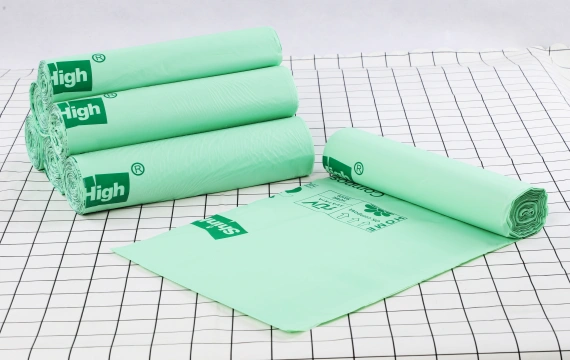
As a concrete example, ShinHigh’s XH-918 and SH-133 compostable resins hold TÜV Austria EN 13432 notifications, and our finished bags are registered under DIN CERTCO for both EN 13432 and ASTM D6400. The certificate shown below is one example — other bag formats carry the same certification. The registration numbers, exact thickness limits, and validity dates are printed on each document, and every entry can also be checked on the TÜV Austria or DIN CERTCO public database.
TÜV Austria EN 13432 certificate for ShinHigh XH-918 compostable resin (registration number and validity printed on the document).
TÜV Austria EN 13432 certificate for ShinHigh SH-133 compostable resin (registration number and validity printed on the document).
EN 13432 vs ASTM D6400: Same Science, Different Region
The two standards share the same goal — to prove a material breaks down safely in industrial composting — but they are not identical. Buyers who sell in both Europe and North America need to understand the differences.
Point
EN 13432
ASTM D6400
Region
Europe
North America
Scope
Packaging and packaging materials
Plastic products and packaging for municipal/industrial composting
Biodegradation threshold
≥ 90% in 180 days
≥ 60% or ≥ 90%, depending on edition and claim
Disintegration
≤ 10% on 2 mm sieve after 12 weeks
≤ 10% on 2 mm sieve after 12 weeks
Heavy metals
11 controlled elements including Mo, Se and F
Per D6400 edition and BPI scheme — number and list vary; check the certificate appendix
PFAS / fluorine
EN 13432 sets total-fluorine limits (Annex); BPI and other schemes add explicit total-fluorine / PFAS criteria
Addressed through edition updates and BPI certification
Mark/body
Seedling / OK Compost (TÜV Austria), DIN-Geprüft (DIN CERTCO)
BPI certification mark
If a supplier shows you one certificate and claims it covers both markets, read the scope line carefully. EN 13432 and ASTM D6400 are tested separately, even though a single product can pass both. Some finished bags — such as DIN CERTCO-registered products — list both standards explicitly on one certificate, which is what a buyer selling in both regions should look for.
The Certificate Scope Traps Buyers Miss
A certificate is only as good as its fine print. Here are the mistakes we see most often from buyers and brand owners.
1. Resin certificates and finished-product certificates are separate
In the industry, a certificate issued for a resin grade does not automatically cover a bag made from that resin. Thickness, additives, colour masterbatch, printing ink, and adhesive labels can all change compliance, so the finished product normally needs its own certificate — or the resin certificate must explicitly state the converted product form (some certifiers grant a change-of-product review instead of full re-testing). For buyers, the safe question is simply: “does the certificate name my exact finished product?” A supplier that also holds a finished-goods certificate removes the ambiguity.
2. A formulation change needs re-testing
Swapping resin grade, adding a new slip agent, changing colour masterbatch, or switching print ink usually invalidates the original certificate. Re-certification is required.
3. The certificate is expired or does not list the exact product
Always verify the registration number on the certifier’s public database (TÜV Austria or DIN CERTCO) for the exact holder, product form, thickness, colour, and validity dates. A logo on a brochure is not proof.
Industrial Only — Not Home, Not Soil, Not Landfill
This is where many claims drift into grey territory. EN 13432 is strictly for industrial composting. It does not certify:
home composting;
soil biodegradation;
landfill degradation;
marine biodegradation.
This article focuses on EN 13432 — the industrial-composting scope. For readers who also need home composting, note that home-compostable certification (AS 5810 / OK Compost HOME family) is a separate certification track; not every industrially compostable grade qualifies. Among ShinHigh’s two reference resins, XH-918 additionally carries a home-compostable certificate, while SH-133 is certified for industrial composting only.
What EU Buyers Should Verify in 2026
Regulatory pressure is increasing. The EU Packaging and Packaging Waste Regulation (Regulation (EU) 2025/40) applies generally from 12 August 2026, and from 12 February 2028 specific formats — permeable tea/coffee bags, fruit-and-vegetable sticky labels and certain soft-after-use beverage packaging — must meet industrial compostability requirements (Article 9). It is not a blanket rule that all compostable packaging must be EN 13432 certified from that date; the scope is limited to those named formats, with Member States free to add home-composting requirements. Buyers who source now should lock in compliance evidence before the rush.
A practical verification checklist:
Ask for the certificate PDF, not a logo screenshot.
Match the product name and model on the certificate to your SKU.
Check the maximum thickness and colour listed.
Confirm the certificate is still valid and has not expired.
Ask whether the certificate covers finished goods or only raw material.
Request a third-party lab report if the certificate is old or the formulation has changed.
Conclusion
EN 13432 is not just a logo. It is a test-backed claim about how a specific material behaves in an industrial composting facility at 58 °C. The real value for any buyer is in the certificate scope: the exact product, thickness, colour, and formulation that passed the four core tests and the chemical-compliance checks.
When you review a supplier’s claim, read the certificate itself — not just the mark on a product photo. Confirm the product name, the standard edition, the validity window, and whether it covers your finished goods. A certificate that names your exact product is the only one that protects you.
FAQ
What is EN 13432?
EN 13432 is the European standard for packaging recoverable by organic recycling / industrial composting. It requires a material to pass biodegradation, disintegration, ecotoxicity, and heavy-metal tests under controlled industrial composting conditions.
Is EN 13432 the same as ASTM D6400?
No. They share the same scientific framework but differ in region, threshold details, and certifying bodies. EN 13432 is used in Europe; ASTM D6400 is used in North America. A product can be certified to both.
Does EN 13432 mean a product is home compostable?
No. EN 13432 is for industrial composting only. Home composting requires a separate standard such as AS 5810, NF T 51-800 or OK Compost HOME, or a certifier’s own home-composting scheme — there is no single EN standard for home composting.
Can I use an EN 13432 resin certificate for my finished bag?
In general, a resin certificate and a finished-product certificate are separate: the same resin can be made into many bag formats, and additives, inks or labelling can change compliance. The safe move is to ask for a certificate that names your exact finished product. Some suppliers — including those that hold a finished-goods certificate in addition to a resin certificate — can provide that directly.
What is the Seedling logo?
The Seedling logo is a registered trademark owned by European Bioplastics and used by certifiers such as TÜV Austria and DIN CERTCO under licence. It shows that the certified product meets EN 13432 for industrial composting.