



You loaded the perfect model, dialed in your settings, and hit “Print.” But instead of smooth layers, you hear annoying pops and cracks. Your print appears to have hairy warts, and the layers aren’t adhering properly. Congratulations—your filament is wet.
In 2026, despite advances in active drying enclosures and graphene-based barrier packaging, moisture absorption (hygroscopy) remains the #1 enemy of high-quality 3D printing. Even “beginner-friendly” PLA can turn into a brittle, stringy mess if its moisture content rises above 0.1%.
This guide explains why filament absorbs water, how to diagnose moisture issues, the best ways to dry your spools (from budget hacks to pro solutions), and how sourcing from a quality manufacturer like ShinHigh can prevent these headaches before the spool even leaves the factory.
Why Does Filament Absorb Water? (It’s Not Just PLA)
Most 3D printing filaments are hygroscopic, meaning they naturally attract and absorb water molecules from the air. At a molecular level, water binds to the polymer chains.
When you print “wet” filament, the hot nozzle (190–250°C) instantly vaporizes that trapped water. This steam creates bubbles (voids), causes uneven expansion (stringing), and acts as a plasticizer, weakening the polymer bonds.
While PLA is the most popular, different materials absorb water at drastically different speeds:
|
Filament Type
|
Absorption Speed
|
Max Recommended Moisture
|
Drying Temp (°C)
|
|---|---|---|---|
|
PLA
|
Slow-Moderate
|
< 0.1%
|
45–55°C
|
|
PETG
|
Fast
|
< 0.05%
|
60–70°C
|
|
ABS/ASA
|
Moderate
|
< 0.1%
|
70–80°C
|
|
PA (Nylon)
|
Very Fast
|
< 0.1%
|
70–80°C
|
|
TPU
|
Very Fast
|
< 0.05%
|
50–60°C
|
Note on PLA: Many beginners think PLA doesn’t need drying because it doesn’t pop as loudly as Nylon. This is false. Wet PLA often leads to “under-extrusion” (due to steam back-pressure) and severe brittleness. If your PLA snaps inside the Bowden tube, moisture fatigue is almost certainly the culprit.
Symptoms: Is My Filament Actually Wet?
-
Audible Popping/Cracking: Small explosions inside the hotend as water vaporizes.
-
Excessive Stringing: Hairy prints. While retraction settings can affect this, using wet filament exacerbates the issue exponentially.
-
Surface Defects: Tiny pimples, blobs, or an “orange peel” texture.
-
Poor Layer Adhesion: The print feels spongy or breaks easily due to steam-created voids.
-
Brittleness: The filament snaps easily when bent or while feeding through the extruder.
How to Dry Filament: 4 Methods Ranked
1. Dedicated Filament Dryers (Highly Recommended)
-
Pros: Precise PID temperature control, forced-air circulation, and they double as a drybox while printing.
-
Cons: Initial cost (150).
-
Verdict: Essential for serious hobbyists and print farms.
2. Modified Food Dehydrators
-
Pros: Affordable and effective at heating.
-
Cons: Often lack precision temp control (risk of melting PLA); may require modification to fit 1kg spools.
-
Verdict: Viable budget option if you use an external thermostat.
3. Oven Drying (Use with Extreme Caution)
-
How-to: Set to the lowest temp (usually 50–60°C). Place spools on parchment paper. Use an independent oven thermometer.
-
Risks: Ovens notoriously overshoot. Exceeding 55°C for PLA can cause permanent crystallization, warping, or fusing into a solid brick. PETG can handle up to 70°C.
-
Verdict: Only use if you have verified temperature accuracy and no other options.
4. The “Lazy” Method: Desiccant Boxes
-
Verdict: Use airtight boxes with desiccant for storage, not for drying.
How Long Should You Dry It?
-
PLA: 4–6 hours at 45–55°C.
-
PETG: 4–6 hours at 60–70°C.
-
ABS/ASA: 4–8 hours at 70–80°C.
-
Nylon/TPU: 10–12 hours at 70–80°C (these are extremely hydrophilic).
Pro Tip: If you live in a humid climate (Florida, Southeast Asia, coastal regions), consider drying your filament while printing. The airflow from part cooling fans can accelerate moisture absorption on the exposed section of the spool.
The B2B Perspective: Prevention Starts at the Factory
For home users, drying is a minor inconvenience. For print farms, distributors, and OEM brands, moisture is a profit killer. A pallet of 500 spools arriving with an average moisture content of 0.3% means 500 failed prints and thousands in wasted labor and material.
This is why sourcing from a reputable manufacturer is critical.
-
Pre-Drying Pellets: Raw PLA pellets are dried to optimal levels (<0.02% moisture) before extrusion to ensure zero hydrolysis.
-
Vacuum Sealing Standards: Every spool is vacuum-sealed immediately after winding. ShinHigh utilizes heavy-duty barrier bags with high-capacity silica gel packs, ensuring the seal survives long-haul global shipping (US, UK, EU, etc.).
-
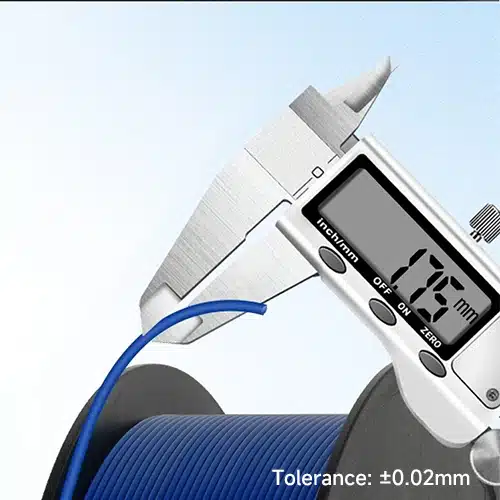
Quality Assurance: As a bulk PLA filament supplier, ShinHigh utilizes laser-based online diameter detection (±0.02mm) to ensure dimensional stability isn’t compromised by moisture swelling during storage.
-
OEM Packaging: For private label brands, ShinHigh offers customized packaging solutions, including thicker mylar bags or double-sealing options for extreme humidity markets.
Maintenance: Keeping Your Filament Dry
-
Dry Box Storage: Use airtight containers (e.g., cereal keepers) with color-changing silica gel.
-
Print from the Box: Run PTFE tubes from your drybox directly into the printer.
-
Monitor Humidity: If room humidity is above 50%, invest in a room dehumidifier.
-
Refresh Desiccant: Recharge silica gel in the oven or replace it once it changes color.