



Introduction: The Great Packaging Debate
As an e-commerce entrepreneur, you face countless daily decisions. But one of the most deceptively simple—and impactful—is this: do you ship your product in a sleek mailer box or a sturdy shipping box?
It’s a choice that directly touches your bottom line, your customer’s first impression, and the safety of your product in transit. While many searches promise a definitive “winner,” the truth is more strategic. The real question isn’t “which is better?” but “which is the best fit for my specific product, brand, and budget?“
This guide cuts through the confusion. We’ll move beyond basic comparisons to provide a clear, actionable framework. By the end, you’ll know exactly when to choose a mailer for its lightweight efficiency and premium appeal, and when a standard box is non-negotiable for ultimate protection.

Defining the Contenders: Mailer Box vs. Shipping Box
Before we dive into the comparison, let’s clearly define our two contenders. This isn’t just semantics—understanding their core design is key to making the right choice.
A mailer box is a self-contained, all-in-one shipping solution typically made from corrugated cardboard. Its key feature is an integrated closure system—like a tuck-top flap, auto-lock bottom, or sealed sleeve—that requires little to no additional tape. Think of it as the “premium folder” of shipping: it arrives flat, is assembled in seconds, and presents a clean, brandable surface on all sides. It’s designed for efficiency, a great unboxing experience, and minimizing dimensional weight for cost savings.
A standard shipping box (often a Regular Slotted Carton or RSC) is the classic, no-frills workhorse. It’s a flat, corrugated cardboard sheet that you fold into a six-sided rectangle and seal shut with packing tape. Its primary virtue is unmatched structural strength and customizable void fill. It offers superior protection for heavy, fragile, or irregularly shaped items. While utilitarian, it provides maximum flexibility in size and is the undisputed champion for securing contents that need robust cushioning from the rigors of transit.
Feature Comparison
This side-by-side breakdown highlights the critical trade-offs between mailer and shipping boxes across five key business dimensions.
|
Feature
|
Mailer Box
|
Standard Shipping Box
|
Key Takeaway
|
|---|---|---|---|
|
Durability & Protection
|
Excellent for semi-fragile, lightweight items. Rigid structure protects against minor crushing, but offers less defense against severe impacts or heavy weights.
|
Superior for heavy, dense, or highly fragile items. The double-walled corrugated construction provides unmatched crush resistance and stackability in transit.
|
Choose a shipping box when product safety is the #1 priority.
|
|
Shipping Cost Efficiency
|
Typically, the cost-winner. Lighter weight minimizes dimensional weight (DIM) charges. A snug, product-shaped fit avoids “shipping air,” further reducing costs.
|
Heavier weight and often extra void fill can increase dimensional weight, leading to higher rates. Cost-effective only when its protection is essential.
|
For pure cost savings on lightweight goods, mailers are usually cheaper to ship.
|
|
Assembly Time & Labor
|
Designed for speed. Most feature self-locking bottoms, tuck tops, or peel-and-seal strips. Assembly takes seconds, streamlining high-volume fulfillment.
|
Requires manual labor. Must be constructed, bottom-taped, packed, and top-taped. This adds time and material cost (tape) to each order.
|
Mailers drastically cut packing time, boosting fulfillment efficiency.
|
|
Branding & Unboxing Experience
|
A powerful marketing tool. Offers a 360-degree branded canvas for printing. The elegant opening feels like unwrapping a gift, enhancing perceived value.
|
Primarily functional. Branding is limited to labels or printed tape. The experience is utilitarian—customers cut tape and open a plain brown box.
|
Mailers turn shipping into a memorable brand experience.
|
|
Eco-Friendliness
|
Often uses less material overall, is easily collapsible for storage, and is highly recyclable. The reduced weight also lowers the carbon footprint per shipment.
|
Made from highly recyclable cardboard, but uses more material. Its bulk creates more waste if not reused and increases transport emissions due to weight.
|
Both are recyclable; mailers often have a slight edge in material efficiency and emissions.
|
The Decision Guide: Which Should YOU Choose?
Now, let’s translate those features into a clear decision. Your best choice isn’t about the “best” packaging in a vacuum—it’s about the best packaging for your specific situation.
The “Budget & Brand Experience” Play → CHOOSE A MAILER BOX
-
Ideal for: apparel, fashion accessories, cosmetics, small electronics, plush toys, and curated gift sets.
-
Why It Works: Here, your product is relatively lightweight and not prone to crushing. A mailer box is the undisputed efficiency champion. It minimizes your single largest variable cost—shipping—while maximizing perceived value. The premium unboxing experience builds brand loyalty and encourages social sharing, directly contributing to customer lifetime value. It’s the smart choice for direct-to-consumer brands where presentation is part of the product.
The “Heavy-Duty Protection” Play → CHOOSE A SHIPPING BOX
-
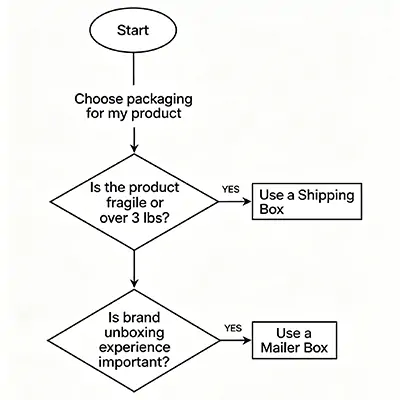
Ideal For: Glassware, ceramics, kitchen appliances, hardcover books, multi-item kits, heavy components, any item over 3-4 lbs.
-
Why It’s Non-Negotiable: When product safety is paramount, compromise is not an option. A standard corrugated box provides a protective void buffer that can be filled with cushioning (like air pillows or foam). Its rigid structure protects against the crushing weight of other parcels in transit. The cost of a damaged item, a refund, and a lost customer far outweighs the slightly higher shipping cost of a box. This decision is driven by risk management.
The “Subscription Box” Dilemma → IT DEPENDS
-
The Analysis: This requires a calculated balance. You must weigh the recurring cost-per-shipment (where mailers shine) against the monthly “wow” factor (where mailers also excel) and the physical contents.
-
If your box contains lightweight, non-fragile lifestyle goods (socks, snacks, beauty samples), a mailer is likely ideal for keeping costs predictable and the experience exciting.
- If your box contains heavier, fragile, or multiple bulky items (cookware, bottles, tech gadgets), a sturdy shipping box is necessary, and you must build that cost into your subscription price. For some brands, a hybrid approach works: a sturdy outer shipping box for protection, with a beautifully branded inner mailer for the reveal.
-
FAQs
Let’s tackle the most-searched questions head-on. These are the practical concerns that keep online sellers up at night.
Q: Is it cheaper to ship a box or a mailer?
A: In the majority of cases, a mailer will be cheaper to ship. This is because carrier costs are heavily influenced by dimensional weight (DIM weight)—a formula that charges you for the space a package occupies, not just its actual weight. Mailers are designed to be svelte and form-fitting, minimizing wasted space and keeping DIM weight low. A standard box, with its rigid, often partially empty structure, frequently hits a higher DIM weight bracket. However, if your product itself is very dense and heavy (over 5-7 lbs), the weight-based charges will dominate, and the packaging choice’s impact on total cost diminishes.
Q: Is it cheaper to send a package with a USPS Flat Rate box or your own box?
A: It depends entirely on your item’s weight and destination. USPS Flat Rate boxes are a fantastic deal if you’re shipping very dense, heavy items (like books or metal parts) across long distances, as the price is fixed regardless of weight (up to 70 lbs). However, for the typical lightweight e-commerce product (clothing, cosmetics), using your own, smaller mailer with a commercial postage rate (from platforms like Shopify, Pirate Ship, or a carrier account) will almost always yield a lower “actual cost.” The free Flat Rate box isn’t truly free if a $4.50 mailer shipment costs you $8.00 in a Flat Rate envelope.
Q: What is the difference between a mailer and a shipping box?
A: The core difference lies in design, structure, and primary use case.
-
A Mailer Box is an all-in-one, branded shipping container with integrated closure flaps (tuck-top, auto-lock). It’s designed for lightweight efficiency, superior branding, and a premium unboxing experience. Think of it as your product’s retail-ready outer gift box that also mails.
-
A Standard Shipping Box is a modular, utilitarian container (like an RSC box) that requires external tape to seal. It’s engineered for maximum structural protection, stackability, and safe transportation of heavy, fragile, or irregular items. Think of it as a durable, functional crate for transit.
Conclusion: Making Your Strategic Choice
So, which is truly better—a mailer or a shipping box? As we’ve proven, the answer is not universal. It’s strategic.
-
Choose the Mailer Box for its lightweight efficiency, lower shipping costs, and premium unboxing experience. It’s the champion for brands where presentation is paramount, and products are durable.
-
Choose the Standard Shipping Box for its heavy-duty protection, superior strength, and versatility. It’s the guardian for products where safe arrival is the only metric that matters.
Choose the Standard Shipping Box when your priorities are: Guaranteeing absolute protection for heavy, fragile, or valuable items, regardless of a slight cost increase or a less glamorous presentation.
There’s no one-size-fits-all solution, but there is a right-fit solution for every product. The best way to know for sure? Put them to the test. We encourage you to order free samples of both a mailer and a shipping box in your estimated size. Pack your actual product, feel the durability, weigh them, and even get a shipping quote. This hands-on test is the single most reliable way to make the optimal choice for your business, your customers, and your bottom line.